
MSc Production Engineering and Management
The master's programme in Production Engineering and Management handles the engineering and management aspects of production and how they interact. The engineering side includes manufacturing technologies, automation, maintenance, and production development tools and methods. The management side includes operations strategy, planning and management of resources for a sustainable production environment. Graduates work in various production fields worldwide.
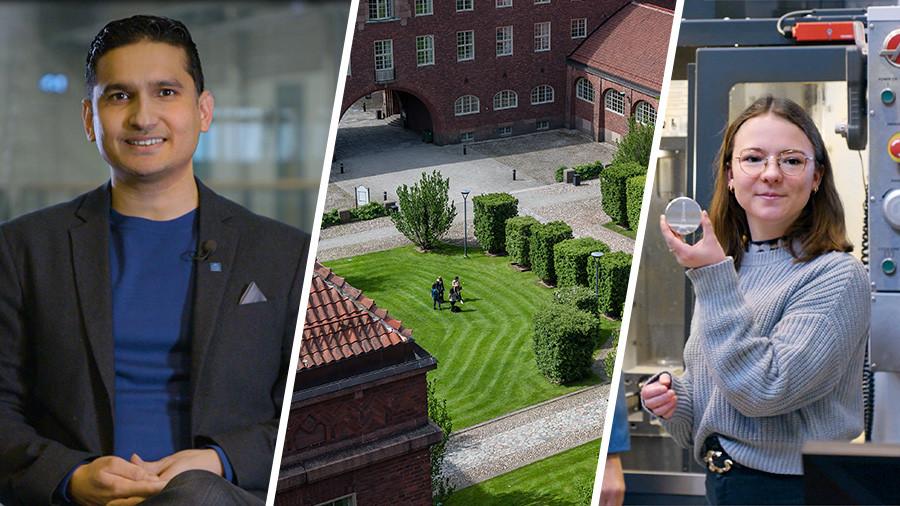
Production Engineering and Management at KTH
The master's programme in Production Engineering and Management provides a solid foundation for becoming a professional with knowledge of both the engineering and management aspects of production and their interaction. The engineering side includes the operation and integration of manufacturing technology, automation, maintenance, quality, production development tools and methods, and software. The management side covers systematic decision-making, operational strategy, planning, and the control and management of resources essential to achieving a sustainable and energy-efficient production environment. You also develop an understanding of how environmental and cultural differences influence production systems and management practices in a global context.
The programme emphasises both theoretical knowledge and applied skills covered through project courses, individual and group assignments, individual and group laboratory works, and industrial visits. Furthermore, to maintain relevance to the state-of-the-art industrial developments and research, leading researchers and industrial professionals are invited to share their knowledge with our students. The educational activities and structures promote self-learning, teach you to communicate effectively with different stakeholders, and create a study environment that provides equal learning opportunities.
You gain hands-on experience with advanced CAD software and IT tools, including PLM, enabling you to model and simulate industrial processes effectively. In the Circular Manufacturing Systems course, you work in teams on projects that apply circular economy principles to real production challenges. Using LCA software, multi-method simulation, and digital twins, you will design strategies for reuse, remanufacturing, recycling, and resource-efficient production, translating sustainability theory into practice. Additive Manufacturing, a rapidly evolving research area, is integrated into the programme’s broader production engineering education. You will explore the full potential of AM for complex geometries, rapid prototyping, and sustainable production. You work directly with metals and polymers, gaining practical skills in designing components optimised for AM processes. In addition, the programme covers machining and manufacturing technologies. You will train with CNC machines, milling, turning, and precision equipment, building a solid understanding of the entire workflow from material selection to the finished component.
This is a two-year programme (120 ECTS credits) given in English. Graduates are awarded the degree of Master of Science. The programme is given mainly at KTH Campus in Stockholm by the School of Industrial Engineering and Management (at KTH).
Programme structure and progression
During the first year, all students follow a set of mandatory courses that provide a foundation in production engineering and management. The courses cover areas such as production planning and control, circular manufacturing systems, industrial IT tools, modelling and simulation, and scientific methodology. In parallel, you deepen your knowledge through elective courses within production engineering and management, industrial IT systems, or industrial welding.
In the second year, you continue to tailor your studies through elective courses in areas such as advanced manufacturing technology, metrology, digital factories and decision-making for advanced manufacturing. The programme also includes a production engineering project course. The programme concludes with a degree project carried out during the final semester.
Courses in the programme
The courses in the programme cover topics such as manufacturing technology, measurement and metrology, information management in industry, computer-aided design and manufacturing, modelling and simulation, assembly and automation, production development, sustainable production systems, maintenance and quality strategies, research methodology.
Courses in the master's programme in Production Engineering and Management


Future and career
As production is global, graduates from our programme are able to find positions as technical specialists, production developers, production engineers, production managers or consultants in various production fields worldwide. Some companies that employ graduates are Scania, Sandvik, AtlasCopco and Volvo.
During the studies, there may be opportunities to engage in research and other types of work at KTH as a research and teacher assistant as well as a student representative. Some graduates also continue their studies for a doctoral degree at KTH or other technical universities.




Sustainable development
Graduates from KTH have the knowledge and tools for moving society in a more sustainable direction, as sustainable development is an integral part of all programmes. The three key sustainable development goals addressed by the master's programme in Production Engineering and Management are:

Gender Equality: In the programme, our policy is that all students are treated equally within the study environment and education, regardless of gender, ethnicity or age. The environment gives you opportunities to train and develop your skills and learn how to interact, communicate and exchange experiences with other students professionally.
Industry, Innovation and Infrastructure: The programme addresses the challenges to industrial innovation in the courses. This is accomplished by industrial projects in close cooperation with manufacturing industry. The global student environment, with students from all around the globe, enables the creation of sustainable solutions for industrial challenges. The programme fosters the student in analysis, decision-making and prepares them for future industrial challenges.
Responsible Consumption and Production: Circular manufacturing is a mindset that has been implanted within the course. Key elements of discussions are material footprint, reducing waste, recycling products and materials, lean thinking and production, and other environmental issues.
Faculty and research
The programme is hosted by the Department of Production Engineering , which focuses on all aspects that support and enable production and aims to improve the sustainability and competitiveness of manufacturing industries. The industrial production area is broad and multidisciplinary and encompasses many issues. Among other themes, the research at KTH focuses on Smart Manufacturing Systems, Precision Engineering and Metrology, Circular Manufacturing Systems, Sustainable Production Systems, Digital Smart Production and Additive manufacturing. Most research is conducted with industrial partners and brings together researchers from different areas. As a student in the programme, you will gain access to an array of labs where this research is carried out.