
BepiColombo
KTH space instrument reaches planet Mercury in Dec 2026onboard the ESA and JAXA satellite mission BepiColombo

Mercury in false color image to reveal surface properties, and the two BepiColombo spacecraft.
The BepiColombo space mission
One of the most prestigious space projects of the European Space Agency ESA is the BepiColombo satellite mission. It is performed in collaboration with the Japanese Space Agency JAXA and has the aim to explore planet Mercury and its surrounding space environment. Mercury, with its proximity to the Sun, is the least explored of the inner planets, which makes this mission so exciting.
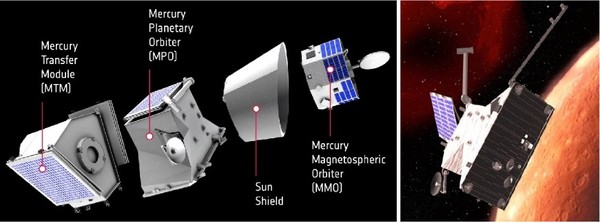
The two BepiColombo spacecraft MPO (which will mainly perform planetary measurements) and Mio (which will focus on magnetospheric science).
KTH electric field instrument onboard
The design and construction of the satellite’s 16 instruments has been done by space institutes all around Europe and Japan. One of these instruments, MEFISTO, is an electric field measurement device that has been designed and built by the space group at the EMP department at KTH.
The head engineer at the space group, Lars Bylander, has been involved in design and development of the space instrument since the very beginning. It took over 10 years from first design ideas to the final design of the E-field instrument, which was launched together with all the other instruments in 2018. The instrument consists of two conducting spheres on 16 m long wire booms. These wires are wound up and stored in cylinders for the long travel from the Earth to Mercury. Reaching Mercury in December 2026, the lock of this cylinder will be opened via remote control, and the spheres will deploy until the wires have reached their maximal lengths. The resulting 32 m distance between the two spheres allows for accurate electric field measurements even in the very thin plasma environment of the solar wind and magnetosphere of Mercury.


The eight-year long travel to Mercury
The BepiColombo satellite was launched on an Ariane-5 rocket from Europe’s spaceport in French Guyana in October 2018, and has since then travelled through space to reach Mercury. In December 2026 it will finally reach its destination. The reason for this very long journey is the complicated journey through space, including close encounters (‘flybys’) with Earth, Venus, and Mercury itself, to use their gravitational forces and orbital velocity to help BepiColombo into the correct orbit around Mercury. While the satellite instruments have been shut down during the major part of this journey, they have been switched on for testing during each of the nine flybys. However, it will still be nerve-wracking to see whether everything works as planned when the satellite will reach its final orbit, and all booms are deployed and all instruments are switched on. For this reason, our head engineer Lars Bylander will be at the control center in Japan during several weeks in December, to ensure a successful commissioning of MEFISTO.

It is a long journey to Mercury, with many flybys of the inner planets, in a kind of pin-ball game to finally reach Mercury.
The start of the Science Mission
The insertion of BepiColombo into Mercury orbit and the start and test of all instruments will take several months. From April 2027, the official science mission starts. From that time on, Professor Tomas Karlsson, who is the lead Co-I on the MEFISTO instrument, and a recently recruited PhD student (Emanuele D’Arca) will start analyzing the data, together with their colleagues in Uppsala and around the world. Professor Karlsson has since a long time been studying, among other phenomena, the interaction of solar wind and Mercury’s magnetosphere, trying to understand how the solar wind brakes at Mercury’s magnetosphere, which types of waves and turbulence appear in this boundary region, and how these affect Mercury’s inner magnetospheric space environment. So far, there was only access to magnetic field data and sparse particle data from the older NASA mission MESSENGER. With the new BepiColombo mission and its numerous state-of-the-art plasma instruments, many of the unanswered questions will hopefully get an answer soon.

MEPHISTO instrument lead Co-I Prof T Karlsson, Responsible lead engineer Lars Bylander
Further reading
www.esa.int/Science_Exploration/Space_Science/BepiColombo
www.eoportal.org/satellite-missions/bepicolombo#launch
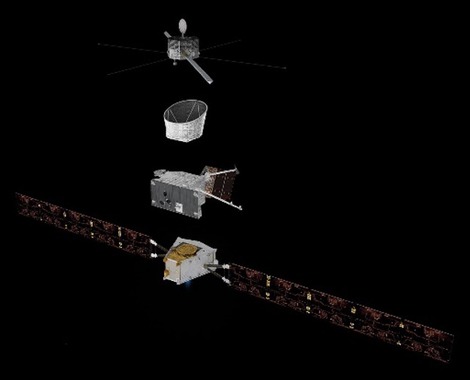
BepiColombo (expanded view) BepiColombo is actually 3 spacecraft, plus a sunshield, that launched together and will travel to Mercury as a combined vehicle. From bottom to top these are: the Mercury Transfer Module, the Mercury Planetary Orbiter, a sunshield, and the Mercury Magnetospheric Orbiter.Image: ESA / ATG medialab