KTH Rymdcenter samordnar och synliggör rymdrelaterad verksamhet som pågår vid flera olika avdelningar på KTH, med målet att etablera KTH som ”rymdlärosäte” och ett nav för svensk rymdforskning och rymdteknik
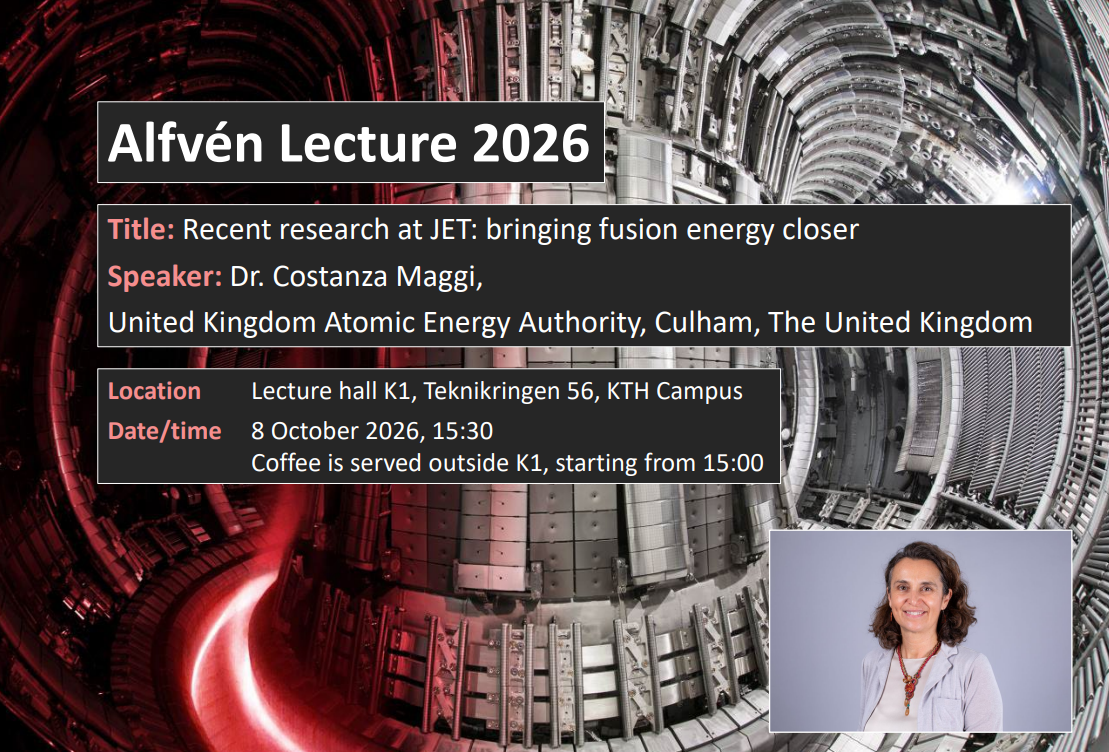
2026 Alfvén Lecture, Recent research at JET: bringing fusion energy closer
The Alfvén Lecture 2026 given by Dr. Costanza Maggi, United Kingdom Atomic Energy Authority, Culham, The United Kingdom
Speaker: Dr. Costanza Maggi
Location: Lecture hall K1, Teknikringen 56
Date & Time: 8th October 2026, 15:30-16:30
Coffee and "fika" is served outside of the seminar hall from 15:00.
Hosts:
Anita Kullen, Head of the Department of Electromagnetics and Plasma Physics, KTH
Mark Pearce, Prof. Department of Physics, KTH and KTH Space Center
Lorenzo Frassinetti, Prof. Department of Electromagnetics and Plasma Physics, KTH
Abstract:
The JET tokamak has been at the forefront of fusion research since its first plasmas in 1983. Over the past 20 years JET has been the largest operating tokamak in the world, exploring conditions approaching those expected in a thermonuclear reactor. Amongst these was the capability to operate with Tritium and Deuterium-Tritium (D-T) fuel, the fuel mixture of ITER (the international fusion experiment under construction in France) and fusion power plants. In order to accelerate ITER’s research plan, in 2021 JET exploited these unique features, coupled to the new metallic wall installed in 2011, to carry out a second major D-T campaign (JET DTE2), after DTE1 carried out in 1997 with a carbon wall. A third D-T campaign followed in 2023. These new ambitious D-T experiments represented the culmination of a series of JET enhancements and of preparatory experimental campaigns accompanied by an unprecedented predictive modelling effort with advanced plasma transport models. DTE2 was complemented by a sequence of physics campaigns to study the dependence of plasma transport and plasma-wall interactions on the main ion isotope mass (hydrogen, deuterium, tritium and their mixtures), topics of fundamental importance for accurate extrapolations of plasma behaviour from JET to future thermonuclear reactors. The recent JET experiments have yielded the most fusion reactor relevant plasmas to date, expanding our understanding of isotopes and D-T mixture physics and supporting fusion technology. Beyond establishing new world records for the highest D-T fusion energy achieved, the most significant output of these experiments is the wealth of new physics results and the validation of current models in unique and ITER-relevant conditions. In my talk, after an introduction on magnetic confinement fusion, I will report on highlights of this recent fusion energy research at JET in support of ITER and future fusion power plants.
The lecture is supported by the Royal Swedish Academy of Sciences through its Nobel Institute for Physics
Save the date: 17–18 maj 2027, House of People, Stockholm
Den 17–18 maj 2027 samlas Sveriges rymdsektor i Stockholm för Rymdforum 2027
Tema: Rymd och totalförsvar.
KTH står tillsammans med Saab, OHB Sweden och FOI som arrangörer för Rymdforum 2027, som nu återvänder till Stockholm. Senast konferensen arrangerades i huvudstaden var 2009.
Rymden är en alltmer strategisk domän – för kommunikation, navigation, övervakning och lägesbild. Samtidigt har sårbarheten i dessa system blivit tydlig. Med det förändrade säkerhetsläget i Europa, pågående rymdrelaterade satsningar från både regeringen och Försvarsmakten, och ett växande behov av samverkan mellan civilt och militärt, är temat rymd och totalförsvar högaktuellt.
Rymdforum 2027 syftar till att belysa hur rymdteknik kan möta de utmaningar som omvärldsläget ställer oss inför – och hur akademi, industri och myndigheter kan bidra, både enskilt och gemensamt. Det blir även en central arena för deltagare från industri, akademi, myndigheter och politik att mötas och nätverka.
Två dagar, brett program
Den första dagen ägnas åt huvudtemat, med fokus på rymdens roll inom såväl militärt som civilt försvar. Den andra dagen erbjuder parallella sessioner inom ämnen som rymdfysik, jordobservation, rymdteknik, innovation och utforskning – med koppling till totalförsvarsperspektivet.
Konferensen hålls på House of People (Folkets Hus) i centrala Stockholm, en kort promenad från Centralstationen. Utställnings- och sponsormöjligheter kommer att finnas under båda dagarna.
Program och medverkande presenteras löpande. Mer information publiceras på rymdforum2027.se.
För frågor och mediaförfrågningar: Madeleine Bergman-Sidoli, projektledare Rymdforum 2027, msidoli@kth.se
Om Rymdforum Rymdforum är en ideell förening vars syfte är att sprida kunskap om svensk och internationell rymdverksamhet. Konferensen samlar regelbundet aktörer från industri, akademi, myndigheter och politik och har arrangerats på olika orter runt om i Sverige – senast i Trollhättan 2025.
Opportunity to Participate in an Ongoing Space Project at KTH | The Svalinn Team is Recruiting
KTH Space Center would like to highlight an exciting opportunity for students who are interested in space technology, systems engineering, and mission design.
A student team at KTH, team Svalinn, is taking part in the Earth Cup Race 1 Challenge, an international solar sail competition. The project begins with a white paper challenge with submissions due 8 May, and the selected teams can then advance to an on-orbit challenge focused on mission objectives in low Earth orbit. The broader aim of the Earth Cup is to advance solar sail technology and build experience in space mission development. The Svalinn team is looking for highly motivated students who would like to contribute to this effort. This is a valuable opportunity to be part of an ambitious interdisciplinary project and gain hands-on experience in areas such as spacecraft design, analysis, systems thinking, research, and technical development. Students from a wide range of backgrounds and disciplines are welcome. Whether your interests are in engineering, physics, sustainability, project coordination, communications, or related areas, this could be a chance to work on a real-world space project together with other engaged students at KTH.
If you are interested in joining Team Svalinn, please apply by emailing Team Lead Arvid Althoff (aalthoff@kth.se) with your CV, letter of interest (no more than half a page) and which areas you would be interested in working in. More information about the project can be found on Earth Cup's website https://earthcup.space/ or by asking Arvid on the email above.
We encourage you to share this opportunity with other students at KTH or elsewhere who may be interested.
If you are interested in participating in a space project but this one does not match your areas, we also advise you to look at the miniature student satellite project MIST (
mistsatellite.space/
) who are launching a real satellite in 2027 as well as ÆSIR, the KTH student rocket association (
www.aesir.se/
). KTH Space Center supports space-related activities across the university and aims to strengthen KTH as a hub for Swedish space research and technology.
Swedish Space Plasma Meeting 2026
The space group (formerly SPP) in the Department of Electromagnetics and Plasma Physics, KTH, is delighted to host the Swedish Space Plasma Meeting from lunch to lunch on March 26–27, 2026. This annual meeting offers a forum for space plasma researchers and students throughout Sweden to connect and share their latest scientific findings.
The meeting is open to all without registration fee. To know how much coffee and food we should order, please register no later than March 13th at 13:00 (registration responses can be edited before the deadline). The registration form can be found below:
Space Seminar | How to Become an Analogue Astronaut and Get Space Exploration Experience
Meet Madeleine Monperrus, a student in the Vehicle Engineering program at KTH and join this lunch lecture to know more about Asclepios, an international student led organisation simulating a lunar mission every summer. As a selected analogue astronaut for Asclepios VI, Madeleine Monperrus will talk about her own experience in the organisation, but most importantly what it takes for you to participate in the only student-led mission in the world.
If you want to get one step closer to real human space exploration, book the time in your calendars and we’ll see you there!
The seminar was held on 27 February. If you missed it you can watch it
here
.
Sveriges första satellit, Viking, sändes upp för 40 år sedan och KTH var djupt inblandat
Sveriges första satellit, Viking, sändes upp med en Ariane-raket från Kourou i Franska Guyana den 22 februari 1986. Satelliten utforskade jordens magnetosfär på höjder upp till 13500 km, d.v.s. ungefär en jorddiameters höjd. Svenska rymdplasmaforskare från KTH, och Institutet för Rymdfysik i Kiruna och Uppsala var djupt inblandade i projektet och dess vetenskapliga instrument. Projektet leddes av Rymdbolaget (numera kallat SSC Space) och satelliten utvecklades av Saab i Linköping och Boeing Aerospace i Seattle i samarbete. Den ursprungliga idén till Viking väcktes av professor Bengt Hultqvist vid Institutet för Rymdfysik i Kiruna. Projektledare hos Rymdbolaget i Solna under satellitens tidiga utvecklingsfas var civ.ing. Per Zetterquist (KTH, E).
Detta år, den 22 februari, markerar 40 år sedan Vikings uppskjutning. Läs mer om Sveriges första satellit
här
och de på KTH involverade i dess utveckling.
Space Seminar with MIST | 9 February
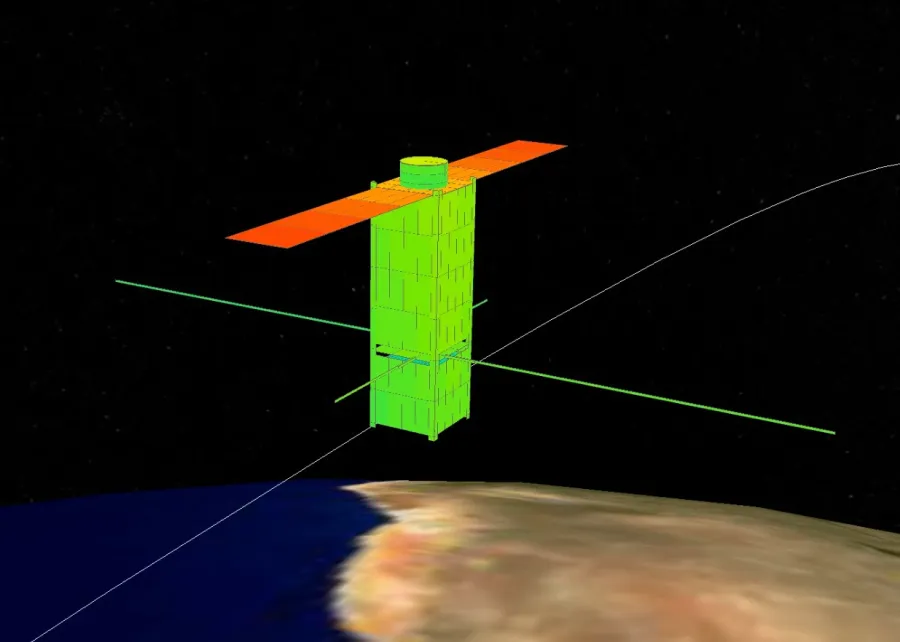
The MIST team held a lunch seminar on how KTH students are developing a real satellite mission. Formulated in 2014 and worked on since, the project is now moving into its final phase ahead of a planned launch in 2027 as part of KTH’s 200-year anniversary. If you missed it you can watch it
here
.
Contact Sven Grahn (sveng@kth.se) for information on how you can get involved.
New Director
We are pleased to welcome Professor Mark Pearce as the new Director of KTH Space Center, succeeding Professor Christer Fuglesang who has done a remarkable job ever since the formation of KTH Space Center in 2014.
Mark Pearce is a professor of physics specialising in astroparticle physics and develops instrumentation and methods to study cosmic radiation from space platforms. His current research focus is X-ray polarimetry, an observational technique that enables new kinds of studies of high-energy celestial sources. He is also Head of the Particle Physics, Astrophysics, and Medical Imaging Division at the Department of Physics at KTH. Read more about our new director, Mark Pearce,
here
.
Professor Fuglesang will remain closely involved through the Space Center’s reference group and will be the chairman of a new advisory group that is currently being assembled. He is also the director of the newly formed
Swedish Space Research School
that is led by KTH.
Space Rendezvous Autumn 2025
On Friday 14th of November KTH Space Center hosted Space Rendezvous autumn 2025 where you got a chance to come listen to speakers within the space field. The theme was space and defence and programme featured prominent speakers from SNSA, SAAB, FOI, LTU, the Swedish Defence Institute and more.
The even was followed by a space pub between 13-17 in F2 at T-Centralen (Drottning Kristinas väg 29).
The next Space Sendezvous will be in spring 2026. Read more about the event
here
.
Seminar: Why Microgravity? A Primer on Platforms and Experiment Design
On 8th of October 2025 Stefan Krämer came to hold a lecture on the topic "Why Microgravity? A Primer on Platforms and Experiment Design".
Stefan Krämer is a Program Manager at the Swedish Space Corporation (SSC), where he has been active since 2014. He currently leads SSC’s Microgravity Services and the SubOrbital Express program, managing missions that enable advanced research in weightlessness. Stefan also oversees the development of microgravity experiment and flight systems for sounding rocket missions, drop towers, and related platforms. Previously, he was responsible for the REXUS/BEXUS student rocket and balloon program. Over the years, he has led eight microgravity missions and coordinated several stratospheric balloon launches, contributing significantly to SSC’s suborbital and educational spaceflight initiatives.
Why Microgravity? A Primer on Platforms and Experiment Design
Microgravity research enables scientists to observe phenomena that are otherwise obscured by Earth’s gravity—revealing new insights in physics, biology, and materials science. In this short lecture, we’ll explore why microgravity matters, what platforms are available to access it, and how to approach experiment design in this unique environment.
From drop towers to orbital missions, each platform offers distinct opportunities and constraints. While sounding rockets may be used as illustrative example for capabilities enabled in Sweden, the goal is to broaden understanding of microgravity capabilities and introduce key design principles such as duration, acceleration environment, and payload integration.
This talk is intended as a gateway for students and researchers curious about the potential of microgravity experimentation.
Seminar: Environmental Control and Life Support, the Long View
On 14th of August 14:15-14:45 KTH Space Center hosted its first space seminar of the school year.
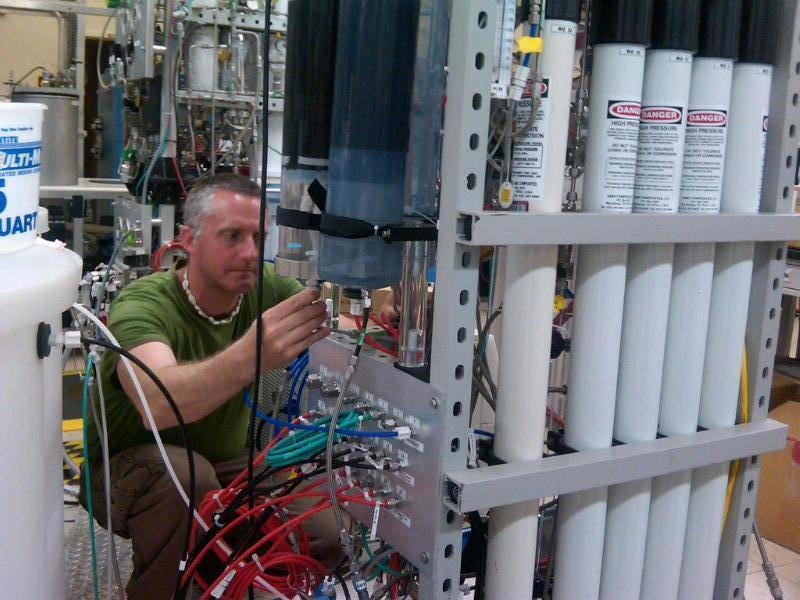
This time Dr. Sherwin Gormly came to KTH to explore how we can keep humans alive in the most extreme environments—even on Mars. He spoke about the cutting-edge water recycling and life support systems making it possible, with insights that also have surprising benefits for life back on Earth.
Known as “The Urine King,” Sherwin Gormly is a former NASA researcher with over 30 years of experience developing cutting-edge water recycling systems for space. He is a senior advisor for Swedish company Hydromars and will, amomg other things, be talking about their current development efforts.
If you missed the seminar you can now watch it
here
!🚀
Environmental Control and Life Support Systems (ECLSS) are essential for sustaining human life beyond Earth’s atmosphere. These integrated systems manage critical functions such as air revitalization, water recovery, and waste recycling within closed habitats. They form the technological backbone for long-duration space missions and provide important models for advancing sustainable resource management on Earth.
In this lecture, Dr. Sherwin Gormly, Senior Advisor on Water ECLSS Engineering at Hydromars, provided a detailed, systems-level perspective on the design and operation of ECLSS. Drawing on decades of experience and data from spaceflight programs, including the International Space Station (ISS), Sherwin explored key engineering aspects such as metabolic mass balancing, system scalability, and the implementation of regenerative water technologies capable of supporting missions ranging from weeks to multiple years.
The talk covered critical trade-offs between expendable and regenerative components, the influence of gravity environments - from microgravity to lunar and Martian gravity - on system performance, and the use of modelingtechniques to optimize life support architectures for future space habitats.
Sherwin also presented Hydromars’ current development efforts focused on lightweight, energy-efficient water recycling systems designed to enable continuous human presence in space. This discussion will highlight how advances in ECLSS engineering contribute to the broader goal of sustainable space exploration while inspiring innovation relevant to environmental challenges on Earth.
Sherwin Gormly is a veteran researcher formerly at NASA’s Ames Research Center, where he led the NASA Water Recycle Laboratory for five years. With over 30 years of experience in Space Life Support (ECLSS) and regenerative water process research, Sherwin has hands-on expertise in the fabrication and engineering of ECLSS prototypes and flight experiment hardware, including membrane-based solutions for treating wastewater and urine in both microgravity and terrestrial settings.
Sherwin holds a PhD in Civil Engineering (Water Processes), is a Licensed Professional Engineer (PE), and previously served as a USAF Captain and launch officer. He has authored over 40 peer-reviewed publications, and earned the nickname “The Urine King”, popularized by Packing for Mars by Mary Roach. He also contributed to NASA’s technology innovation efforts, such as “Waterwalls for Life Support” (a 2017 NASA Invention of the Year Honorable Mention).
Vinnarna av bästa rymd-examensarbete 2024
KTH Rymdcenter har tagit fram vinnarna av bästa examensarbete inom rymdområdet på avancerad och grundnivå för 2024!
På grundläggande nivå säger vi stort grattis till Amer Avdic och Alfred Mjörnheim som får 5000 kr vardera för deras studie som undersöker hur ljuspulser från neutronstjärnor, som uppstår på grund av deras magnetiska och rotationsaxlar, kan användas för att samla information om deras egenskaper och beteende.
Priset för bästa examensarbete på avancerad nivå och 15 000 kr går till Simon Thor för hans examensarbete som fokuserade på att förbättra simuleringar av tauleptoners sönderfall för att möjliggöra mer noggranna observationer av tauneutriner med IceCube-detektorn vid sydpolen, genom att integrera högprecisionssimuleringar från Tauola.
Stort grattis till vinnarna och deras intressanta och givande examensarbeten!
Passa på att lyssna på Amer och Alfreds presentation under Space Rendezvous på torsdag den 20e Mars! Simon Thor kommer presentera sitt arbete vid ett senare tillfälle i höst.
Intresserad i användandet av AI för övervakning av miljöförändringar?
Under World Space Week 2024 höll KTH Space Center ett seminarium med titeln "Earth Observation Big Data and Deep Learning for Global Environmental Change Monitoring," med
Dr. Yifang Ban
som föreläsare. Hon presenterade banbrytande
metoder
för att övervaka miljöförändringar med hjälp av satellitdata och AI, med fokus på skogsbränder och urbanisering.
Om du missade seminariet, kan du se det här:
För den som vill fördjupa sig i ämnet erbjuder KTH även flera kurser inom geoinformatik och fjärranalys. Bland annat dessa där Dr. Yifang Ban är kursansvarig:
Efter att ha läst någon av dessa kurser finns också möjligheten att göra examensarbete inom detta spännande forskningsområde.
Marcus Wandts besök på KTH
I mitten av februari besökte Sveriges nya astronaut Marcus Wandt KTH, organiserat av KTH rymdcenter, och med Rymdstyrelsens Generaldirektör Anna Rathsman som moderator för en fullsatt hörsal. Marcus berättade om hela sin rymdresa, från astronautträningen och uppskjutningen med SpaceX Dragon-kapsel, till arbetet han utförde på internationella rymdstationen och känslan av tyngdlöshet.
Vi vill också tipsa om att lyssna på
Har vi åkt till Mars än?
som produceras av RundFunk Media. Podden är en populärvetenskaplig serie med fokus på rymden, som genom intervjuer med de främsta experterna svarar på de mest intressanta frågorna!
Stöd till rymdprojekt på KTH
Vi vill påminna om att KTH Rymdcenter erbjuder möjlighet för grupper eller individer på KTH att ansöka om ekonomiskt bidrag som önskar genomföra rymdprojekt eller övrig rymdrelaterad verksamhet.
Stödet är i första hand tänkt som ett uppstartstöd för nya projekt, men även pågående projekt eller annan verksamhet kan komma ifråga. Ansökan är öppen för alla KTH-anställda och KTH-studenter. Belopp på upp till 50 000 kr kommer att vara det normala, men högre summor kan i vissa fall förekomma.
Ansökan skickas till KTH Rymdcenter rymdcenter@sci.kth.se
En titt inuti KTH Rymdtekniklaboratorium
KTH Rymdtekniklaboratorium är en central del av KTH Rymdcenter. Laboratoriet erbjuder moderna miljöer med laboratorieutrustning och teknisk personal, med syftet att stärka KTH:s roll inom internationell forskning och rymdteknik. Vill du ta en titt inuti laboratoriet och se vad det har att erbjuda? Vi presenterar nu vår nya video av KTH Space Technology Laboratory!