KTH Logo

Om haven och möjligheten att utveckla hållbara havsnäringar

Förenta nationerna har förklarat perioden 2021 till 2030 som ”The decade of ocean science for sustainable development” Anledningen till det är att utan friska hav så kommer vi inte att få en hållbar framtid för mänskligheten. Våra hav förorenas av plaster, organiska miljögifter och stora mängder näring från land. Våra hav har tagit hand om över 50 % av all den koldioxid som mänsklighet frigjort. Våra hav blir uppvärmda och försurade pga. klimatförändringen och koldioxidutsläppen. Havsekosystemen rubbas pga. miljöproblemen och lokalt av främmande arter som människan flyttar runt med ballastvatten över hela jorden. Samtidigt så finns framtiden och de nya jobben i havsrelaterad verksamhet. Våra landekosystem har nått vad man inom ekologin brukar kalla ”The carrying capacity” det finns väldigt lite bördig jordbruksmark att uppodla eller skogar att hugga ner framöver, bara en art Homo sapiens använder nästan 45 % av landekosystemens primär produktion för att mätta sig själva direkt eller indirekt via våra husdjur. Resten får alla andra landlevande djur leva på, rätt ohållbart eller hur?
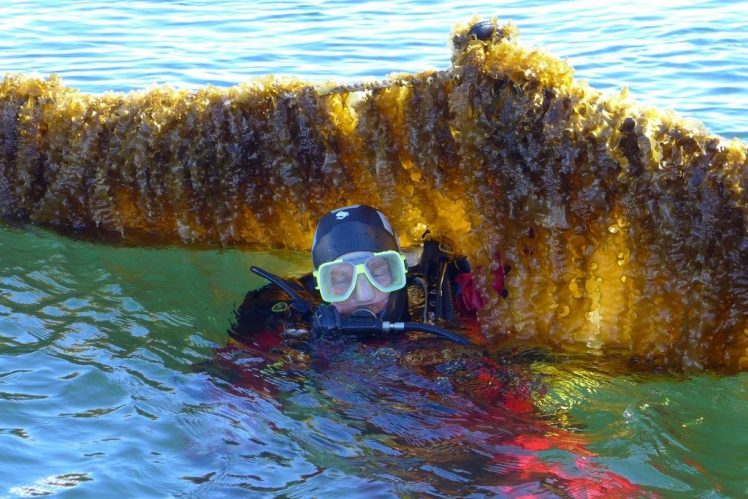
KTH:s egen “havsbonde” Fredrik Gröndahl i sitt rätta element (foto: F. Gröndahl)

Våra världshav täcker 70 % av jordens yta och har ett medeldjup på nästan 4000 m. Denna enorma havskropp vet vi fortfarande väldigt lite om. Vi vet mer om planeten Mars än våra djuphav. Om havet skulle vara ett land så skulle det utgöra världens sjunde största ekonomi. Intäkterna är kopplade till exempelvis fiske, vattenbruk, transporter och inte minst kustnära turism. Vi människor älskar att vara nära havet, titta på det och färdas över det. Men det finns så mycket mer vi kan använda våra hav till i framtiden om vi lär oss att utnyttja dem på ett skonsamt vis utan att förstöra dess livsystem. Jag skulle vilja hävda att en förutsättning för människans överlevnad i framtiden är att vi tar vara på vad haven kan ge. Fisk har sedan länge varit väldigt viktigt som näringskälla för fattiga människor runt vår planet. Tyvärr så har fisk i allt större utsträckning blivit väldigt dyr och fisk kan idag betraktas som lyxvara. Detta är resultatet av ett rovfiske på några få arter av rovfiskar som vi människor uppskattar väldigt mycket som t.ex. tonfisk, torskfiskar, makrill och hajar. En del rovfiskar har vi börjat odla som laxfiskar i Norge och Chile, men för att föda den odlade fisken så har vildfisket gett sig på mindre arter som sillfiskar som mals ner till fiskmjöl och sedan ges till odlingar av lax och på land till kycklingar. Resultatet kraftigt minskade bestånd av fisk i våra hav, nya arter tar över som hummer eller maneter.

Vi blir fler och fler på vår jord och inom en snar framtid måste vi fördubbla vår matproduktion och för att klara detta räcker inte vårt jordbruk, fiske eller odling av rovfiskar till. Vi behöver bli bättre på att få vår näring längre ner i näringskedjan och då hamnar vi i odling av musslor och alger.  Att odla i havet är dessutom både klimatsmart och kräver ingen bevattning. Algodlingar kan dessutom bidra till ökad biologisk mångfald och upptag av koldioxid vilket faktiskt förbättrar havsmiljön. I Kina, Korea och Japan har man ägnat sig åt vattenbruk i tusentals år men i europeiska och svenska vatten så har vi bara precis börjat. Det finns en stor möjlighet att skapa hållbara jobb inom vattenbruket under de närmast åren exempelvis på svenska västkusten men möjligen också i Östersjön.  Förutom som mat kan alger också användas som foder, energigröda, gödsel och som bas för biobaserat material som plaster, limmer och textiler. Tillsammans utgör våra skogar och våra havsskogar basen för den biobaserade värld som vi måste skapa för att förhindra den klimatpåverkan som drabbar oss pga. det fossilbaserade samhälle som vi lever i idag.

Odling av alger i våra kustvatten kommer att bli väldigt viktiga i framtiden för att leverera stora mängder biomassa till den nya biobaserade industrin som nu är i sin gryning. Algodlingen är också väldigt hållbart och ett gott exempel på cirkulär ekonomi som dessutom kan vara gynnsamt för miljön.

Samtidigt som vi nu börjar bli havsbönder så måste vi också börja värna haven och se till att de mår bra och är friska. Ännu finns det hopp om detta och speciellt haven har en stor förmåga att återhämta sig när en påverkan upphör även om det ibland tar tid. Positiva tecken finns i skyddade havsområden där de stora rovfiskarna börjar återvända efter årtionden av fiskeförbud. En viktig del i detta arbete skulle kunna vara att skapa stora marina reservat i våra världshav. Ett sådant finns redan ner i Antarktis men fler behövs och haven är stora det finns plats både för odling och att skapa internationella marina reservat.

Fredrik Gröndahl
Professor, Institutionen för Hållbar utveckling, miljövetenskap och teknik, KTH

World Water (Scarcity) Day

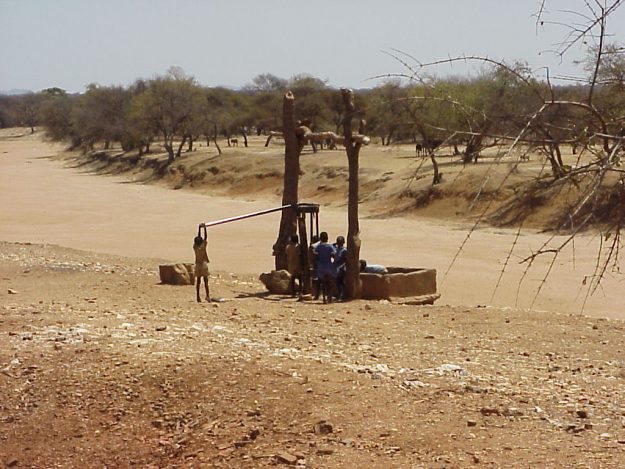
Zansukwe, Southern Zimbabwe. Photo: David Nilsson

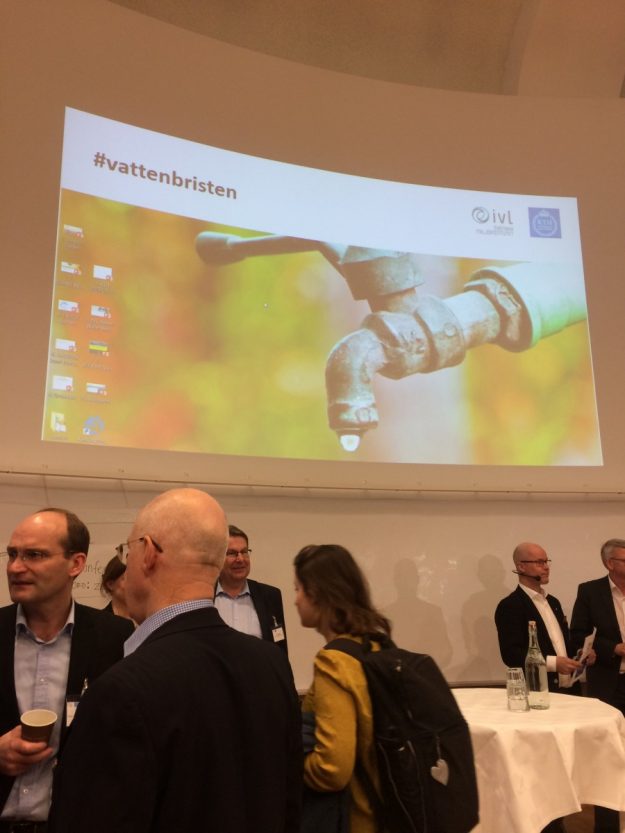
An average woman in rural India travels 14,000 km every year just to get water. At the same time clever solutions to manage water more sustainably have found their way from India to Gotland, in the face of increased water scarcity in Sweden. These were some of the interesting things discussed at the full-day conference on water scarcity arranged by KTH and IVL yesterday, as a run-up to World Water Day, March 22.

Almost half of the world’s population live in areas under water stress today and it is not expected to diminish in the decades to come. Water scarcity has been a reality in large parts of the world for a long time, but in recent years it has become a real threat also in a place like Sweden. Water is truly a global challenge, but it manifests itself in local settings and typically must be dealt with by local actors.

On the largest island in Sweden, Gotland, the local authorities have issued a total irrigation ban already from 1 april this year – much earlier than any year before. As Patrik Ramberg, the technical director for Gotland region, explains, the island naturally has very low water storage capacity because of its geology. But the massive drainage programmes implemented in the 19th century made things much worse; most of the wetlands are gone and with them, important buffering capacity. Now a project is going on with IVL and KTH to restore storage capacity and also to promote re-use of wastewater.

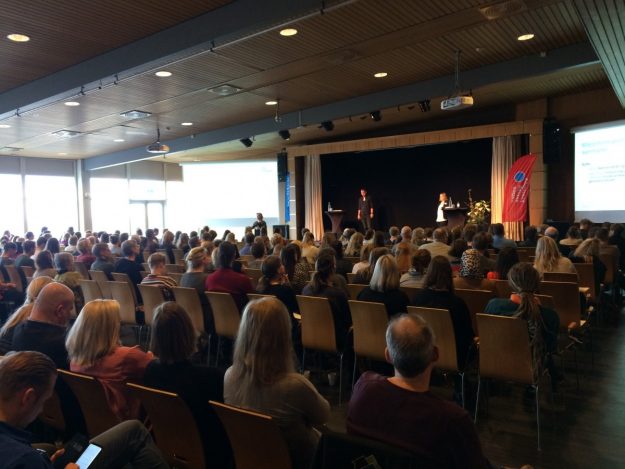
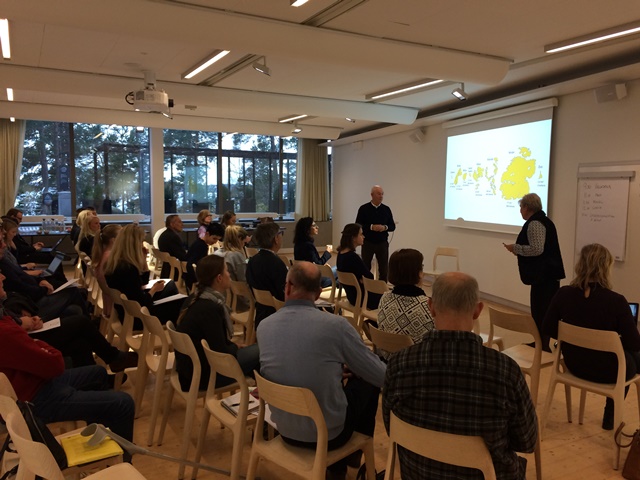
Over 100 people from research, industry, local and national agencies gathered

Re-use of wastewater came up in several of the examples and presentation. As Christian Baresel from IVL put it; why not just clean the water once, and then keep on using it within the same loop? Alexandra Lazic from Xylem showed that many different solutions for wastewater re-use already have been implemented throughout the world, not least in the USA. Technologies like ozonation, membranes, UV, advanced oxidation, bio-filters etc can be combined in an endless way to match the conditions and needs in different places.

Some large industries have already understood this and are trying ways of re-using not just the water, but also recoving some of the products in the wastewater, like phosphorous. Andreas Rosberg from the metallurgy and tools company Sandvik, pointed out that they think a more circular production would in the end also be good business.

Sweden’s scarcity problem of course pales in comparison with the Indian case presented by Rupali Deshmuk, IVL. ”We don’t even really have water scarcity in Sweden!” proclaimed Bosse Olofsson, geo-hydrology guru and KTH professor. The annual run-off  by far exceeds the withdrawals in our country and the amount of freshwater available per capita is still very high. The problem is that the water is not available where it is needed and when it is needed – such as during the growth season – and therefore water scarcity is a temporal and local phenomenon.

The largest consumer of water is by far agriculture, accounting for around 70% of the water withdrawals globally. And with rising demand from energy production, industry and food production there are bound to be conflicts. The Director General of Swedish Agency for marine and water management, Dr. Jakob Granit, cautioned that we are ill prepared for handling these kinds of conflicts. Responsibility for the many aspects of water management have been portioned out to a plethora of institutions at central, regional and local levels, and the overall picture is one of serious fragmentation.

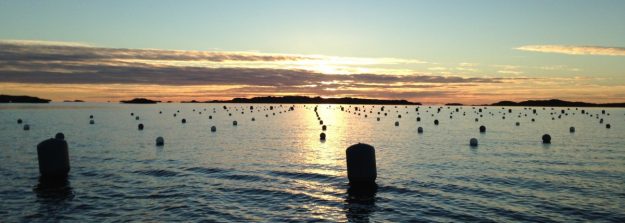
Fredrik Gröndahl from KTH pointed to the oceans as a solution. Much more of the primary production of food, energy and raw materials could be done through sustainably farming the seas, thus relieving the terrestrial eco-systems and the limited fresh water on land. A good thing about farming the seas is that they don’t need irrigation. Fredrik, calling himself a ”sea farmer”, argued that we can live well off our polluted seas; we don’t need to add nutrients either!

Farming the seas. Photo: F Gröndahl

Despite the ominous conference title ”Vattenbristen” (Water Scarcity) the speakers were optimistic about our ability to face up to the challenge. It is obvious that a range of solutions already exist, and that they include technical, organisational and behavioural changes that are within reach. What is needed is closer collaboration between a multitude of actors; politics, finance, academia, industry and citizens. ”Collaboration”, said Jakob Granit, ”cannot just be a word, it must also happen.” In the concluding discussion, Katarina Luhr, Stockholm City councillor invited more collaboration around water, with the view to using the city as a testbed.

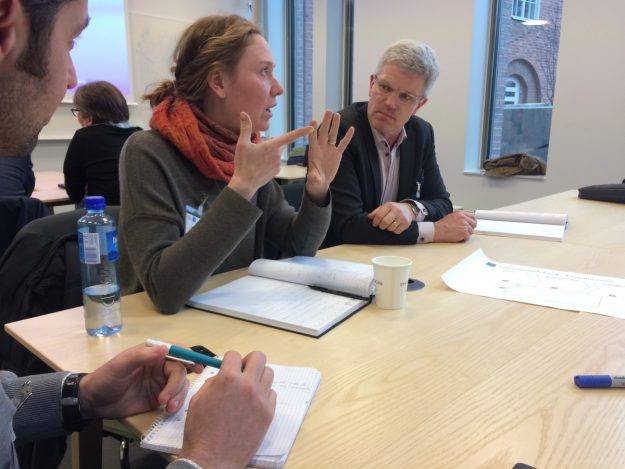
Workshop participants discussing how digitalisation can help in managing water

If we can get the collaboration right and show a viable business model around sustainable water use, we might be able to not just avoid future problems in Sweden, but also contribute to more just and sustainable water practices globally. Not a bad message for World Water Day!

Video from the conference here


Water and Sanitation is Rock ‘n Roll!

A packed room with 500 people cheering and clapping hands in front of the stage. Walls covered with photos of rock icons like Bowie, Rolling Stones and Joni Mitchell. Am I really at a conference on small scale water and sanitation?

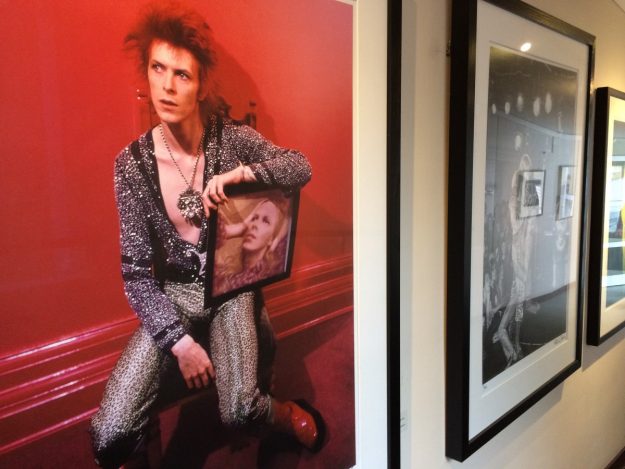
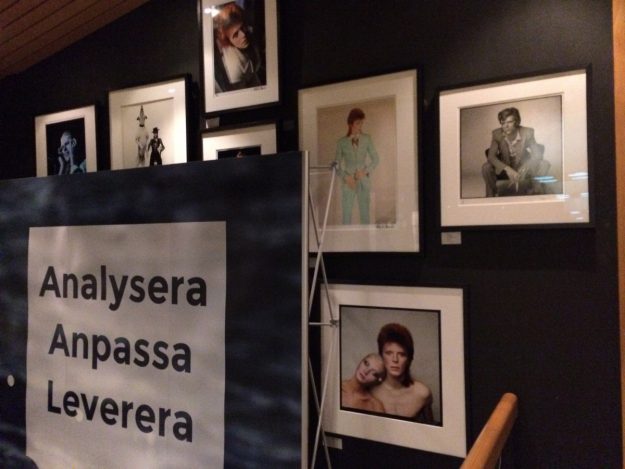
Yes – the conference organisers had the good taste of staging the VAK2019 conference on circular water and sanitation solutions in the Tylösand hotel whose proprietor Per Gessle (Roxette) has turned the establishment into a permanent rock and pop art collection. For two days, these rock and pop culture giants look down at us from their passe-partouts, peeking out from behind the sales materials and pop-up stores of mini-sewage treatment plants, filters, tanks and toilet seats. And it feels… just right.

David Bowie, photographed by Mick Rock. Rebel rebel!
Rock icons peeking out behind sales screens.

Come on. Why should there the be even the faintest connection between rock ’n roll and something as unsexy as water and sanitation, you ask?

Because there’s a revolution coming in water and sanitation. The emerging shift to a circular water economy is an outright revolt against age-old principles and norms. A new generation of professionals and consumers are taking up a fight against the burden of history, breaking out of traditions, and charting a new and independent path. If that isn’t Rock ’n Roll, then nothing is.

Maybe I’m getting carried away by the atmosphere in the company of like-minded. So let’s do a recap.

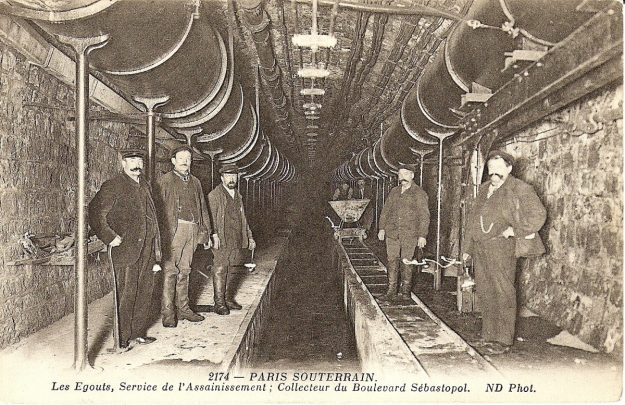
Essentially, most of our so called ”modern” water systems are based on principles of linear transport, which hail from the Middle East and Meditteranean great cultures. The flush toilet is more than 3000 years old. Although the Roman Empire went down their technology, organization and water legislation lived on and was picked up as an ideal in Europe’s 19th century modernisation processes. ”I will turn Paris into a Rome of today” said Baron von Haussmann, as he led the cleaning up of the city and built an extensive sewer network (Reid 1991). The ”Modern Infrastructure Ideal” of networked water and sewerage systems that still dominate the cities of the world are not modern. Essentially, they are antique.

“Les Egouts” of the Parisian sewers. Photo in the US public domain.

But the global water regime is now under pressure of a magnitude it has not seen since the collapse of the Roman Empire. Why? Due to its inherent logic requiring unrestrained and stable supply of raw water. But worldwide, water scarcity and climate change are now very real.

This transformative pressure has already led to change. Waste water is reused in Spain, Portugal, Israel, Greece, the United Arab Emirates, Australia, the United States and China. Especially for irrigation purposes in agriculture. At 60% of all irrigated agricultural land in Israel, recycled wastewater is used. Also so-called “urban re-use” is on the rise, e.g. flushing, cleaning, golf courses etc. And it is economically beneficial. A study in Hong Kong showed that investment in treatment and reuse of gray water for toilet flushing at property level is profitable already after five years of operation.

But Australia and Hong Kong is very far away. Is re-use of wastewater realistic in Sweden? Two things are clearly pushing us in this direction: the hunt for water and the hunt for energy.

Water is already in short supply in parts of Sweden. We are repeatedly affected by drought, especially during the summer months. More than half of Sweden’s municipalities reported water shortages 2018 and 85 of them issued irrigation bans or other restrictions. Last year Värmdö municipality terminated the service agreement with one of the golf clubs in the municipality. No more tap water for the fairways and greens.

So why not look for opportunities to use the freshwater once more? A number of researchers and students from KTH now investigate precisely this on seven islands in the Swedish, Finnish and Åland archipelago. Within the Circular Water Challenge, as the project is called, we work with the local people, the business community, the municipalities and county councils, and with other experts. Lessons learned on these micro-systems will benefit many others. Together with IVL, KTH also runs Hammarby Sjöstadsverk where we investigate how we can improve costs and performance of circular technology.

Secondly, new requirements for energy efficiency in buildings drive property owners to recover the heat in the wastewater. Some property owners are now thinking about the next step. They investigate the possibilities of reusing the actual hot water. Why not spin around the hot water for showers and basins? This is already happening and in a FORMAS-funded project we investigate what this can mean in the long run.

Yes, but this is only marginal, you might say, what would a few islands or isolated properties matter? The thing is that this is always how technology shifts begin. They start in the margin, in so-called “niches”. We already see municipalities that are planning for entire districts based on a circular principle, such as in Helsingborg. And then things start to happen with the large systems.

So when is the revolution coming? It might come sooner than we think. As I wrote in a blog over a year ago we could face a future where network consumers use both less water and energy. And this may trigger a spiral that make the systems change unexpectedly fast. Surely, we are just in the beginning of the revolution and much work remains.

But I say like Bob Dylan: ”I know a change is gonna come, oh yes it will.”


PS – don’t miss our conference 21st of March on the same topic: ”Vattenbristen”.

Cryo-desalination – A nature inspired solution to obtain freshwater

New water innovations are needed to secure freshwater supply for human use, even in the Nordics that are typically perceived as water secure nations. Cryo-desalination, also known as freeze-melt desalination or freeze-thaw desalination, allows to obtain fresh water by freezing seawater. Is that even possible, how energy efficient is it and why is it not implemented yet?
In pursuit of new methods to obtain freshwater
Global availability of clean water is one of the Sustainable Development Goals set by the United Nations for 2030. The rise of global temperatures due to climate change is a major problem impacting every continent and threatening the ability to secure SDG 6. In many parts of the world the water footprint has already exceeded sustainable levels, whereas due to the global dimension of water consumption, many countries have significant impact on water consumption and pollution elsewhere. Looking into the future, it is important to think creatively about the types of innovations that will form tomorrow’s toolbox for securing not only water but also the health of ecosystems. Desalination is a very attractive nature inspired solution for obtaining fresh water from the seawater, which comprises 97% of the water in the world and yet has a marginal role in human water consumption. Traditional desalination processes (e.g. thermal evaporation, membrane processes) despite having improved performance over the years, they still lack sustainability and have systemic problems (e.g. linked to pollutants and membrane fouling).

The sustainability potential of cryo-desalination as opposed to traditional desalination is higher if we consider energy demand over the entire process.  As the melting of ice takes approximately 7 times less energy than boiling water, cryo-desalination has the potential to be more energy efficient.  In addition, since this approach does not rely on any filters in it can be fully sustainable form the perspective of new materials usage as well.

What is cryo-desalination?
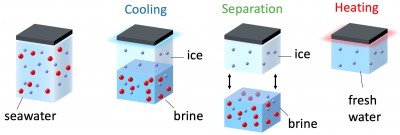
Cryo-desalination, the separation of water and salt upon freezing, utilizes the natural tendency of water to push out salt upon freezing. In practice, one utilizes energy to cool water and form ice. As ice is forming it expels most of the salt, resulting to the so called brine, which is very highly concentrated saltwater. Then the ice and brine are separated followed by the warming up of the remaining ice in order to obtain the fresh water.

Most of the energy required for the freezing and melting of ice can be recovered by an external thermal bath and coupling to a process that has excess cold energy such as liquid natural gas. Thereby, this technology can be applied equally to both cold and warm climates. The ice-brine separation is the critical step that defines the amount of seawater that can be obtained. There is a difficulty here though since during freezing salt and water mix down to microscopic level forming small brine pockets inside the ice. Understanding the water-salt separation mechanism could therefore be an important part of creating better technological solutions for cryo-desalination.

A schematic describing the steps in cryo-desalination (also known as freeze-melt desalination). Most of the energy required of the cooling and heating can be recycled, whereas the ice-brine separation limits the amount of fresh water that can be obtained.


From water molecules to societal mainstreaming
There is no doubt that cryo-desalination is an expanding field of innovation with potential to address challenges of water insecurity. Nevertheless, few initiatives bridge this fundamental understanding of water with implications of the technology for market and societal mainstreaming.

Importantly, we find that a more broadly defined interdisciplinary approach could be beneficial for advancing cryo-desalination. It could for example combine basic research at the molecular level, with engineering and the social sciences, and thereby attempt to explore new connections across different fields of knowledge, with water as the common element.  How might a molecular study of water become combined with insights from a social study of key water players in a growing city such as Stockholm to deepen insights about its feasibility?

A combination of field observations and interviews with water experts, energy and water utility companies but also business actors could provide a better insight into whether decisions about future investments in different water innovation portfolios can include more radical solutions. We know that insights from basic research such as from theoretical physics are crucial for solving complex water questions at the molecular level, but how could we further couple these investigations with other important fields of study?

Creating a safe space for new partnerships
Entering the recent Skolar Award competition which took place in Finland has been an incentive to push ourselves to think outside the box.

As water researchers ourselves (from theoretical physics and the social sciences), we have entered what might at times feel like an uncomfortable partnership. Because of the distance, we sometimes feel between our own disciplines. Moving forward however, we are excited to explore how this new partnership around cryo-desalination could provide a platform for asking a different set of questions around water that joins insights from molecular and societal perspectives.

Foivos Perakis
Assistant Professor at Stockholm University.
Timos Kaprouzoglou
Researcher, Division of History, Science, Technology and Environment, KTH.
Research coordinator of the WaterCentre@KTH.

Water is life. Water is circular. So life is … circular?

Every year around this time we do the accounts. What have we done in the past year? We look back to discern things that happened which distinguishes  this year from other years. We search for things that stand out as a deviation from routine. Maybe it has to do with modern Western view on life as a linear journey with a distinct beginning and a definitive end. Maybe in other cultures, where life and death are just stages in the perpetual cycle of generations, this obsession of progress is less marked.  In fact, most of our lives is about repetition anyway. But an end-of-year blog summing up things that have remained exactly the same will not be very interesting reading. So let me first give you the accounts. Then I’ll return to why life in the future might be more circular.

To communicate some of the cool KTH water research, we produced the exhibition ”Get Wet” for the KTH library which has thousands of visitors every day! Another new feature was the Water Expert Portal aimed at making it easier to find relevant water experts at KTH.

Speaking of experts. The visit of this year’s Stockholm Water Prize Laureates; Mark van Loosdrecht and Bruce Rittmann, was another highlight.  These superstar experts spent a whole morning at KTH talking with students and staff about their water research.

Mark van Loosdrecht and Bruce Rittmann, Stockholm Water Prize Laureates 2018 visiting KTH

In May, KTH signed a new partnership agreement with Värmdö Municipality. This partnership is already a very lively one, with project courses by master students, field trials of more sustainable desalination technology, and preparation of a new testbed for small-scale water supply.

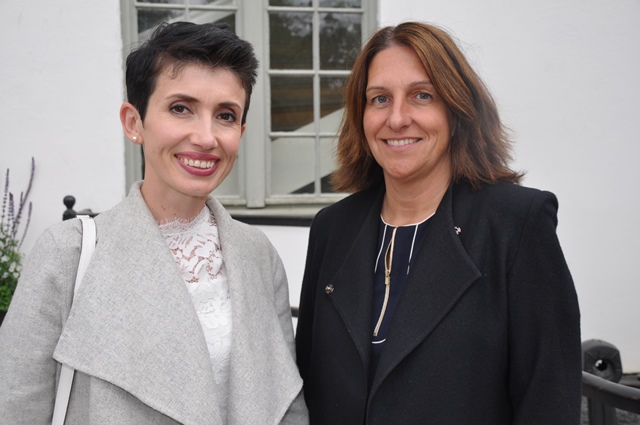
Deshira Flankör, Mayor of Värmdö, and Muriel Beser Hugosson, Head of ABE school, at partnership dialogue in May

Our collaboration with IVL, SEI and City of Stockholm has also deepened in the course of the year. Through our collaboration initiatives, we have been able to catalyse several new research projects.

In the MISTRA InfraMaint programme, old networks for piped water and transport meets the digital age. How can sensors and artificial intelligence change the way we manage infrastructure? KTH contributes knowledge from structural engineering, environmental economics and industrial management, in close collaboration with the city of Stockholm. The programme runs for 4 + 4 years and comprises a broad range of actors, coordinated by RISE.

In a new Formas-funded project, a KTH team with competence in energy, water and innovation studies collaborate with ten private and public organisations to understand the system effects of on-property technology for water and heat recovery. A year ago I wrote a blog post about this phenomenon, and its fantastic that we now can learn more about it together with other actors.

We also congratulate our new colleague Dr Timos Karpouzoglou for managing to secure a grant from Formas to compare informal water provision systems in low-income areas of the metro regions of Nairobi and Delhi. These new projects, including a generous contribution from the city of Stockholm, means 25 fresh millions (kronor) to KTH. Not bad.

Finally. The year which passed showed us all with uncomfortable clarity that water is a finite resource. As I pondered in an earlier blog, maybe the summer of 2018 was, with extreme heat, fires, and water scarcity, a glimpse of our future.

In this not so distant future we will need new ways of managing water. The key will be to go from linear flows to circular. Every kid in elementary school knows the hydrological cycle. Yet, all our technical systems for water in human settlements have adopted a linear approach. In the linear approach, water is just a transport medium for carrying human waste. Cheap and easy. But it depends on nature’s moderation of the hydrological cycle, and a cycle turn-around fast enough for our ever-growing demand.

During 2018 we launched the ”Circular Water Challenge”. In the coming year, we will work with communities and students on eight islands in the Baltic Sea to look for solutions for water scarcity, where re-use of water will be at the centre stage. If you are interested in this project please contact Christian Pleijel at KTH Executive School.

Kick-off for Circular Water Challenge, at Artipelag on Värmdö, in Nov 2018

Moreover, we have begun building a wide coalition for circular water solutions. What started as an attempt to write a Vinnova application will hopefully grow into a national knowledge network for circular water technologies, including actors from municipalities and public agencies, private sector and academia. Curious? Drop us a line!

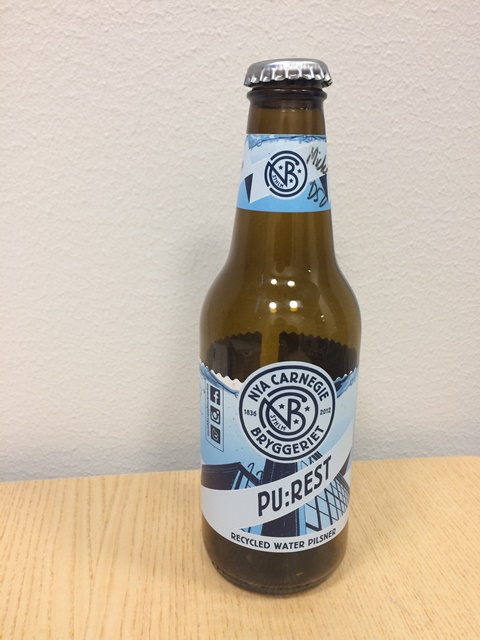
Changing from the linear to the circular will require not just a shift of knowledge and practices. It also requires a shift of attitude. We need to challenge our own ideas about what wastewater is and can be used for. Take the example of Pu:Rest, a beer produced in 2018 by our partner IVL and the Carnegie Breweries. A crisp nice lager made out of wastewater from the Hammarby Sjöstadsverk, the experimental treatment plant co-owned by KTH and IVL. Kudos to IVL and Carnegie for that!

Beer brewed on wastewater from Hammarby Sjöstadsverk

In the future perhaps ”recycled” beer will be the standard drink at our monthly WaterPubs. Quite naturally, circular water approaches will become more common as water becomes more scarce. Since water is life, maybe our lives will also be more circular.

Happy New Year!

David Nilsson


Director of the WaterCentre@KTH

Associate Professor in History of Science, Technology and Environment

KTH Royal Institute of Technology

Email: watercentre@kth.se