MSc Vehicle Engineering
The master's programme in Vehicle Engineering covers all aspects from vehicle design, functions and dynamic properties, to systems for safety and comfort, and vehicles as part of the transport systems. You can specialise in Road or Rail Vehicle Engineering and develop the knowledge and skills to shape the next generation of safe, efficient, and sustainable transport. Graduates have global career opportunities and the skills to contribute to innovative and sustainable solutions that minimise the transport industry's environmental impact.

Vehicle Engineering at KTH
Vehicle Engineering is a broad area of engineering science driven by an ever-increasing degree of mobility in the world. At the same time, the transportation sector faces the challenge of minimising its environmental impact, requiring innovative solutions and capable engineers. This field will continually demand specialists to drive the transition to sustainable road and rail transport. This is evident in the new vehicle designs and concepts from established manufacturers as well as new start-up companies, especially as connectivity, electrification, self-driving, and AI technologies are changing the way we design, build, test, and operate new vehicles.
The master's programme in Vehicle Engineering covers vehicle design, functions, requirements, and the evaluation of various road and rail vehicles. Vehicle dynamic properties, their interaction with the road or track, active systems for safety, monitoring, and comfort, and human vehicle interaction are essential topics within the programme. The programme also addresses vehicles within transport systems and their interactions with humans and society. The programme is based on lectures, assignments, simulations, experiments and team-based project work. In the project courses you get theory and practice in systems engineering and apply your knowledge to real engineering challenges in collaboration with industry and cutting-edge research at KTH.
Road Vehicle Engineering
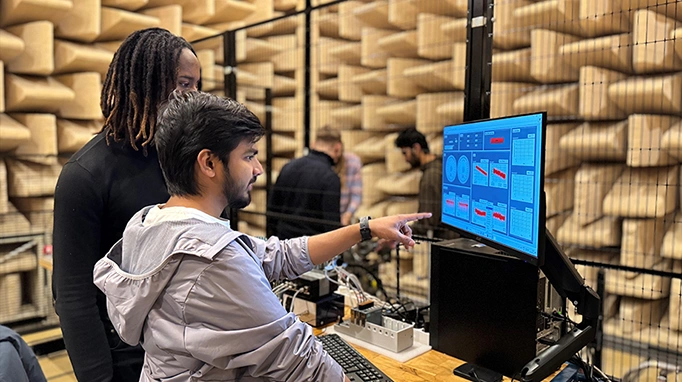
The Road Vehicle Engineering specialisation is for students who want to develop future road vehicles, from individual components to complete vehicle systems. You study vehicle technology, components, vehicle dynamics, modelling and simulation, while developing an understanding of how vehicles interact with drivers, roads, and the wider transport system.
Throughout the specialisation, you combine analytical methods with simulations, experiments, and project-based learning. You also explore electrified and hybrid propulsion systems, sustainable vehicle technologies, and future trends in vehicle development.
Rail Vehicle Engineering
The Rail Vehicle Engineering specialisation is for students who want to develop future railway systems by understanding how vehicles, infrastructure, electrification, and signalling work together. You study rail vehicle technology, railway signalling, electric transportation, and rail vehicle dynamics, while developing expertise in modelling, simulation, and system analysis.
Throughout the specialisation, you combine analytical methods with simulations, experiments, and project-based learning. You learn to analyse vehicle-track interaction, optimise vehicle performance, and design safe, energy-efficient, and sustainable railway systems.
This is a two-year programme (120 ECTS credits) given in English. Graduates are awarded the degree of Master of Science. The programme is given mainly at KTH Campus in Stockholm by the School of Engineering Sciences (at KTH).
Programme structure and progression
During the first year, you build a foundation in vehicle engineering through mandatory courses in vehicle systems, vehicle technology and vehicle dynamics, as well as courses within your chosen specialisation. The programme also gives you considerable freedom to shape your studies according to your interests and career goals through elective courses in areas such as vehicle design, structural design, control theory, electrified vehicles and transport systems.
During the second year, you continue to develop your chosen specialisation through elective courses, a project course and a degree project carried out either at KTH or, more commonly, in collaboration with industry. You are encouraged to seek a suitable industry project, with KTH providing support and relevant contacts.
Courses in the programme
The courses in the programme cover topics such as vehicle systems and their components, vehicle-road/track interaction, dynamics, modelling and simulation, analysis, control, validation, experiments and team-based project work.
Courses in the master's programme in Vehicle Engineering


Future and career
The master's programme in Vehicle Engineering provides an excellent basis for pursuing a career in the global automotive and rail vehicle industry, at consulting companies, transportation authorities, fleet operators, and universities and institutes active in this field. Vehicle engineering is a research-intensive area in which graduates from the programme work with, for instance, design, development, calculation and testing of vehicles, vehicle components and active vehicle systems. Graduates also work with systems analysis and energy and environmental assessments of vehicles and transport systems.
The cooperation between the Swedish vehicle industry and the Division of Vehicle Engineering and Technical Acoustics is very close. There are several major ongoing research programmes involving KTH, key manufacturers and the transport administration. Graduates from the programme work at companies such as Volvo Cars, Scania, Volvo Group Trucks Technology, Bombardier Transportation, CEVT, Daimler, BMW, Williams, Koenigsegg, Mathworks, Altran, Semcon, SNC-Lavalin Rail & Transit, Alstom, SJ, TÜV Süd, Öhlins, Continental and Bosch. Due to the strong need for research in this field, at least a handful of graduating students each year pursue careers in academia through doctoral studies at KTH or other prominent academic institutions, research institutes, or as industrial PhD students.




Sustainable development
Graduates from KTH have the knowledge and tools for moving society in a more sustainable direction, as sustainable development is an integral part of all programmes. The three key sustainable development goals addressed by the master's programme in Vehicle Engineering are:


Within the master's programme in Vehicle Engineering, you will gain knowledge that will allow you to participate in solving the challenges facing vehicles and transport systems of the future, concerning, for example, sustainable development goals such as good health and well-being, industry, innovation and infrastructure, and sustainable cities and communities. You will learn about the role of vehicles in transport systems and society; their subsystems, structures, and functions; how to design, construct, and evaluate their characteristics for different transport tasks; and how these factors affect safety, economy, energy efficiency, and environmental aspects.
New, innovative technical solutions and knowledgeable engineers are needed to enable a transition to sustainable road and rail transport. As a vehicle engineer, you can work within global companies on, for instance, design, development, environmental aspects, calculations, testing, and assessment of vehicles and transport systems, with sustainability as an essential aspect of the work. With your acquired knowledge of vehicle engineering, you can contribute to the development of environmentally friendly, resource-efficient, smart, and safe vehicles and mobility solutions, which are essential components of an integrated transport system for a sustainable society.
Faculty and research
The division of Vehicle Engineering and Technical Acoustics is responsible for the master's programme in Vehicle Engineering and most of the courses in the programme.
Road Vehicle research group
The Road Vehicle research group is focusing their research on vehicle conceptual design and vehicle dynamic analysis, including both interaction with the environment, human interaction and system-of-systems. In summary:
- Innovative vehicle concepts: for example, greener, smarter and safer over-actuated vehicles.
- Driver-vehicle interaction: for example, subjective-objective correlation, driver modelling, driving simulators and remote driving.
- Vehicle dynamics control: optimising, for example energy, safety and comfort depending on driving conditions and transportation task.
- Vehicle system and environment interaction: for example, tyre-road modelling, energy losses, wear, active suspension, crosswind and optimality in design configurations.
Conceptual Vehicle Design research group
The Conceptual Vehicle Design research group focuses on translating societal needs for transport functionality into a plan for sustainable vehicle solutions. Including the development of methods to link effects across different system scales so that vehicles may be optimal from a broader transport perspective. The multifunctional design also involves many questions about how to model different functions with appropriate non-biased fidelity and include secondary knock-on effects when evaluating the impact of change on a system.
Rail Vehicle research group
The Rail Vehicle research group focuses on the dynamic interaction between rail vehicles (trains) and track. Modelling and simulation play a major role in predicting system behaviour, optimising system parameters, predicting maintenance needs, total cost of operation, and improving system performance like ride comfort, running stability and vehicle-track interaction forces. In summary:
- Active suspensions.
- Mechanics of the wheel rail contact, new contact theories and implementing theories for wear and high cycle fatigue in the models.
- Dynamic interaction between rail vehicle pantographs and catenary.
- Condition-based maintenance based on predictions with digital twins and/or machine learning.
- How to make train design and operation even more energy and power efficient.
Sound and Vibration research group
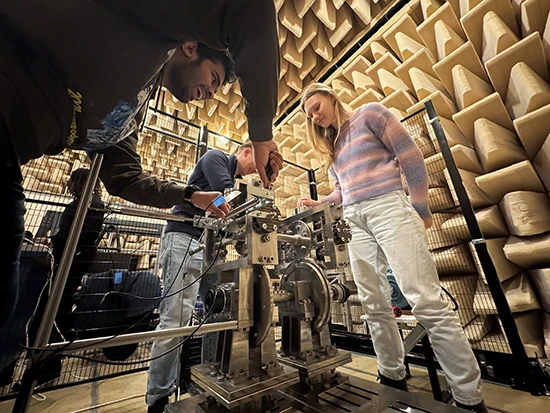
The Sound and Vibration research group work on topics like flow acoustic interaction with particular focus on sound propagation in confined flows like ducts and the respiratory system, and on acoustic design as an enabler for resource efficient vehicles. Numerical methods for, and modelling of coupled acoustics and vibration applications, including efficient Finite Element modelling of large-scale problems, design optimization and acoustic materials or metamaterials. The group also work on transportation noise, including the development of a mixed experimental-numerical approach, noise impact assessment, feeding into dynamically-controlled traffic strategies. In summary:
- Flow acoustics
- Acoustic design
- Numerical methods for coupled acoustics and vibration applications
- Noise impact assessment
- Multi-functional structural components
Faculty involved in the programme