
Tiny organs, big potential: how a PhD student is bridging microfabrication with organoid research
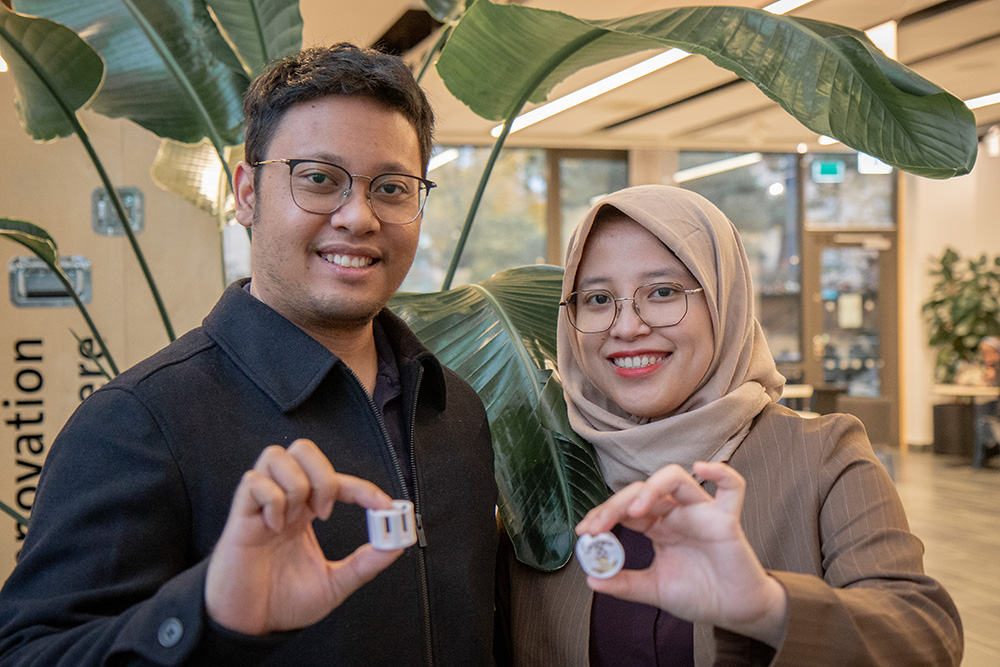
Organoid research is opening new possibilities for studying human diseases and testing drugs. But despite their potential, manipulating and studying them under the microscope is still a technical challenge. Jessika Jessika, a PhD student at KTH is developing a solution.
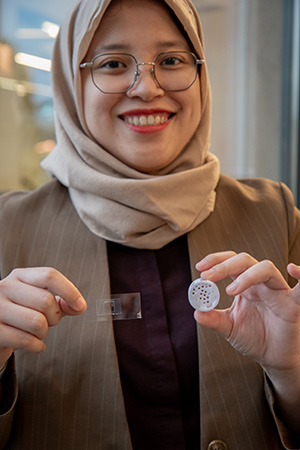
Jessika Jessika is pursuing a PhD in biotechnology and has a background in nanotechnology. Alongside her doctoral research, she’s developing OrCAGE, a startup born from her passion for making advanced cell research tools more accessible.
Solving a microscopic problem
Organoids are small, three-dimensional assemblies of human stem cells that mimic the function of real organs. They are valuable for research and drug testing because they can show how human tissues respond to treatment more accurately than animal models or traditional 2D cell cultures, but they are delicate and tend to move around which makes it hard to study them.
“When you image organoids under a microscope, they float freely in liquid media. Even a slight movement can completely shift them out of view. Imagine trying to capture a high-resolution image of something that’s constantly drifting. Researchers often spend hours pipetting organoids manually, trying not to lose them”.
Keeping organoids in place
With her startup OrCAGE, Jessika Jessika and her co-founder Akbar Bagas Pramantya are developing a solution: 3D-printed microstructures that hold the organoids in place.
“With our device, the organoids are localized but still free enough to behave naturally. This helps localize them for imaging and testing, which makes the process faster and more reliable. Because the structures are 3D printed, they can be customized for different organoid sizes or types.”
From class project to startup
OrCAGE is one of the teams in KTH Innovation Launch , a program for promising startup projects founded by students and researchers at KTH.
“OrCAGE actually started as a class project. I took a PhD-level Design Thinking course at KTH where we had to create a proposal for a product. When I saw the call in KTH Innovation’s newsletter just days before the deadline, I submitted that same proposal and got accepted!”
Combining PhD studies with innovation
Together with the other teams in her batch, Jessika Jessika joins weekly workshops on business development, gets access to the premises at Teknikringen 1, and forms a supportive community of founders.
“The Launch program has been essential. As a PhD student, it’s easy to get lost in your own research. The weekly workshops and the support from my business coach keep me accountable and help me move forward.”
How does combining PhD studies with running a startup work?
“The curriculum is flexible enough for research-based projects but structured so you actually make progress. Learning from other participants, even those from totally different industries, helps you find patterns and apply them to your own case. I wouldn’t have come this far on my own. The combination of coaching, peer learning, and structure makes a huge difference.”
Jessika Jessika also sees how her learnings can be useful for her future research career.
“Even if your end goal is to become a PI (principal investigator), you still need to manage budgets, teams, and projects. The program helps you develop those skills while exploring how your research can have real-world impact.”
From exploring ideas to launching startups
KTH Innovation’s support is open to all students and researchers at KTH, starting from just an idea or a research result. You can start exploring your ideas at any time, but if you want a clear path to follow, and a group of other teams to work alongside, then KTH Innovation Launch is the way to go.
“I definitely recommend joining the Launch program, especially for other PhD students. The skills you gain, like project management, grant writing, and strategic thinking are very valuable whether you stay in academia or go into entrepreneurship.”
Future plans
What’s your plan for your future career and OrCAGE?
“I see myself continuing in academia while also developing OrCAGE. Being active in both worlds helps. For market validation, I can reach out to contacts through my research network. People are often more open when you approach them as a fellow researcher. Stockholm is a fantastic place for this, it’s a biotech hub with a rich network of researchers and startups.
“My vision for OrCAGE is to make the tools and devices we create in research more accessible. Scientists buy so many life science products - why not build our own? We can turn academic innovation into something practical and shareable.”
About OrCAGE:
Founded by Jessika Jessika, PhD Student at the Herland Lab , KTH Department of Protein Science, and Akbar Bagas Pramantya with the mission to streamline organoid research through spatial control.