
Lorenzo
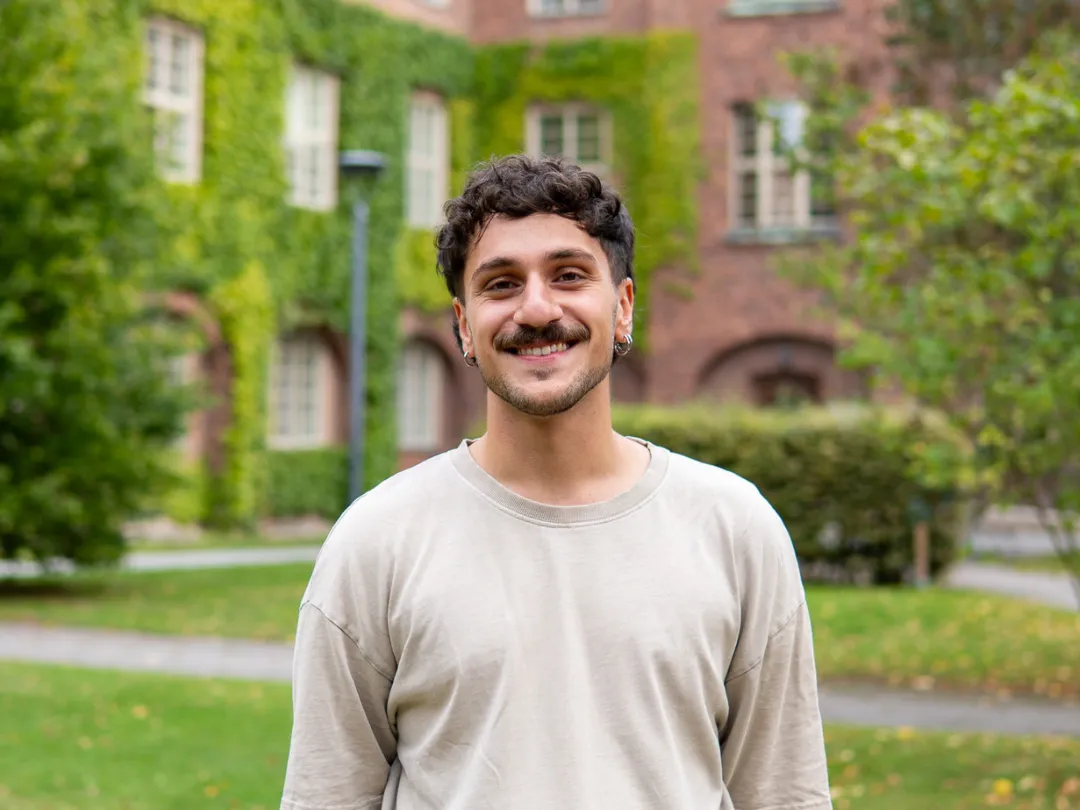
Lorenzo is from Italy and holds a bachelor’s degree from the University of Modena and Reggio Emilia in Computer Engineering. He is currently pursuing the master’s programme in Systems, Control and Robotics at KTH. In his free time, he enjoys attending aerial yoga classes at KTH and spending time with his friends.
Why did you choose this master’s programme at KTH?
I developed a strong interest in robotics while working on the Formula Student Driverless project during my undergraduate studies in Modena, Italy. Seeing a real, tangible autonomous car running code that I had written sparked my interest more than any other piece of software I had created before. This is the main reason why I chose robotics as my major. Regarding KTH, my interest in pursuing a master's degree here primarily stemmed from an exchange semester I spent in Sundsvall, Sweden, during my undergraduate studies. I loved exploring a new culture and living in a new country, and I fell in love with Sweden. So, when I started looking for master's programmes, KTH was my first choice - it also has one of the best robotics programmes in Europe!
What are the best aspects of your programme?
I think the best aspect of the Systems, Control and Robotics programme is its interdisciplinary nature. Students can choose from a wide range of courses and decide what to specialise in. One can decide whether to focus on control courses, machine learning, electrical engineering, or computer science, and even take part in research projects.
Have you chosen a specialisation track within the programme? Which track and why?
The programme offers two tracks: Learning, Decision and Control Systems (LDCS), and Robotics and Autonomous Systems (RAS). Personally, I chose the Robotics and Autonomous Systems track. To be honest, the difference between the two is not that significant, as it only comes down to two courses. Also, choosing one track doesn’t exclude taking courses from the other. The reason I chose the RAS track is that, coming from a background in Computer Engineering, I was initially more interested in subjects like Computer Vision and Artificial Neural Networks.
What are some of your favourite courses so far?
So far, my favourite courses have been:
-
Applied Estimation: This is one of the two compulsory courses in the RAS track. I really enjoyed this course. I loved the subject itself, and at the end, we had the opportunity to develop a project in small groups as well as write an article-like report about it.
-
Engineering Project in RPL: This is a very versatile course. Similar to the Research Project course, you can contact a professor and participate in a real project within the RPL department, either alone or in a group. I worked at SMaRC (Swedish Maritime Robotics Centre), where I helped to create two fully autonomous boats, both in simulation and on real hardware. The field testing at the lake and the BBQs have been amazing. Jokes aside, I truly learned so much from this experience, and I would recommend that everyone take one of these projects.
-
Advanced Control Theory and Practice: This course was initially very daunting for me. Due to my background in computer engineering, I lacked knowledge of control theory and physics in general, but it turned out to be one of my favourites so far. The course changed my perspective so much that I have decided to do something I would have thought impossible just a few months ago: I am going to take more control courses! Specifically, the Model Predictive Control and the Automatic Control Project course.
How do studies at KTH differ from your previous studies?
Studying at KTH is very different from what I was used to in Italy. For example, the academic year here is divided into four periods, whereas in Italy it consists of two semesters. However, the real difference lies in the teaching method. Back when I was at my old university, I never had any assignments to hand in during the courses. It was just a matter of attending lectures from 9 to 5 for three months and then studying for the final exams. Here, the situation is very different. Firstly, learning is mainly autonomous. On average, there are only four or five lectures per week, so you are expected to do a lot of independent study. Secondly, there are the assignments. KTH highly values hands-on experience alongside theory, so expect to spend lots of time in the labs!
How is student life in Stockholm?
Stockholm really offers a lot; there is so much to do that I probably only know about 5% of it. Regarding KTH specifically, my favourite things are the KTH Sport Foundation, where you can attend classes ranging from calisthenics to aerial yoga (try that out, trust me!), and the chapter pubs.
How would you describe your time at KTH so far?
I am really enjoying my time at KTH. To be honest, the first few months were quite overwhelming. Moving to a new country meant that I had a lot on my plate all at once, and the courses were very tough and fast-paced, which was quite a challenge to get used to – mainly, I guess, because of the transition from my previous studies. However, once that initial period had passed, I really started to make the most of this journey! KTH truly offers plenty of opportunities and good times - you just need to look around and find what makes you happy!
What do you want to do after graduating?
As a continuation of my engineering project, I would like to work in the field of maritime robotics and perhaps start my own start-up with the help of KTH Innovation.