KTH Logo

Disassembling an induction machine

It is always fun to disassemble something without the burden of reassembling it!

This time an ancient induction machine, MT71B14-4, manufactured by ASEA (The “A” in “ABB”) becomes my victim.
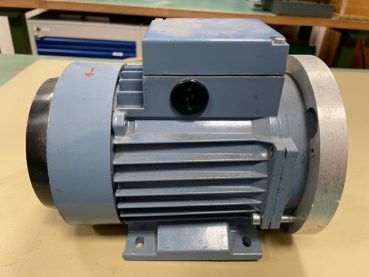
This guy. Let’s do it!
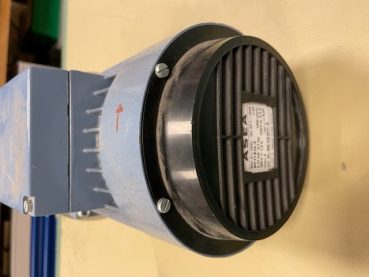
The nameplate says that this machine is rated as class B according to the IEC standard 34-1-1960. Its rated power is 0.37 kW, rated rotating speed is 1400 rpm, and rated power factor is 0.69.  If the “Y-connection” is adopted for the three phase of stator windings, its rated linear voltage is 380 V and rated current is 1.3 A; while if the “Delta-connection” is adopted for the three phase of stator windings, its rated linear voltage is 220V and rated current is 2.3 A.
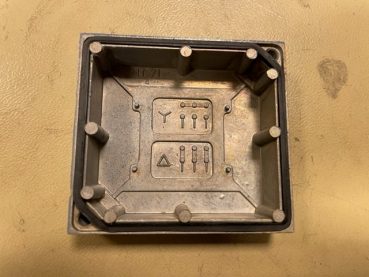
The connection methods of electrical  cables for them are illustrated on the backside of its lid.
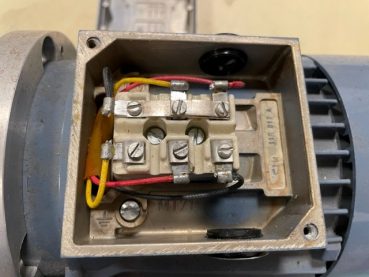
Obviously the “Y-connection” is adopted for the three phase of stator windings.

The non-drive end has a centrifugal fan which helps cool the machine with forced air convection.
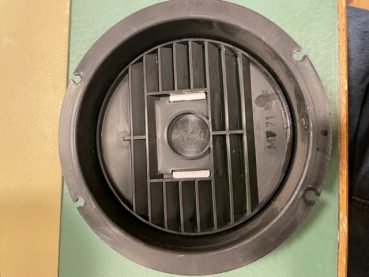
The cover with louvers.
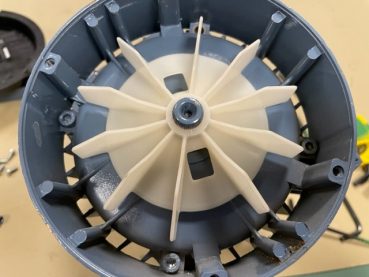
The cowling which guides the airflow into open channels between fins on the casing.
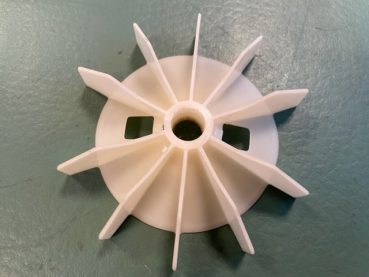
The fan has radial straight shape blades, which makes it able to work in both rotating directions.
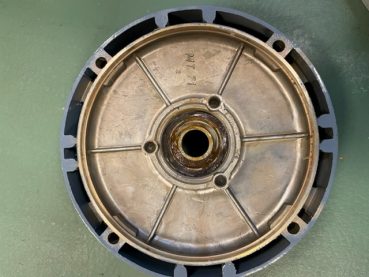
The endcap, which fixes the position of the bearing and support it.
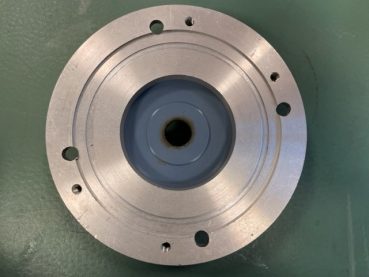
The flange in the drive end, guessed to be used for connecting with the load machine.

There are 24 slots in total for the stator.
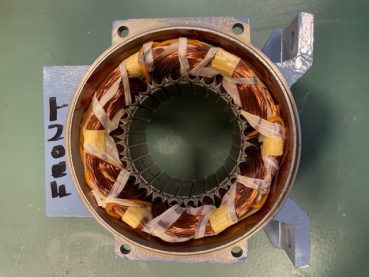
Random windings are used for this kind of small size squirrel caged motor.
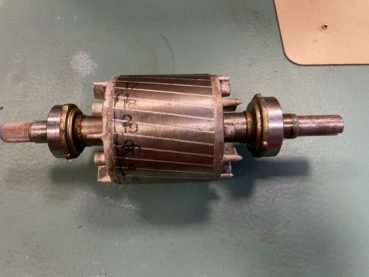
Rotor bars are skewed to improve the starting torque, prevent the magnetic locking between the rotor and the stator.
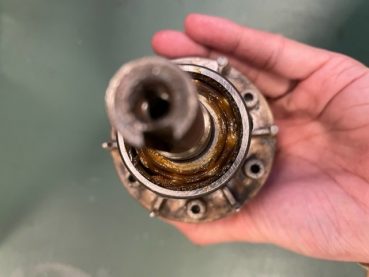
A common ball bearing is used in this machine.
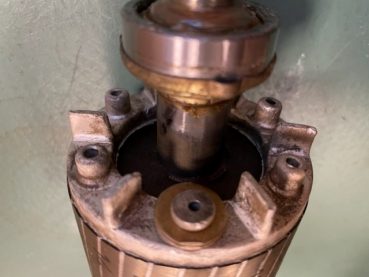
There are two washers below a specific bolt at the end ring to balance the weight of the rotor.

Where are my chainsaws? Now I will cut these endwindings off…

P.S. Thanks to Jesper Freiberg for the help in the disassembling process.

PhD studies – summer school

Earlier we have been talking about how life is as a PhD student here at KTH. Today, I would like to describe another part. As a PhD student I am in the early stages in my professional career, still with limited knowledge, experience and network. The PhD studies helps with all of these. While knowledge and experience are build up on a daily basis, a network is built and expanded through talking people. Throughout the last two years, due to the pandemic, we did not have the chance to meet many other people working in our area, especially outside of KTH.

With the pandemic seemingly to be over in Europe, I was given the opportunity to attend a PhD summer school on power electronics, electrical machines, energy control and power systems in Gaeta, Italy. This was the first opportunity for me to attend an event to meet with other young researchers in my field. Furthermore, the course helped me to earn the required credits.

The summer school was organized by the university of Cassini and as they are in charge of the medieval castle in Gaeta, that was the venue. Gaeta is a small medieval town at the shore of Italy south of Rome. With a total of five PhD students from our division we took the airplane on Sunday to Rome and took the train to Gaeta, enough time to check in the accommodation and take a round in the town.

On Monday, the school started. After the introduction, throughout the week we listened to lectures from professors of several European universities on various topics in the topic. One lecture on wireless power transfer, with details on why, how and where. Other lecturers spoke about the global elevator industry, the overall development as well as special challenges from a technical perspective. We also received information on practical laboratory work, i.e. how to implement power hardware in the loop tests.

Next to listening to lectures, one essential part of a researcher’s life is to present the own work. A common way is to use a scientific poster. I was not in the group who had to present a poster, but I took the chance to have a look on other students work. A poster is a short summary of one’s work and a starter for a discussion. Everyone of us, who attended from KTH, found a fellow student who works on something similar. A great chance to see how other people approach a problem and maybe a source of inspiration for the own work.

Last but not least, one intense week also has space for informal exchange. For that purpose, the summer school organized lunch, coffee breaks and night filling dinners for us to get to know each other in a casual way. And since it was Italy, of course the food was amazing.

After this one week, did I not only listened to a wide selection of experts of my field, but also gained insight into PhD life in other countries and universities. I found PhD students to discuss academic topics but also how to master the pitfalls of mastering a PhD. Returning back to Stockholm, I was happy to get some rest and not having 100people around me but also sad to leave my new gained contacts behind.

This week, I took the final test of this summer school. With this, the summer school is finally done. With this experience in the mind, one more motivation to publish on a conference in order to meet more fellow PhD students.

If you would like to know more about this particular summer school, you can have a look here: https://www.ecpe.org/events/european-phd-school/european-phd-school/


PhD Studies: A Story of Not Merely Research

What is it like to study for a PhD? This question probably has as many answers as there are doctors and PhD students. But in most cases, you will hear that it is a lot of work and many hours of diligent struggle. So research is tedious, you conclude.

However, working towards a PhD at a Swedish university includes much more than just conducting your own research. For sure, keeping up with the current research in your field, setting up experiments, testing out ideas in simulations, presenting your research, and other research related tasks comprise the bulk of the work load (it should make up 60 % of the time, according to the formal study plan that all PhD students set up). So what about the rest?

Let’s peak at my own schedule for Thursday and Friday last week. Although not being two typical days, they gives a pretty good indication about the average (how about that, do you remember your stats course?).

On Thursday, I went to Västerås to conduct experiments with a colleague who is carrying out an industrial PhD at ABB. We had a fairly rough start when realizing that the current sensors where picking up an awful amount of noise. Such intermezzos are almost commonplace when conducting experiments and something you learn to live with. Once solved, we could both run the experiments and have a long a fruitful talk about the machine modelling. Keeping in touch and sharing knowledge with industrial partners is an important part of the PhD studies.

Friday morning – after a night with not too much sleep – I had an oral exam in a course on electronic system design. Much like the studies on undergraduate level, a PhD student continues to take courses throughout his/her five years. Supposedly, they should make up 20 % of the curriculum.

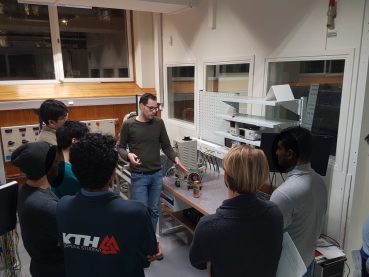
My colleague, Giovanni, teaching the principles of magnetic induction and Lorentz force in our lab

Having passed the exam, I scrambled to the power electronics lab at KTH, which right now is hectic with different laboratory exercises in undergraduate power electronics and machines courses. My role was now switched from student to a tutor. Those four hours in the afternoon make up part of my departmental duties, which constitute another 20 % of the curriculum. For most of my colleagues and myself, that means tutoring including correcting hand-ins, and preparing tutorials and labs.

So if you ever went into a university lab with the equipment prepared for your experiment, you now know – from this post and the last – who set up the bench.

The labs

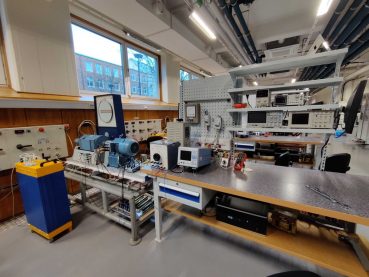
Christmas time is coming up, not only at Luca’s home, also in the Sustainable Power Lab (SPL) here at KTH. The SPL is located at Teknikringen 33, where we let ingenuity sprawl (to be judged by you 😉 ).

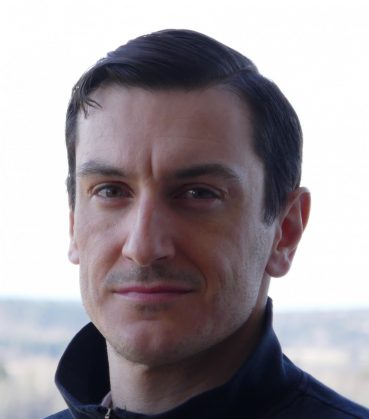
A major part for us EMD people in the advent time are the laboratory exercises in the course “Electrical machines and drives”. This task is taken over by the PhD students working on electrical machines and drives. Let me take the chance and introduce myself: My name is Yixuan and I am a PhD student with Luca on “Fault tolerance of electrical machines”. I will talk more about the research in another post.

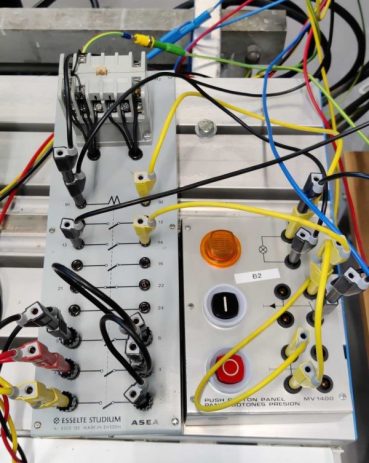
So, with my fellow colleagues Giovanni and Gustaf, we are preparing the lab benches for the students these days. We call this task “the yearly sanity test” due to a latch circuit involved in the bench setup. In a nutshell, it is a circuit for on/off-buttons, such that one does not need to hold the on-button. This year, due to Giovanni’s experience, I consider us to have passed the test on the first try….not senile yet.

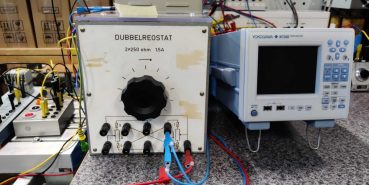
Another favorite component of ours are the rheostats, i.e. variable resistors. Very analogue and apparently fragile. Unfortunately, one of them didn’t survive this year so well.

Before the laboratory exercises start we will finish the benches and make sure that everything actually works. A small sneak-peak here:

So, see you soon in the lab!

We are on!

Welcome to our blog “Converted to energy conversion”! Yet another blog? Yes. But interesting.

We are a group of KTH people – master students, doctoral students, and faculty employees – who are passionate about electric energy conversion. We deal with all sorts of stuff like electric machines, frequency converters, electric drives, power electronics, control, etc. All that we need to produce mechanical power out of electric power supply (motors!) or to generate electric power out of mechanical power supply (generators!).

We like to simulate but mostly to test our ideas in the laboratory. Easily said than done. The struggles to make things work as they should are going to shape our own lives. In some cases, they have already irremediably done so.

This blog is meant to be a place for our thoughts and insights on our lives as KTH researchers in this scientific field. I hope it will be useful for understanding what actually happens behind the curtains, as well as for unloading our souls of the joys and pitfalls of our daily work.