KTH Logo

Gender and Technology course – featuring the student posters about trouble with gender biases in technology

Did you know that AI generated photos depict women in a more sexualized manner than their male counterparts? Or that KTH’s own learning platform Canvas should include queer inclusive pronouns? Have you heard about the pill for men and why it has been a long time in the making? And did you know that some scientific fieldwork is only accessible for certain groups of people?

Those timely and thought provoking topics were addressed by the students in this terms poster presentation session in the Gender and Technology course. Click on each picture below to get a full size readable PDF!

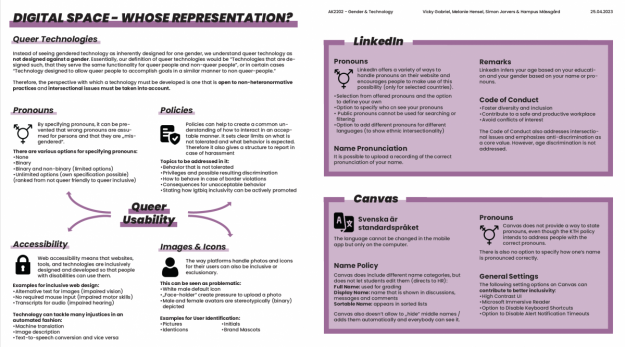
Check out the poster ‘Digital Space – Whose Representation’. The group analyzed queer technology in our society, specifically in online identities and used Canvas and Linkedin as examples. This poster has some real world impact because it addresses KTH’s learning platform. The students are invited to talk about their results concerning CANVAS in the ABE schools working group for gender equality, diversity and equal treatment issues (JML).
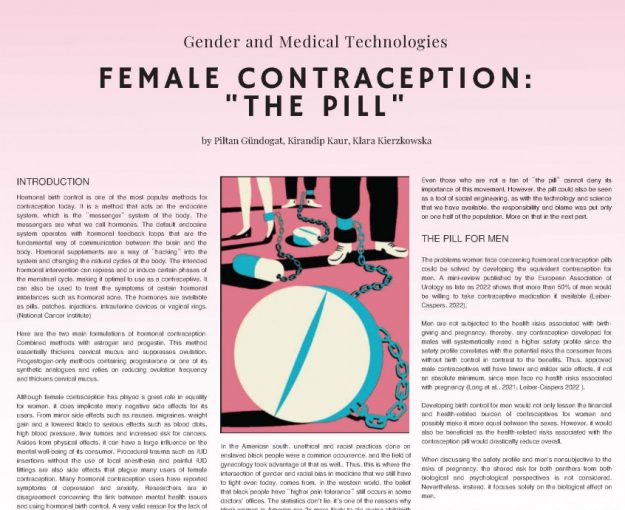
The poster ‘Gender and Medicine – Female Contraception’ addresses the injustice women have faced in the medical world. The students found that contraceptive research and testing has been dismissive of female health struggles, while male contraceptives are tested more rigorously and introduced with great caution.
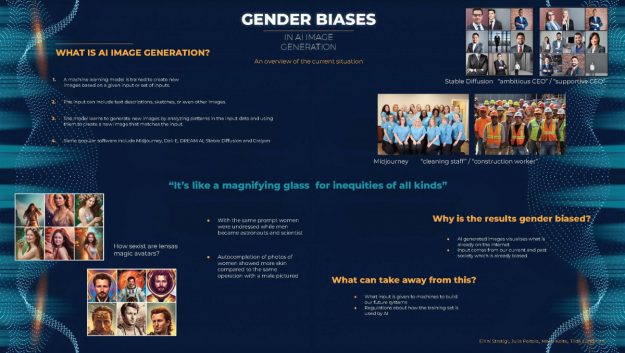
‘AI Generated images’ addresses the biases that are embedded in algorithms used by AI technology. The students found that AI generated images of male and female avatars are sexist. They discovered that with the same prompt female avatars showed more skin while male avatars were depicted as astronauts or scientists.
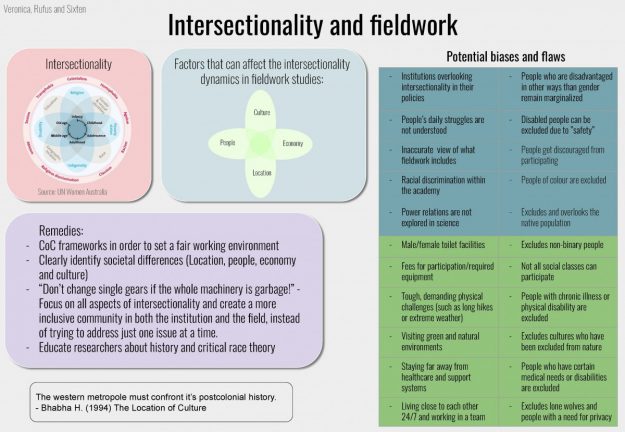
Another student group worked with ‘Intersectionality and fieldwork’ asking how fieldwork could be adapted to become more inclusive. The students suggested some remedies, like using remote sensing technology for observation in the field and introducing code of conducts to improve the working environment during fieldwork.
‘Artificial intelligence and data feminism’ discusses how algorithm developers can become more aware of their own biases in order to counter-act discriminatory gender representation on the internet. They group found some possible solutions to counter-act invisible biases by increasing transparency and participation in developing AI algorithms.
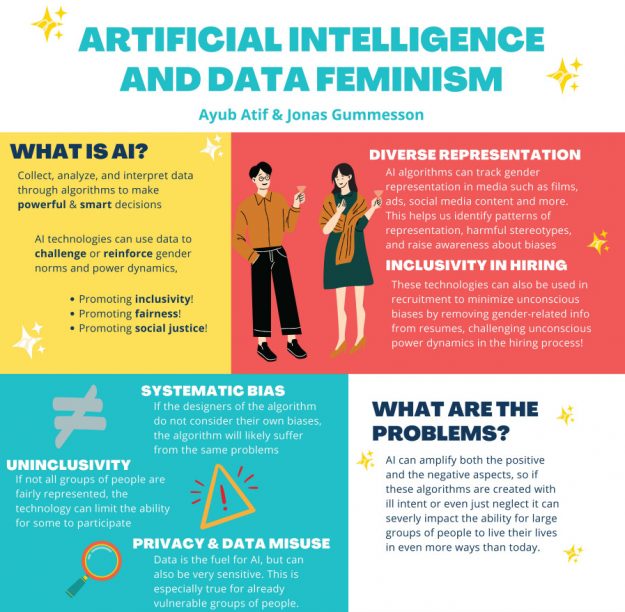
I hope that those posters are food for thought, for not only the Gender & Technology class of 2023, but all students and employees at KTH who are interested in promoting and maintaining are more inclusive, open and nurturing learning environment for all of us.

A special thanks to the students of the Gender & Technology class of 2023.
Profile picture of Tirza MeyerAuthor Tirza Meyer, course responsible teacher for Gender & Technology, 2023.

Upcoming: Söderberg’s “Resistance to the Current”, 30 January

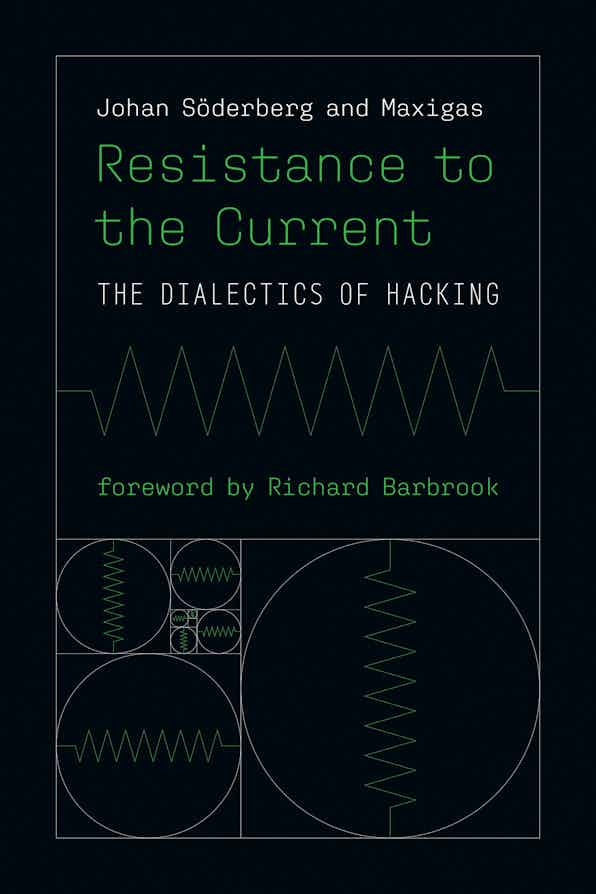
As part of the division’s Higher Seminar schedule for the upcoming spring term, Associate Professor in the Department of Philosophy, Linguistics and Theory of Science at Göteborg University Johan Söderberg will present his new book “Resistance to the Current. The Dialectics of Hacking” (MIT Press, Nov. 2022). Together with his co-author Maxigas, Senior Lecturer in the Department of Media at Amsterdam University, our visitor investigated four historical case studies of hacker movements and their role in shaping a connected 21st century society.

Please find the book description here.

If you want to read the book, it is available open access here.

https://mit-press-us.imgix.net/covers/9780262544566.jpg?auto=format&w=298&dpr=2&q=20

Johan will visit us on 30 January, presenting at the higher seminar at 1.15-2.45pm, Stockholm time. The event is hosted in the seminar room at the division (Teknikringen 74 D, level 5). If you are interested, please come by and visit us!


Upcoming Seminar: Decoding Power Relations in Computing Technologies

This joint seminar features two perspectives on how power relations have become embedded in computer technologies. Beginning with the early history of computers, Janet Abbate examines how computers were metaphorically described as “giant brains.”

Brain imagery encouraged the public to believe that computers had remarkable powers, while simultaneously obscuring the skilled labor of human programmers (often women) who did much of the actual work. This metaphor helped to devalue human labor and also fed the illusion that autonomous machines, rather than the people who controlled them, were responsible for the results produced by computers.

Abbate argues that in recent times the word “algorithm” has taken on the metaphorical role of the “giant brain” and performs similar ideological work, making human labor invisible while raising questions of accountability.

Fernanda R. Rosa explores power relations embedded in Internet infrastructure, revealing how Internet routers reflect and perpetuate global inequalities. She introduces an analytical technique called “code ethnography,” a method for examining code as a socio-technical actor, considering its social, political, and economic dynamics in the context of digital infrastructures.

Rosa focuses on the code for the Border Gateway Protocol and examines how this code is implemented at the internet exchange points (IXPs) that interconnect networks and allow the Internet to operate as a global infrastructure. Her comparison of the IXPs located in Frankfurt and São Paulo reveals inequalities between the global North and the global South and a concentration of power at the level of interconnection infrastructure hitherto unknown in the context of the political economy of the internet.

Both talks emphasize that an algorithm or an Internet router can only be understood in context: not only as part of a larger technological system, but also as an active element in social, economic and political power relations.

Time: Fri 2022-06-17 14.15 – 16.00 (Swedish Time)

Location: Division of History of Science, Technology and Environment, Seminarroom Teknikringen 74 D, 5th floor

Language: English

Lecturer: Janet Abbate, Prof. & Fernanda R. Rosa, Ass. Prof., Science, Technology & Society at Virginia Tech

Dr. Janet Abbate is Professor and Dr. Fernanda R. Rosa is Assistant Professor, both at Science, Technology and Society at Virginia Tech.

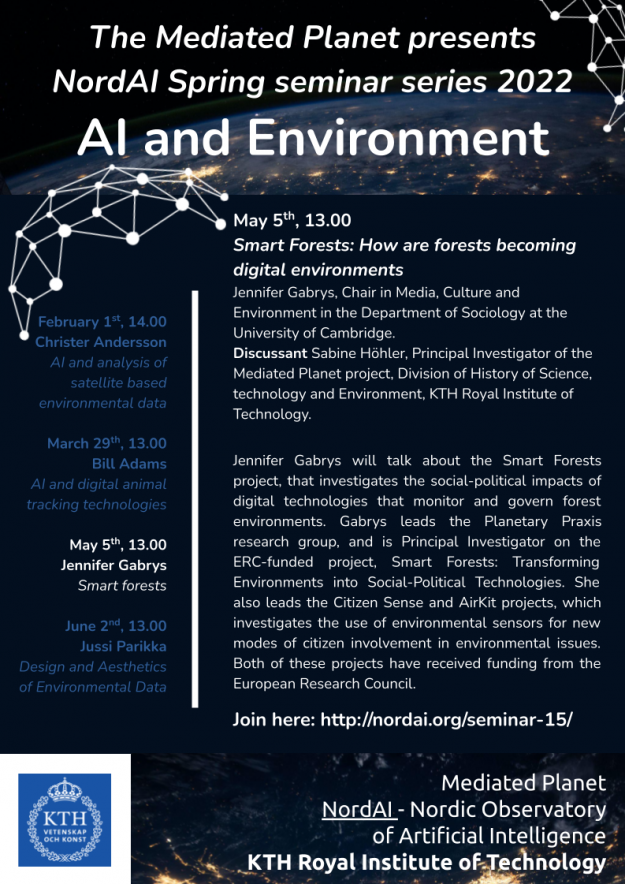
AI and Environment Seminar: Smart Forests with Jennifer Gabry

The 2022 NordAI spring seminars on AI and environment is curated by Adam Wickberg and Tirza Meyer from the Mediated Planet Research Group at KTH. The series feature contributions from leading scholars working with AI at the interface between the human and non-human world, exploring the question of what constitutes the environment through the lens of artificial intelligence. The seminars are held online, and are open to everyone.

Smart forests

May 5th, 14.0o, Jennifer Gabrys, Chair in Media, Culture, and Environment in the Department of Sociology at the University of Cambridge.

Discussant Sabine Höhler, Principal Investigator of the Mediated Planet project, Division of History of Science, technology and Environment, KTH Royal Institute of Technology.

About
Jennifer Gabrys will talk about the Smart Forests project, that investigates the social-political impacts of digital technologies that monitor and govern forest environments. Gabrys leads the Planetary Praxis research group, and is Principal Investigator on the ERC-funded project, Smart Forests: Transforming Environments into Social-Political Technologies. She also leads the Citizen Sense and AirKit projects, which investigates the use of environmental sensors for new modes of citizen involvement in environmental issues. Both of these projects have received funding from the European Research Council.

Join here: http://nordai.org/seminar-15/

Read more: http://www.smartforests.net/

The Mediated Planet presents the NordAI Seminar Series 2022

The NordAI spring seminars is a seminar series, curated by Adam Wickberg and Tirza Meyer from the Mediated Planet Research Group at the Division. The series features contributions from leading scholars working with AI at the interface between the human and non-human world, exploring the question of what constitutes the environment through the lens of artificial intelligence.
Earth Science Planet Globe Environment Lights

The first seminar was held in February and featured Christer Andersson, analyst at the Swedish Defence Research Agency, Sweden on AI and analysis of environmental data: a perspective from the Swedish defence researchers?

Next up is Bill Adam. Claudio Segré Professor of Conservation, Graduate Institute, Geneva; Downing College Cambridge, who among many other things has spent a semester at the Division (2017).

The Digital Animal and Conservation by Algorithm

Digital innovation has brought about a revolution in devices to observe, track and locate animals.  These range from fixed devices such as webcams and camera traps (trail cams), through airborne and satellite remote sensing to tracking and imaging devices fitted to living animals (collars and tags).  Digital data from these devices is streamed, shared, archived and analysed, yielding new knowledge and new systems of knowledge accumulation, and enabling new modes of intervention in non-human lives and human society, ‘conservation by algorithm’.  This seminar will discuss some of these innovations, and their implications.  It will explore the new digital lives that animals take on within databases and information networks, and their implications for human understandings of nature, and for conservation management.

Time: Tue 2022-03-29 13.00
Location: Zoom – link can be found here

Discussant: Finn-Arne Jørgensen, Professor in Environmental History, University of Stavanger
Recommended reading:
Adams, William, “Digital Animals,” The Philosopher, vol. 108, no. 1 (2022).
Adams, William, “Geographies of conservation II: Technology, surveillance and conservation by algorithm,” Progress in Human Geography, vol. 43, no. 2 (2019): 337–350.

Follow this link for more information on NordAI

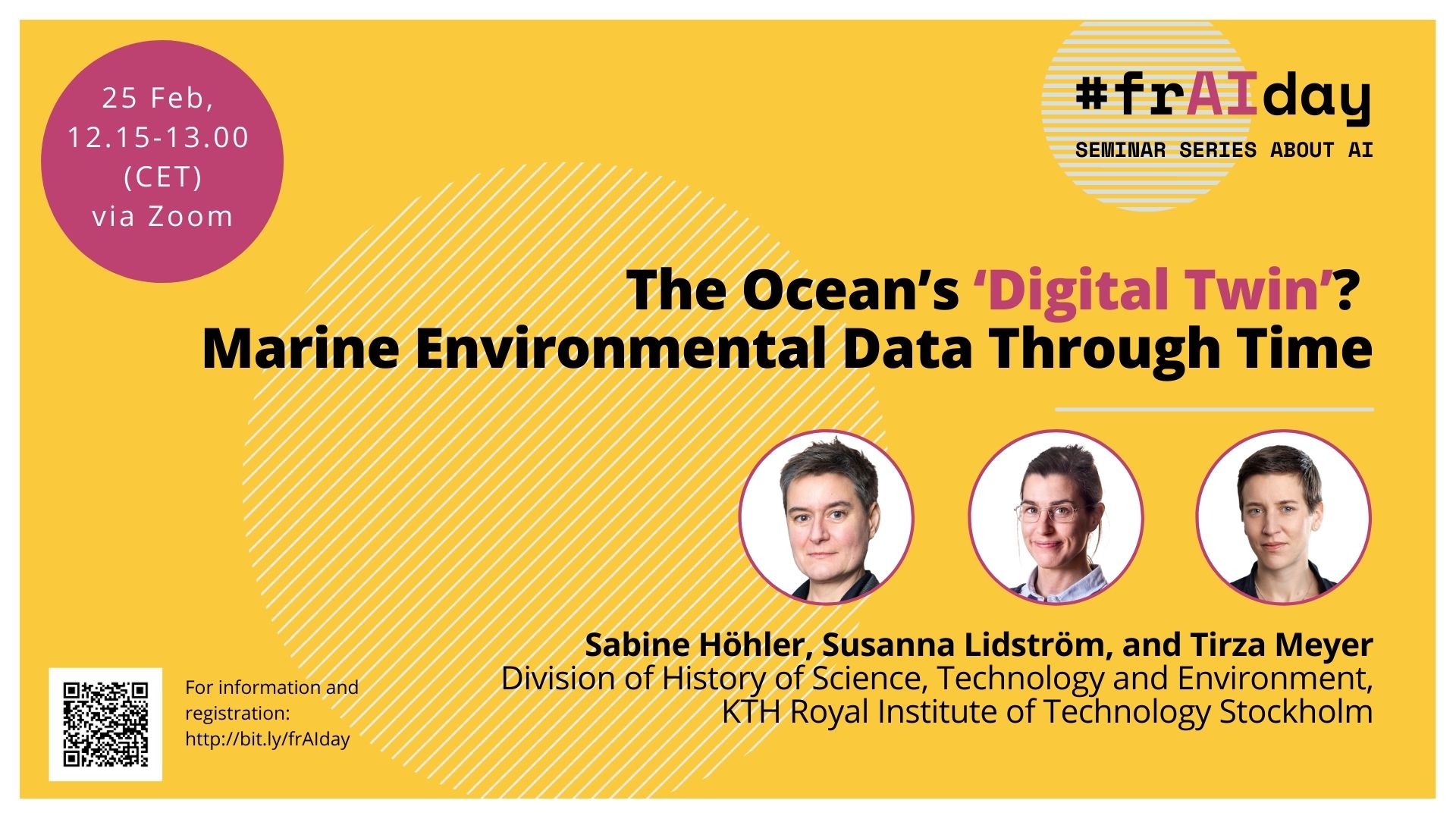
The Ocean’s ‘Digital Twin’? Marine Environmental Data Through Time

Sabine Höhler, Susanna Lidström and Tirza Meyer from the Mediated Planet project at the Division will present in the WASP-HS seminar series #frAIday, organized by Umeå University. In their presentation they aim to sketch the history of opening the ‘black box’ of the ocean.

Seminar poster.

The Ocean’s ‘Digital Twin’? Marine Environmental Data Through Time

Sabine Höhler, Susanna Lidström, and Tirza Meyer

Division of History of Science, Technology and Environment, KTH Royal Institute of Technology Stockholm

Much hope is tied to the creation of a digital twin of the ocean based on an ever more extensive body of ocean data. Representing the ocean in the digital space is a way of analyzing and modeling the ocean in a ‘laboratory’ setting. Studying the ocean stripped from its natural complexity, so the idea, can better inform and instruct humans on how to interact with the ocean environment. Our twentieth century understanding of the ocean as a central ecosystem in the planetary environment would not have been possible without long-term information gathering. However, also ocean data generation is a messy and contested process. Its history is even more important to study since we ‘know’ the ocean mostly in mediated ways. We observe the ocean almost exclusively through scientific instruments, and we formulate ocean policies, legislation, and development goals based on data and increasingly on digital information. That this data has a history makes the past, present, and future of the digital ocean not just a scientific but a political issue.

Our presentation aims to sketch the history of opening the ‘black box’ of the ocean. We use examples of the Challenger expedition in the 1870s, of satellite oceanography in the 1990s, and of present-day autonomous ocean sensor systems. We ask how the specific tools and the information they generated mobilized different understandings of the ocean as resource and territory, as climate moderator and as carbon sink. Dredges, satellites and deep-ocean floats created new ocean knowledges, politics, and also new ontologies. No matter how inclusive, refined, and versatile the databases are, so our argument, the digital ocean will not be a simple 1:1 representation or “twin”. While the data corpus may be quite functional to model ocean behavior, it will always rest on selections serving particular purposes and interest

Click here for information and registration!


Computing the Nordic Way: The Swedish Labour Movement, Computers and Educational Imaginaries from the Post-War Period to the Turn of the Millennium

Lina Rahm investigates how problematisations of the digital have changed over time and how the goal for education on digital technology has been one of political control—either to adapt people to machines, or to adapt machines to people in this article published in the Nordic Journal of Educational History, volume 8, 2021. Abstract and link to open access below.
Binary System Bits Byte Binary Binary Code

Lina Rahm first came to the Division as a Ragnar Holm postdoc in 2020. On Janyary 1 she started an assistant professorship with us, in the History of Media and Environment with specialization in Artificial Intelligence and Autonomous Systems, funded by the WASP-HS Wallenberg AI, Autonomous Systems and Software Program – Humanities and Society. Lina’s research focus is on sociotechnical and educational imaginaries with a span from the 1950s up until today.

Full article: Computing the Nordic Way: The Swedish Labour Movement, Computers and Educational Imaginaries from the Post-War Period to the Turn of the Millennium

Abstract

Based on empirical material from Swedish reformist labour movement associations, this article illustrates how digital technology has been described as a problem (and sometimes a solution) at different points in time. Most significant, for this article, is the role that non-formal adult education has played in solving these problems. Computer education has repeatedly been described as a measure not only to increase technical knowledge, but also to construe desirable (digital) citizens for the future. Problematisations of the digital have changed over time, and these discursive reconceptualisations can be described as existing on a spectrum between techno-utopian visions, where adaptation of the human is seen as a task for education, and techno-dystopian forecasts, where education is needed to mobilise democratic control over threatening machines. As such, the goal for education has been one of political control—either to adapt people to machines, or to adapt machines to people.

Technical Development and Education

As digitisation and computers in general are advancing rapidly, many engineers and scientists work on the possibilities and challenges developing artificial intelligence might pose. AI as a topic is also being researched by a handful of members of our division.

As such, researcher Lina Rahm has published a new article with the title “Education, automation and AI: a genealogy of alternative future” in the journal Learning, Media and Technology. She discusses the co-development of education technologies with both new trends in digital advancements and views on these issues from the past. The way we do education as humanities scholars has already changed profoundly during the ongoing pandemic. Furthermore, change is an ongoing thing and thus Lina’s research is necessary more than ever.

If you are interested in the article you can find it here.

Abstract:

The relationship between technical development and education is a reciprocal one, where education always stands in relation to those skills, competencies, and techniques that are anticipated as necessary in a technological future. At the same time, skills and competencies are also necessary to drive innovation and technical development for the progressive creation of desirable futures. Jumping back to the 1950s, this article illustrates how automation and AI have been anticipated as both problems and solutions in society, and how education has been used to solve these problems or realize these solutions. That is, computerization debates have concentrated on both the growing opportunities and the increasing risks, but almost always also on the need for corresponding education. The article uses a genealogical approach to show how, from the 1950s and up until today, education has been mobilized as an important tool for governance in computer policies.


A new PhD at the division

Life moves on, a new term has started and we as a division are very glad to welcome our new PhD-student Erik Ljungberg, who works in the History of Media and Environment with a focus on AI and autonomous systems. We have asked him a few questions to introduce himself and you can read his answers below.


Profile picture of Erik Ljungberg


Given that you had to switch countries for your new position, how was your transition to KTH?

I have to say that KTH has made the transition very easy. With the opportunity to get an apartment within a short space of time through KTH Relocation, making the jump from Oslo to Stockholm has been pretty effortless. Although shifting COVID restrictions have made the process a little unpredictable at times.


Could you please tell us a bit about yourself and the topics you are working on, especially within your PhD?

I am a historian of knowledge and started at KTH as a PhD student in August. I am more or less associated with the Mediated Planet project, which looks at how data gathering practices, data access and data ownership shape environmental perception and politics. Though my project is also a bit freer to go in different, but related directions.  I have backgrounds in both history of knowledge, which was the discipline I wrote my M.A. thesis in at the University of Oslo, and cultural anthropology, which I did a second B.A. in while doing my masters. Specifically my M.A. thesis looked at the advent of phenology, or in other words the measurement of rhythms of nature, in British natural science in the 18th-century. Phenology is a fascinating endeavor to study from a history of knowledge perspective because the possibility of mapping seasonal variations among plants and animals only really came into being once there was a knowledge infrastructure capable of gathering and processing big amounts of data. Basically you had to make daily observations over several years. Particular ways of handling paper were really at the center of this process. But you also needed ways to structure the recorded data in purely visual terms in order to streamline the process of recording and reading data. So one of the things I highlighted in my research was the importance of the table as the condition of possibility for this kind of knowledge production, stressing the fact that knowledge is simultaneously material and cognitive.

My PhD project will maintain this media theoretical focus on how knowledge emerges through being circulated through socio-material infrastructures, but focuses instead on the role of AI and autonomous systems in environmental understanding. It is exceedingly likely that AI and autonomous systems will fundamentally change the way that human society monitors, models, and manages the Earth’s natural systems. What is interesting to me is placing this development within a longer history of shifting Earth-human relationships wherein mediation plays a crucial role. As the environment becomes increasingly dataified, a central question also revolves around usage and access to data. This becomes especially salient once the issue of monetization comes into the picture. Who should capitalize on the use of data that is public, free, and ubiquitous? Questions such as these are important to address as big tech companies currently stand a fair chance of developing a hegemony of expertise when it comes to these issues.


What is coming up right now? What do you aim for in the near future in terms of research, (side-)projects, or public outreach?

Right now I am making an outline of my project, and also simply trying to get an overview of the field, or several fields actually, that I will be working in. Otherwise, I have a couple of things on the agenda. I am working on a paper for the Nordical Journal for Eighteenth-Century Studies, and I had a paper accepted for one of the panels at the upcoming 4S conference. Also, I hope to have a blog up and running in the next months which can serve as a kind of outlet for some of the developments that are unfolding so rapidly within the field of AI and the environment.


Starting during the pandemic is challenging, although we all hope that regular work routines can be resumed during this term. What kind of impact has Covid-19 had on your work?

Actually I got a scholarship to go to London and spend time in the archives, but that proved unfeasable during the pandemic. Certainly my M.A. thesis suffered from this. On the other hand, since a lot of workshops and conferences have gone digital, it has been possible for me to take part in discussions that I never would have been able to if I had to fly. Hopefully the landscape of post-COVID academia will include a lot less flying, while still acknowledging our need to interact face-to-face.

*

Thank you, and “Välkommen!” Erik, it is good to have you with us!