
Stable power systems for the energy transition
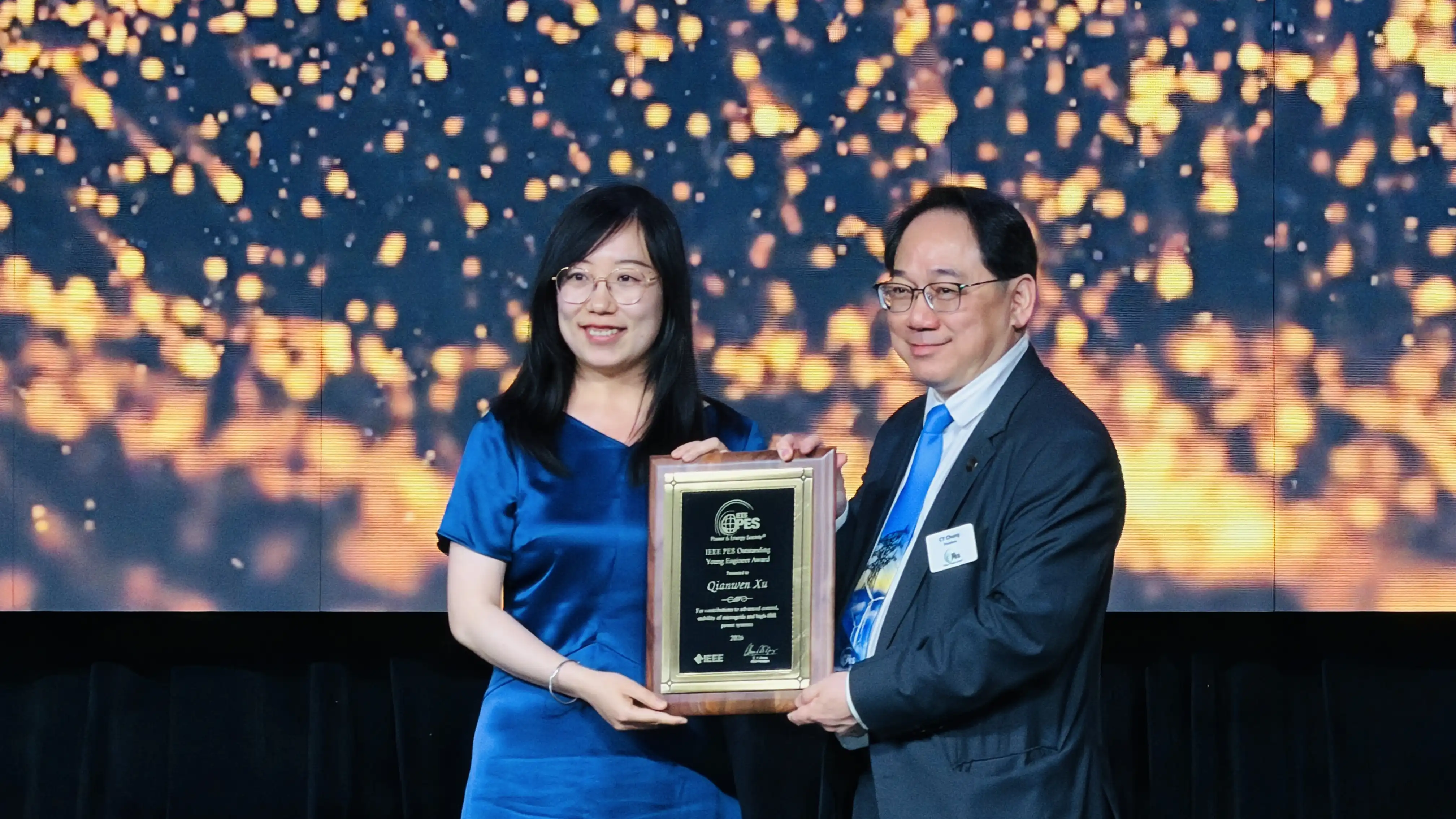
The transition to a more sustainable energy system depends not only on renewable electricity generation, but also on maintaining stable power grids. At KTH Royal Institute of Technology, Qianwen Xu develops methods that help future electricity systems remain reliable as renewable energy, electric vehicles and other power-electronic technologies become increasingly common. Her research has now earned her the 2026 IEEE Power & Energy Society Outstanding Young Engineer Award.
The energy transition is fundamentally changing how electricity systems behave. Wind power, solar power and electric vehicles are increasingly connected to the grid through power-electronic converters, creating new dynamics and new challenges for stability and control.
”The energy transition is changing not only how electricity is produced, but also how the power system behaves. Wind power, solar power and electric vehicles are increasingly connected to the grid through power-electronic converters. They are essential for the transition to a sustainable energy system, but they also create completely new challenges for stability and control," says Xu.
As inverter-based resources (IBRs) account for a growing share of electricity generation and consumption, traditional approaches to power-system operation are no longer sufficient. Xu's research focuses on developing modelling, stability analysis and control methods for microgrids and large-scale high-IBR power systems, with guaranteed stability at the core.
Developed new approaches
Qianwen Xu has developed new approaches for modelling converter-grid interactions and identifying stability boundaries under changing operating conditions. Her work increasingly combines physical power-system models with artificial intelligence to capture complex converter dynamics while preserving knowledge of the underlying system physics.
Building on these advances, Xu develops control and coordination methods for individual converters, microgrids and larger IBR-dominated power systems. This includes safety- and stability-guaranteed AI methods that combine learning and optimisation with explicit physical and stability constraints.
For critical energy infrastructure, the goal is not only to improve performance but also to ensure that systems remain safe and stable.
These challenges are becoming increasingly important as electrification expands and new large electricity consumers, including data centres, connect to the grid.
Across different applications and scales, Xu's research addresses the same fundamental question: how future electricity systems can become more intelligent and flexible without compromising stability.
"A sustainable electricity system also has to be a stable electricity system. The two cannot be separated," she says.
International recognition
For her contributions to advanced control, stability of microgrids and high-IBR power systems, Xu has received the 2026 IEEE PES Outstanding Young Engineer Award.
The award citation reads:
"For contributions to advanced control, stability of microgrids and high-IBR power systems."
Each year, IEEE PES recognises one engineer worldwide, aged 35 or under, for outstanding technical achievements, leadership, and contributions to the power and energy engineering community.