When Millimeters Matter: How do Damaged and Repaired Blades Shape Compressor Performance?
Researchers from KTH, the University of Stuttgart, and GKN Aerospace are investigating how compressor blade degradation and repair-induced geometric variations affect compressor performance and vibration behaviour, with the aim of improving predictive models and enabling more efficient maintenance strategies for future aircraft engines.
Compressor blades in aircraft engines are exposed to demanding operating conditions throughout their service life. Over time, erosion, fouling, and repair operations can alter blade geometry, changing aerodynamic loading, stage matching, and the rotor's vibration behaviour. Despite their importance, the aerodynamic and aeromechanical effects of these geometric variations remain difficult to predict accurately, often leading to conservative repair and retirement decisions.
To address this challenge, researchers from KTH Royal Institute of Technology, the Institute of Thermal Turbomachinery and Machinery Laboratory (ITSM) at the University of Stuttgart, and GKN Aerospace are collaborating in the DARLING project , short for Damaged and Repaired Blade Modelling with In-situ Experiments. The project aims to improve understanding of how damaged and repaired compressor blades behave in operation and to provide high-quality experimental data for validating predictive models.
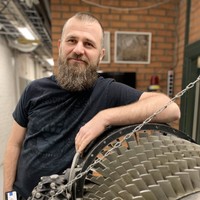
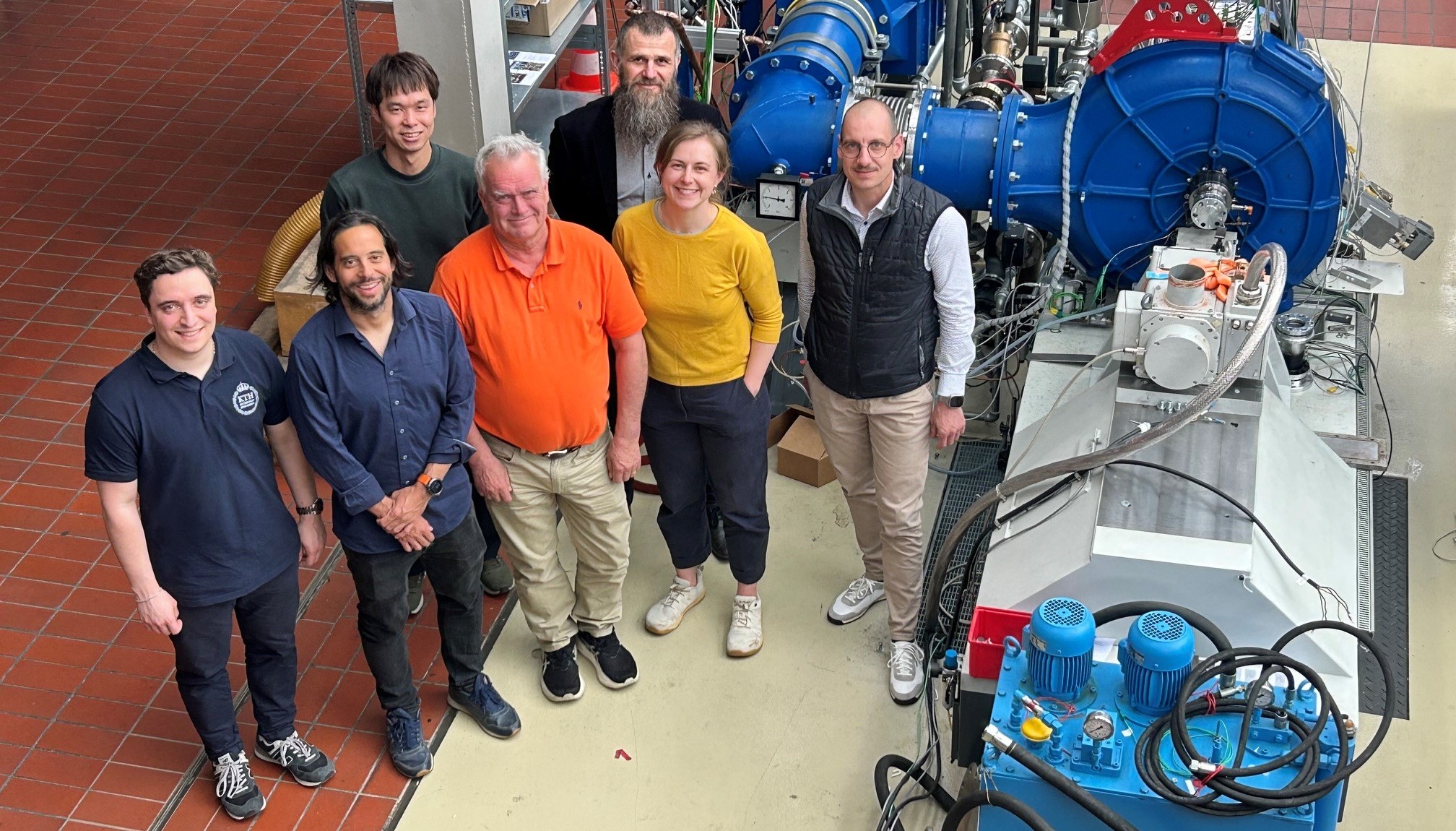
A key milestone in the project was reached before summer and the project partners met in Stuttgart to review progress and discuss upcoming activities. During the meeting, Carlo Rotundo , PhD student at HPT, presented findings from a comprehensive literature review alongside results from the project's first experimental campaign, conducted at the ACTIVE compressor test facility at ITSM . The first test campaign focused on compressor rotor blades with controlled leading-edge geometry variations, representative of damage that commonly develops during engine operation. By systematically introducing these geometric perturbations, the researchers investigated how blade degradation affects compressor aerodynamic performance and aeromechanical response.
The meeting also highlighted progress from the ITSM partners in upgrading the ACTIVE test facility to operate with R-134a as the working fluid. This development will enable experiments under transonic flow conditions that closely resemble those encountered in modern aircraft engines, providing a more representative environment for studying degraded compressor blades.
Building on the initial results, the next phase of the project, commencing this fall, will investigate the effects of blade erosion and twist variations under transonic operating conditions. The resulting data will support the development and validation of advanced modelling tools capable of predicting the aerodynamic and structural consequences of blade degradation with greater confidence.
To learn more about the DARLING project and its research activities or to explore possible collaboration opportunities with the HPT division in related research fields, kindly contact our team.