
MINFLUX – A Breakthrough in Nanoscale Light Microscopy
At SciLifeLab in Solna, within KTH’s facility Advanced Light Microscopy (ALM), researchers have access to one of the most advanced light microscopes in the world: MINFLUX. This technology represents a major leap forward for biological research, enabling visualization of structures inside cells at resolutions below 10 nanometers, in both two and three dimensions. It is the first time such precision has been achieved using light microscopy.
From Nobel-Winning Idea to Research Tool
MINFLUX was developed in 2017 in the laboratory of Nobel Laureate Stefan Hell in Göttingen, Germany. The technique uses a “donut”-shaped light profile to localize individual molecules with extreme precision. Since 2020, the microscope has been commercially available through Abberior Instruments, and thanks to dedicated instrument grants, ALM has hosted a MINFLUX system in Stockholm for two years.
With MINFLUX, researchers in molecular bioscience can track individual molecules in living cells with a resolution previously only possible using electron microscopy, but now with light microscopy and in real time. This opens new possibilities for understanding biological processes at the nanoscale.
Why MINFLUX is Revolutionary
Traditional super-resolution methods such as STED or PALM/STORM achieve resolutions of about 20–30 nanometers. MINFLUX goes further, down to 1–3 nanometers in some cases, allowing scientists to study molecular interactions at an unprecedented level of detail. This is crucial for research in:
-
Cell biology – tracking protein dynamics in real time.
-
Neuroscience – studying synapses and signal transmission at the nanoscale.
-
Structural biology – mapping complex molecular machines.
A recent study published in Science Advances demonstrates how MINFLUX can localize molecules with a precision previously considered impossible for light microscopy.
The Expertise Behind the Technology
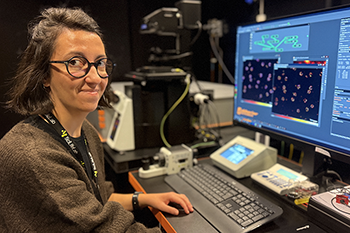
Two key experts at ALM support research projects using MINFLUX:
-
Hans Blom, researcher at KTH and SciLifeLab, holds a degree in Engineering Physics from Uppsala University and earned his PhD at KTH and Karolinska Institutet. After a postdoc in Stefan Hell’s group, where he contributed to Nobel Prize-winning STED microscopy, Hans has led the development of advanced light microscopy at SciLifeLab since 2011.
-
Ana Agostinho, a specialist in super-resolution microscopy, has a background in cell biology from Portugal and earned her PhD at the University of Dundee. She has applied advanced microscopy in genetic studies and now plays a central role at ALM, supporting projects that utilize MINFLUX.
Text: Jelina Khoo