
Developing the Marcus Wallenberg Laboratory for the Future

The Marcus Wallenberg Laboratory (MWL) at KTH Royal Institute of Technology is being developed to meet future needs in sound and vibration research. Through the modernization of its laboratory facilities, including a new modular anechoic chamber and a larger reverberation room, the laboratory will enhance opportunities for advanced research, education, and collaboration. Building on nearly 50 years of excellence in engineering acoustics, the initiative will also create new opportunities for student projects, research partnerships, and collaboration with SCI MakerSpace.
Professor Susann Boij and her colleagues are developing the Marcus Wallenberg Laboratory for Sound and Vibration Research (MWL) at KTH to create a more flexible and future-ready environment for research and education in sound, vibrations, and engineering acoustics.
As part of this initiative, parts of the laboratory are being rebuilt to meet both current and future research and teaching needs. The existing anechoic chamber will be converted into a larger reverberation room, enabling advanced measurements of the acoustic properties of sound-absorbing materials across a wide frequency range. At the same time, a new modular anechoic chamber will be acquired, allowing researchers to adapt the measurement environment to different experiments and research questions.
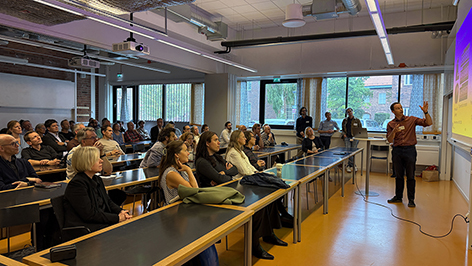
Colleagues and partners visited the Marcus Wallenberg Laboratory to gain insight into the ongoing refurbishment and the facility’s future development plans. The programme also included a look back at the laboratory’s long history and its significant contribution to the advancement of engineering acoustics at KTH.
Nearly 50 Years of Acoustics Research
The Marcus Wallenberg Laboratory has been a cornerstone of engineering acoustics research at KTH for almost 50 years. Its history dates back to the establishment of engineering acoustics as a discipline at KTH in 1977 and the creation of the Marcus Wallenberg Professorship in Engineering Acoustics, supported by a donation from Atlas Copco. Over the decades, MWL has developed into a leading research environment for acoustics, noise, vibrations, and experimental methods.
Visitors were also given the opportunity to tour the laboratory’s well-known anechoic and reverberation rooms while learning more about MWL’s history and its role in advancing sound and vibration research at KTH.
“We are optimizing our facilities to better meet today’s needs. At the same time, we are strengthening our ability to conduct research in engineering acoustics and carry out advanced measurements in environments tailored to different types of sound and vibration experiments,” says Susann Boij.
The upgraded facility will support research on the absorption and transmission of sound and vibrations in new materials and flowing media, as well as sound generation and noise reduction in a variety of environments, both in the laboratory and in the field. The refurbishment will also create new opportunities for student projects, laboratory courses, and research collaborations.
As part of the changes, space will also be made available for KTH Makerspace, creating new opportunities for collaboration between research, education, and hands-on innovation.
The development of the laboratory marks an important step in the continued advancement of KTH’s research environment for sound and vibration studies and lays the foundation for the next generation of research in engineering acoustics at MWL.