MSc Architectural Lighting Design
Light shapes how people experience interior spaces, buildings and urban environments. In the master's programme in Architectural Lighting Design, you explore how natural and artificial light influence human behaviour, comfort and health, and how lighting design can support environmental, social and economic sustainability. At KTH, teaching is linked to lighting research, laboratory work and industry collaboration. Career paths include lighting design, architectural practices and consultancy.

Architectural Lighting Design at KTH
The master's programme in Architectural Lighting design offers a unique approach to light and lighting planning: a combination of visual, physical, and biological-based experience and knowledge applied to design, technology, and health. It provides an in-depth understanding of the field through scientific expertise and practical experience in artificial light and daylight. The programme gradually moves from foundational studies of light, perception and human behaviour towards more advanced applications in indoor and outdoor environments, scientific analysis and independent project work. Graduates from the programme can apply advanced knowledge in lighting design in both practical and academic contexts.
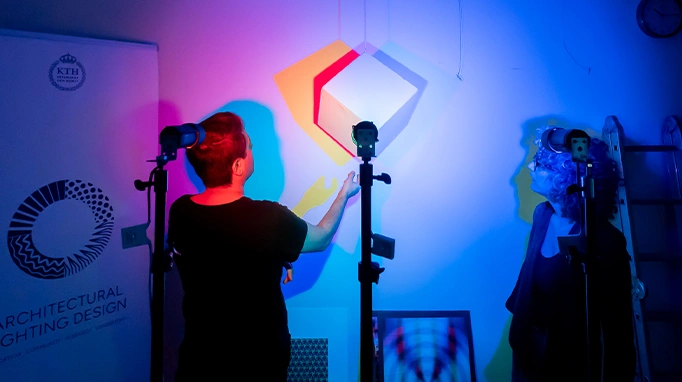
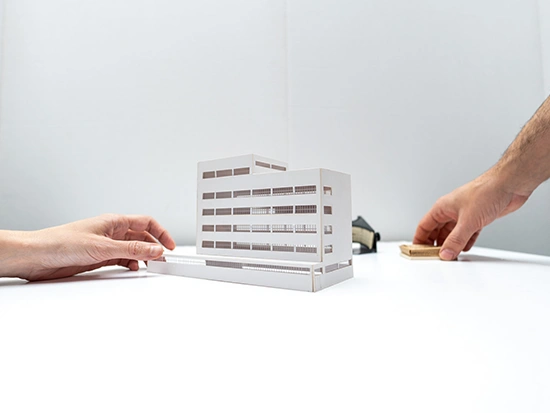
The programme combines theory and practice through lectures, workshops, discussions, laboratory sessions and individual and group design assignments. You work with prototypes, mock-ups and full-scale studies to explore how light behaves in architectural settings, and develop your design proposals through case-based work, presentations and study visits in and around Stockholm. Guest lectures by Swedish and international lighting designers, architects and researchers bring professional and research perspectives to your studies.
The programme is developed by the Lighting Design Division, one of five divisions of the Department of Architecture at the School of Architecture and the Built Environment at KTH. The Lighting Design Division, along with education, conducts several research projects that involve students collaborating with companies and other institutions. The division also organises events to connect academia with businesses and research institutions on specific topics, such as the annual Light Week, a collaboration with the Swedish Energy Agency. Since 2010, the division has organised the Light Symposium, a two-day international event focused on light and health, partnering with the universities of Wismar, Aalborg and South-Eastern Norway. The event was hosted at KTH in 2010, 2015, 2018 and 2023.
This is a full-time one-year programme (60 ECTS credits) taught in English. It consists of four courses and a master's degree project that you will conduct at the end of the second semester. The courses and the degree project are scheduled in a continuous sequence, with no elective courses. Each course requires 100 % study pace, which correspond to 40 hours per week. Graduates are awarded the degree of Master of Science. The programme is primarily delivered at KTH Campus by the School of Architecture and Built Environment, and includes a series of study visits and workshops in and around Stockholm.
Light and Humans
The programme begins with the course in Light and Humans (9 ECTS credits). You will explore the relationship between light and humans, which is mediated by physical space. Knowledge of light qualities, sources, materials, and cultural and human aspects is combined with experience from the design process. After this course, you will be able to develop a comprehensive site-specific lighting design proposal, following a design method that considers social and human factors.
Light and Space – outdoor
The following course is Light and Space – outdoor (12 ECTS credits). This course focuses on the relationship between light and outdoor environments, especially urban settings and their physical and cultural characteristics. It will enhance your understanding of the methodology, tools, concepts, and vocabulary associated with outdoor lighting processes. The design tasks conclude with full-scale, hands-on lighting installations, preparing you to address challenges such as ecological impact, social interactions, and integration within a specific urban identity.
Light and Science
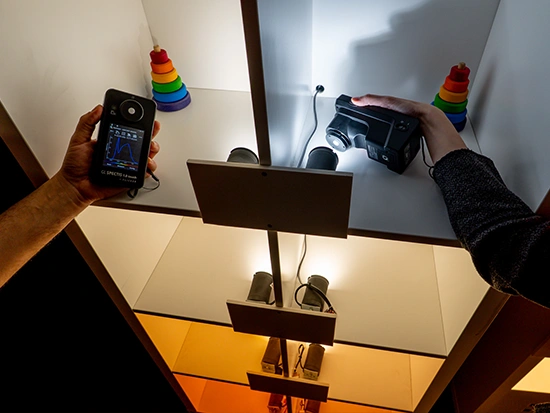
At the final course for the first semester, Light and Science (9 ECTS credits), you will further develop your theoretical knowledge about light. You will focus on its relationship to space and humans through discussions between fellow students and researchers in the field, lectures, experimental sessions and study visits. You will gain the ability to analyse lighting conditions methodologically by understanding the visual and physical concepts of light. You will analyse real lighting environments using both light measuring instruments and user-oriented observation methods.
Light and Space – indoor
In the course Light and Space – indoor (15 ECTS credits), you will explore how daylight and artificial lighting shape indoor environments from both functional and experiential perspectives. The course combines lighting technology, spatial theory, visual ergonomics and sustainability through design projects based on real-life scenarios. You will develop practical skills in lighting design, planning, calculations and visual presentation while learning how to create indoor lighting solutions that respond to human needs, spatial qualities and environmental considerations.
Degree project
The programme concludes with a degree project designed to answer a specific research question, whether theoretically or practically. The focus is chosen from a wide variety of topics within the field of architectural lighting design, promoting sustainable development within the built environment. Theoretical papers with a strong focus on social and ecological sustainability about light and health, light and time, urban lighting, perception and information, as well as practical projects with a theoretical frame in rural lighting and interactive lighting design, are a few examples of previous degree projects. Throughout the years, graduates of the master's programme in Architectural Lighting Design have consistently been awarded national and international research funding and scholarships to support the development of their degree projects. These were submitted and awarded at international conferences.
Courses in the programme
The courses in the programme cover topics such as lighting design, architecture, well-being, sustainability, perception, psychophysical studies, quantitative and qualitative approaches, lighting laboratory and user-oriented approach.
Courses in the master's programme in Architectural Lighting Design


Future and career
Lighting is a rapidly evolving field of knowledge. In recent years, there has been a growing demand for lighting design expertise as lighting designers understand the role of light and lighting in architecture, interior spaces and urban environments. From this role you may add substantial value to a project by enhancing visual performance, energy efficiency, sustainability, safety, well-being and health. There are plentiful job opportunities on an international level for architects, designers and engineers with lighting design competence.
As a graduate, you primarily work in lighting design or architectural studios or as self-employed consultants. Employers might also be construction companies, lighting manufacturers and public, including policy making, or private operators. After your studies, you may also pursue doctoral studies at KTH or other national or international universities.




Sustainable development
Graduates from KTH have the knowledge and tools for moving society in a more sustainable direction, as sustainable development is an integral part of all programmes. The three key sustainable development goals addressed by the master's programme in Architectural Lighting Design are:


Architectural Lighting Design plays a crucial role in the holistic concept of sustainability, influencing productivity, sociability, safety, orientation, and human health, while also being a significant energy consumer. Sustainable lighting design seeks to balance visual and biological needs with minimal environmental impact, addressing both indoor and outdoor contexts, while exploring off-grid solutions that drive innovation in energy use and conservation
The programme integrates sustainability across social, cultural, economic, and environmental dimensions. You will gain the ability to identify and quantify the sustainability impacts of lighting design projects and will be trained to apply ethical and professional responsibility in scientific and technical decision-making. Courses foster a human-centred approach that considers the social implications of urban lighting, promotes collaborative planning processes, and emphasises light’s influence on health and well-being.
You also develop practical skills in analysing energy consumption, designing effective control strategies, and evaluating the economic viability of lighting installations. Evidence from research and practice underscores that lighting solutions grounded in a deep understanding of context, users, and technology lead to designs that are both economically sustainable and beneficial to human health. Through this comprehensive approach, graduates are well-prepared to contribute to sustainable cities and communities, responsible production and consumption, and the promotion of good health and well-being, aligning directly with several key UN Sustainable Development Goals.
Faculty and research
The Division of Architectural Lighting Design is responsible for the master's programme and conducts education and research on how light and darkness shape architectural spaces and affect human perception, behaviour, health and well-being. Its interdisciplinary approach brings together architecture and design with lighting technology, psychology, medicine, ergonomics, media and art. Research addresses both daylight and artificial light in indoor and outdoor environments, with particular attention to human-centred design and environmental, social and economic sustainability.
Lighting Design Lab
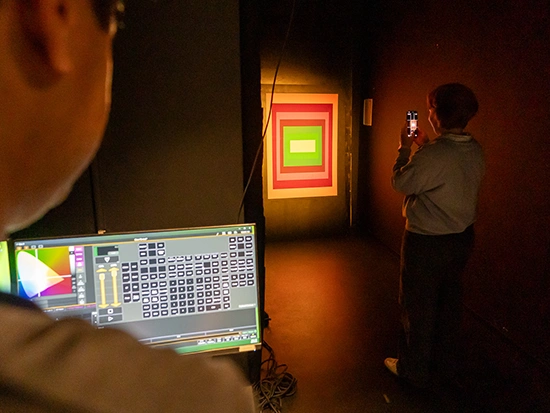
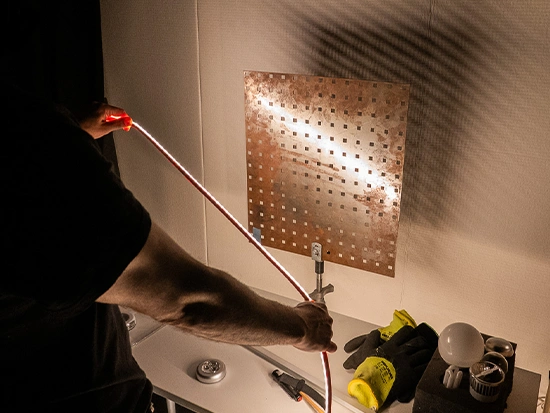
The division's Lighting Design Laboratory provides a dedicated environment for teaching, research and experimentation. In the lab, you explore and evaluate lighting concepts through experiments, prototypes, mock-ups and full-scale studies involving both daylight and artificial light. This allows you to combine practical design work with light measurements and user-oriented observation, and to examine how different lighting conditions affect people and architectural spaces.
Faculty involved in the programme