
Lisa
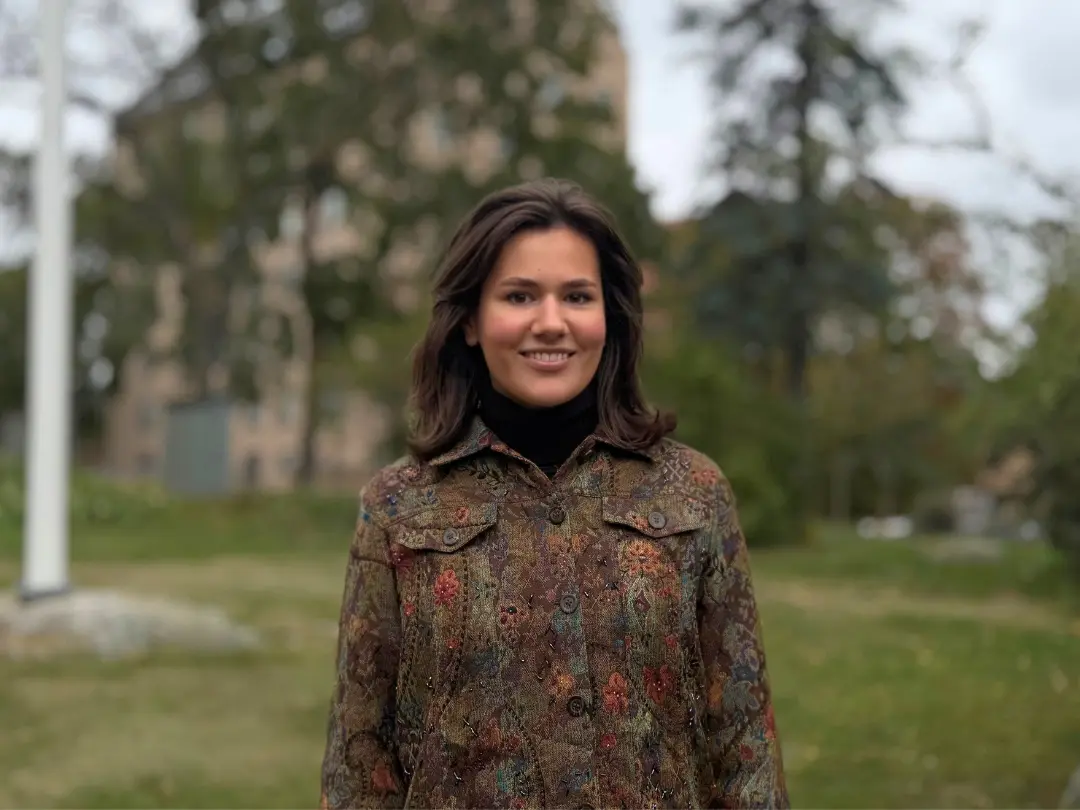
Lisa is from Austria and holds a bachelor‘s degree in Molecular Biotechnology from Hochschule Campus Wien University of Applied Sciences. She is particularly interested in how basic research is translated to real-world applications. In addition to her love for science, she enjoys playing the piano, taking part in sports, and exploring the arts.
Why did you choose this master’s programme at KTH?
My background is in biotechnology and the life sciences, but during my bachelor’s studies, I became more and more interested in computational approaches. I knew I wanted to develop strong quantitative skills without giving up the biological and medical side.
I looked at a lot of master's programmes across Europe, but most of the data science, machine learning or computational biology programmes expect you to already have a solid computational background. I find that this programme works well for someone coming from biotechnology or biochemistry who wants to move in that direction. The first two courses give you a solid foundation in the computational and mathematical basics, and from there you can build up to more advanced topics.
I also like the flexibility of the programme. We can choose elective courses, which gives us the freedom to follow our own more specific interests. Depending on people's background, someone with an engineering degree might lean into a more biology-heavy focus, while I'd lean more computational.
What do you want to do after graduating?
After graduating, I would like to pursue a PhD in either biophysics or computational biology. My long-term dream is to eventually have my own research lab, where I can combine experimental and computational approaches to study biological processes from a systems-level perspective.
At the same time, I would like my research to have an impact beyond academia. I am very interested in technology transfer and the connection between research and industry, although I don’t have a concrete vision yet of what that will look like for me. I am still exploring different possibilities, and I am sure that being at KTH and meeting people with very different backgrounds and career paths will give me a lot of inspiration along the way.
How do studies at KTH differ from your previous studies?
During my bachelor’s studies, lectures were generally delivered in a more rigid and traditional format. So far at KTH, I have found the teaching style to be much more interactive and engaging. The courses are clearly structured, and the final grade is typically based on several components, such as assignments, labs, projects, class participation, and quizzes. I like the way questions and problems are framed. Professors want us to understand the material conceptually instead of just memorising formulas. There is a strong emphasis on critical thinking and applying what we learn. This way classes are a lot of fun!!
How is student life in Stockholm?
There are many student-run associations and clubs, whether you enjoy playing chess, want to join a sports club, or even help build rockets or satellites. I like that there are so many opportunities to try something completely different from what you study.
For international students, the international reception at the beginning of the semester is also a great way to meet people. There are lots of events during the first weeks, and it makes settling into a new city much easier.
Stockholm itself is also very international and welcoming. Almost everyone speaks English, so it is easy to get around and meet people even if you don’t speak Swedish yet. At the same time, there are opportunities to learn Swedish, which I think is a nice way to get to know the culture better. I also enjoy how easy it is to have both city life and nature here. You can explore the city, go to museums or cafés, but you are also never far from the water, forests and parks. Personally, the Nobel Prize Museum is one of my favourites!!
What would you like to say to students thinking of choosing KTH for master’s studies?
I love that KTH is very interdisciplinary. I meet people from completely different fields, and I enjoy hearing about what they are working on. Sometimes a conversation with someone who thinks about problems very differently makes me look at my own research and interests in a different way. I also find it fun to learn about things that have nothing to do with my own programme. There is so much interesting work going on at KTH, and I think being surrounded by that is a big part of the experience.