The fifth wireless innovation workshop highlighted the area of sustainability. 26 participants attended the half-day workshop, engaging with a diverse group of speakers who provided multi-faceted perspectives on how to reconcile the growing demands of wireless connectivity with environmental responsibility.
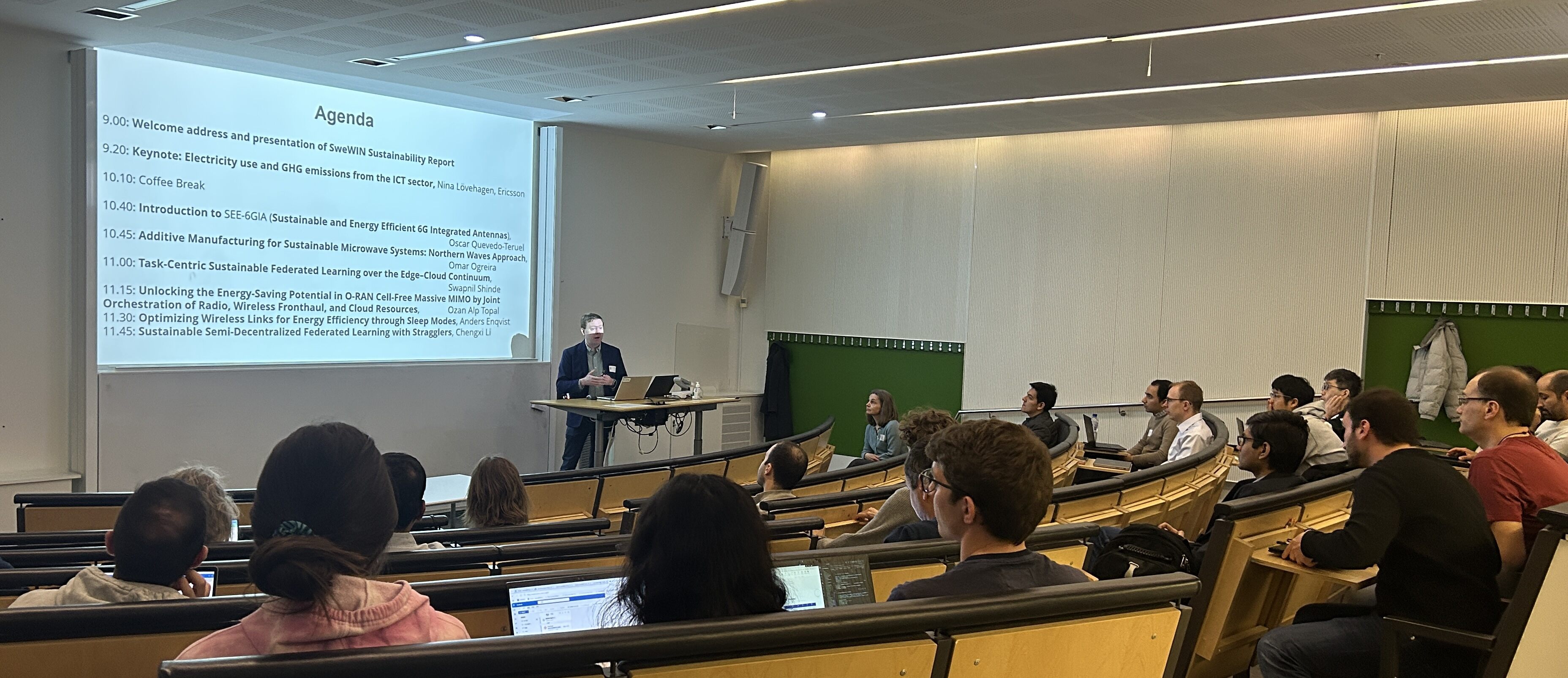
Emil Björnson, SweWIN’s director sharing about the center’s sustainability
On April 14, 2026, SweWIN hosted its fifth workshop (09:00 – 12:00) at KTH Campus (Room Q2, Malvinas väg 10), bringing together speakers from KTH, Ericsson, and Northern Waves to explore the intersection of 6G development and green technology. The session opened with a welcome address and the presentation of the SweWIN Sustainability Report by Center Director Emil Björnson. The keynote, delivered by Nina Lövehagen from Ericsson, provided a comprehensive overview of the ICT sector’s global footprint, detailing electricity consumption and greenhouse gas emissions across networks and data centers. In particular, she emphasized the industry’s ambitious reduction targets and the specific challenges posed by the rising demand for AI.
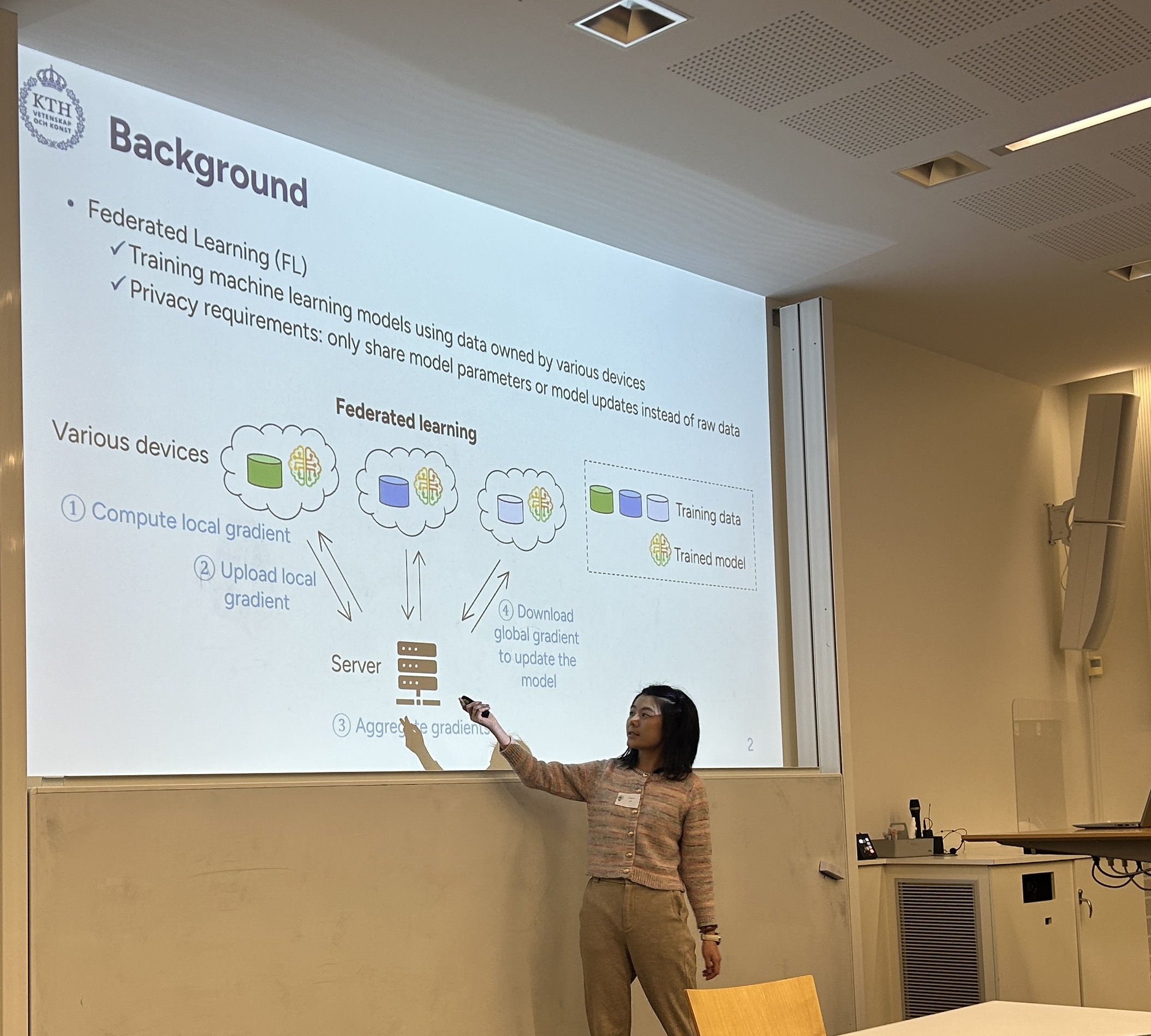
Following the keynote, the technical sessions showcased a broad spectrum of research dedicated to resource efficiency. Presentations covered structural innovations such as additive manufacturing for sustainable microwave components and the energy-saving potential of joint orchestration in O-RAN Cell-Free Massive MIMO networks. Significant attention was also given to algorithmic sustainability, including task-centric federated learning across the edge-cloud continuum, the optimization of wireless links through advanced hardware sleep modes, and communication-efficient methods for semi-decentralized learning. The workshop demonstrated that achieving a sustainable 6G ecosystem requires a holistic approach, spanning from physical hardware manufacturing to intelligent resource management and decentralized machine learning protocols.
Electricity use and GHG emissions from the ICT sector
Nina Lövehagen
Abstract: The Information and Communication Technology (ICT) sector has gained attention in the discussions on climate change, as it could impact global emissions both positively and negatively. The current use stage electricity consumption and the sector’s total lifecycle greenhouse gas (GHG) emissions, divided into networks, data centers and user devices also including internet-of-things, will be presented. In recent years the ICT sector has been stable in using about 4% of the global electricity in the use stage and has represented about 1.4% of the global GHG emissions. However, the electricity use is increasing, especially for data centers, partly due to growing demand for artificial intelligence. Ericsson has conducted sector wide studies since 2007, enabling the development of forecasts. The ICT sector’s electricity use and GHG emissions will also be compared to the closely related areas Entertainment and Media (including e.g., TVs), paper media, and cryptocurrencies. Future developments are influenced by many parameters which allows for the modelling of a multitude of scenarios. Large parts of the industry have set ambitious targets (including Ericsson) for GHG emission reductions and examples will be given of Ericsson’s activities in reducing the GHG emissions related to its products and activities.
Additive Manufacturing for Sustainable Microwave Systems: Northern Waves Approach
Omar Orgeira
Abstract: Additive manufacturing is emerging as a key enabler for next-generation microwave and millimetre-wave systems, offering new opportunities in performance, integration, and sustainability. Monolithic RF architectures can reduce assembly steps, minimize material waste, and enable lightweight structures suitable for space, telecommunications, and advanced sensing applications. This talk presents the approach developed at Northern Waves, where metal additive manufacturing is used to design and produce high-frequency components that combine strong electromagnetic performance with efficient, scalable manufacturing.
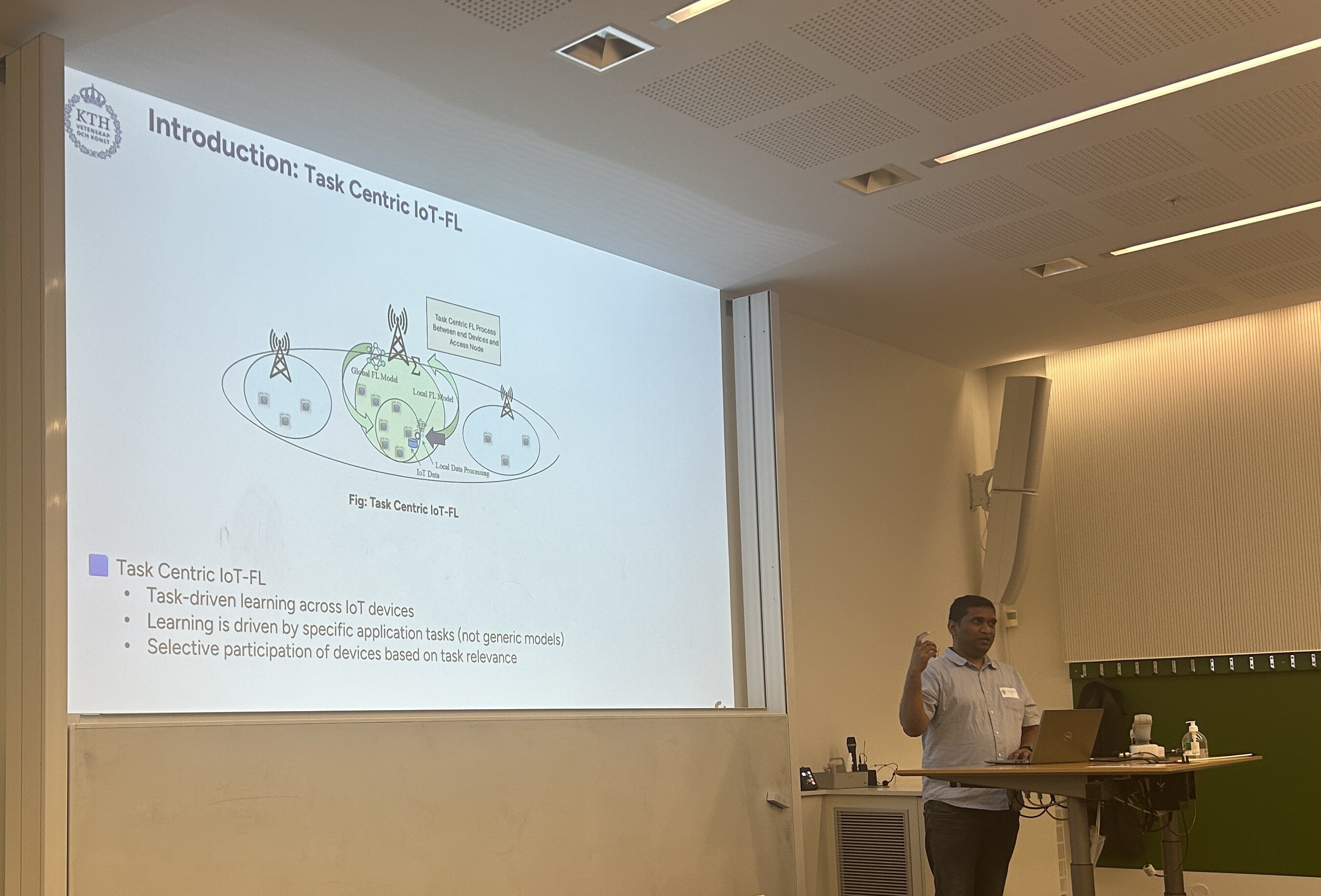
Task-Centric Sustainable Federated Learning over the Edge–Cloud Continuum
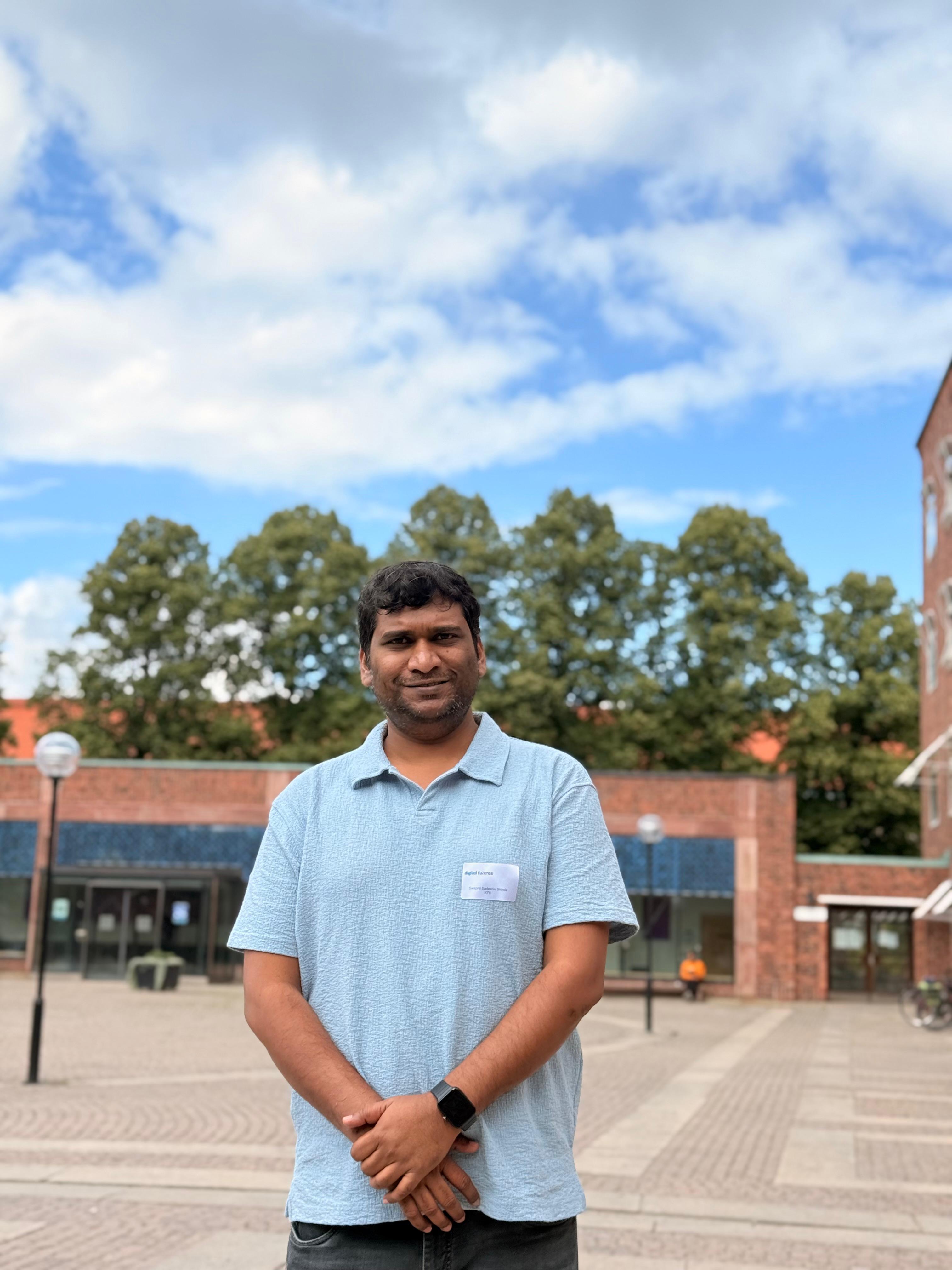
Swapnil Shinde
Abstract: Mobile Edge Computing (MEC), the Internet of Things (IoT), and distributed machine learning are key enablers of the fully connected, intelligent, and sustainable society envisioned for future 6G networks. In this context, edge-based, task-centric Federated Learning (FL), supported by MEC servers and IoT-generated data, is emerging as a promising paradigm to meet the stringent latency, energy efficiency, and intelligence requirements of next-generation services. However, training task-specific FL models directly on resource-constrained IoT devices remains a major challenge due to limited computation capabilities, communication overhead, and energy constraints.
In this talk, we present a task-centric federated learning framework that improves training efficiency by enabling adaptive model transfer across a distributed edge–cloud continuum. The framework models the overall FL cost, incorporating model discovery, data routing, and collaborative training processes. Based on this formulation, we define a constrained optimization problem that aims to jointly minimize latency and energy consumption, supporting more sustainable and resource-efficient learning across distributed edge infrastructures, by selectively transferring pre-trained FL models.
To address the resulting sequential and multi-objective decision-making problem, we formulate it as a Markov decision process (MDP) and develop a hierarchical multi-objective reinforcement learning (H-MORL) approach. The proposed solution explicitly captures the trade-offs among model search, transmission, the training process, and FL convergence.
Simulation results demonstrate that the proposed framework significantly reduces both training latency and energy consumption compared to baseline approaches, highlighting its potential as an efficient, scalable, and sustainability-aware solution for federated learning over the edge–cloud continuum in future 6G systems.
Unlocking the Energy-Saving Potential in O-RAN Cell-Free Massive MIMO by Joint Orchestration of Radio, Wireless Fronthaul, and Cloud Resources
Ozan Alp Topal
Abstract: Network virtualization and cloudification in Open Radio Access Networks (O-RAN) enable joint orchestration of the processing and fronthaul resources, which are essential for realizing the energy-saving potential of cell-free massive MIMO networks. To harness this potential, we investigate cell-free massive MIMO deployed over an O-RAN architecture with a wireless fronthaul that removes the need for fiber deployment. We first model the end-to-end power consumption under wireless fronthaul. Then, we propose a joint orchestration framework for radio, fronthaul, and processing resources that minimizes end-to-end power consumption while satisfying user-equipment (UE) rate requirements and wireless-fronthaul constraints. Distributing the same total number of antennas across the coverage area, rather than concentrating them at a few radio units (RUs), substantially reduces network power consumption, demonstrating that cell-free massive MIMO can deliver both high performance and high energy efficiency in future mobile networks.
Optimizing Wireless Links for Energy Efficiency through Sleep Modes
Anders Enqvist
Abstract: To mitigate the rising power consumption of base stations, we examine the energy efficiency of wireless links utilizing advanced sleep modes. We explore rush-to-sleep strategies, where the base station dynamically scales its hardware power consumption by transmitting at certain rates to exploit idle periods for sleeping. We provide algorithms for the joint optimization of transmit power, bandwidth, and the number of antennas across deep, and micro sleep modes. We also introduce a scheduling framework that dynamically manages a buffer of mixed packet sizes and stochastic packet arrivals with varying deadlines and we analyze when a base station should transition to a sleep mode in order to minimize the power consumption.
Sustainable Semi-Decentralized Federated Learning with Stragglers
Chengxi Li
Abstract: For federated learning (FL) systems with devices that have intermittent connectivity to the central server, often referred to as stragglers, semi-decentralized FL has emerged as a promising solution. In this paradigm, non-straggler devices can relay gradients computed by stragglers to the server, enabling the use of gradient coding (GC) to mitigate the negative impact of devices that fail to communicate directly with the server. However, applying GC in semi-decentralized FL introduces substantial communication overhead due to frequent information exchange among devices, making the approach less sustainable and more energy-intensive.
To address this challenge, this talk introduces COFFEE, a new communication-efficient semi-decentralized FL method. In COFFEE, devices exchange information by performing a limited number of steps toward communication-optimal exact consensus before transmitting to the server. This allows each device to obtain the average of its own gradient and those of its previous neighbours at minimal communication cost. As a result, COFFEE achieves the same learning performance as existing methods while significantly reducing communication overhead, thereby improving the sustainability of FL in practical scenarios.