Later this year, Janet Martin-Nielsen‘s new book, “A Few Acres of Ice: Environment, Sovereignty, and Grandeur in the French Antarctic” will be published by Cornell University Press. This book stems from the GRETPOL project which took place at KTH Stockholm and the University of Stavanger over the past three years.
Janet Martin-Nielsen
A Few Acres of Ice is an in-depth study of France’s complex relationship with the Antarctic, from the search for Terra australis by French navigators in the sixteenth century to France’s role today as one of seven states laying claim to part of the white continent. Martin-Nielsen focuses on environment, sovereignty, and science to reveal not only the political, commercial, and religious challenges of exploration, but also the interaction between environmental concerns in polar regions and the geopolitical realities of the twenty-first century. She details how France has worked (and, at times, not worked) to perform sovereignty in Terre Adeìlie, from the territory’s integration into France’s colonial empire to France’s integral role in making the environment matter in Antarctic politics. As a result, A Few Acres of Ice sheds light on how Terre Adeìlie has altered human perceptions and been constructed by human agency since (and even before) its discovery.
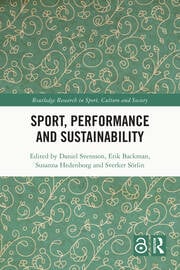
Is the strive for increasing performance and an ever-growing sports sector compatible with sustainable development? This is the key issue that the authors investigates in a new book: Sport, Performance and Sustainability, edited by Daniel Svensson, Erik Backman, Susanna Hedenborg and the Division’s Sverker Sörlin.
Sport, Performance and Sustainability examines the logic of “faster higher, and stronger” and the technoscientific revolution that has driven tremendous growth in the sports economy and in sport performance over the last 100 years.
The chapters provide valuable perspectives on the tensions between performance and sustainability. Co-authors include Sigmund Loland, Simon Beames, Itai Danielski, Andreas Isgren Karlsson, Jack Reed, Johan Carlsson, Isak Lidström, Bo Carlsson and Marie Larneby.
Sport, performance and Sustainability is publisehd by Routledge and written within MISTRA Sport and Outdoor – a research and collaboration programme to generate knowledge and solutions for increased sustainability in sport and outdoor recreation.
Erik Backman is an Associate Professor and Senior Lecturer in Pedagogy and Sport Sciences at the Department of Sport Sciences, School of Health and Welfare, Dalarna University, Sweden, and Associate Professor at the Department of Primary and Secondary Teacher Education, Faculty of Education and International Studies, Oslo Metropolitan University, Norway.
Susanna Hedenborg is a Professor in Sport Sciences at Malmö University, Sweden, and the President of the Swedish Research Council for Sport Science.
Sverker Sörlin is a Professor of Environmental History at the Division and a co-founder of the KTH Environmental Humanities Laboratory.
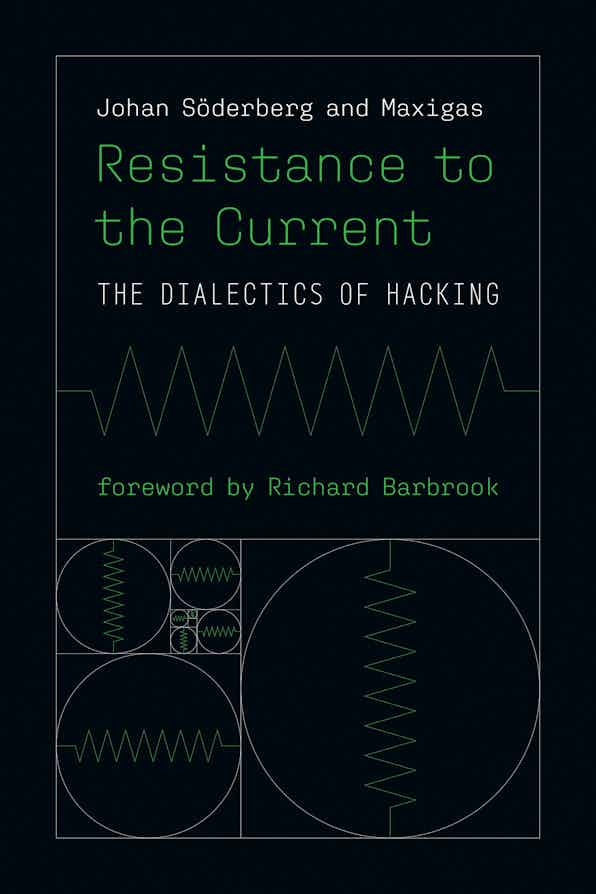
As part of the division’s Higher Seminar schedule for the upcoming spring term, Associate Professor in the Department of Philosophy, Linguistics and Theory of Science at Göteborg University Johan Söderberg will present his new book “Resistance to the Current. The Dialectics of Hacking” (MIT Press, Nov. 2022). Together with his co-author Maxigas, Senior Lecturer in the Department of Media at Amsterdam University, our visitor investigated four historical case studies of hacker movements and their role in shaping a connected 21st century society.
Johan will visit us on 30 January, presenting at the higher seminar at 1.15-2.45pm, Stockholm time. The event is hosted in the seminar room at the division (Teknikringen 74 D, level 5). If you are interested, please come by and visit us!
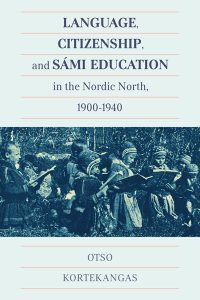
Otso Kortekangas, postdoc at the division, has written a new book. In “Language, Citizenship, and Sámi Education in the Nordic North, 1900-1940” Otso investigates how Sámi people were affected by nation state education doctrines in Finland’s, Norway’s and Sweden’s North.
One important part of the political context in the genesis of this book is the announcement of the Finnish government to form a Truth and Reconciliation Commission in 2019. Its task is to investigate, showcase and discuss injustice and oppression done by the Finnish state towards the Sámi, with the aim of reconciliation and a better future.
The year 2021 will witness the start of the work of a Sámi Truth and Reconciliation Commission (TRC) in Finland. A TRC is already working in Norway, and in Sweden, the planning for a Sámi TRC is under way. The main aim of the TRCs in each country is to review and assess earlier governmental policies targeting the indigenous Sámi population in Norway, Finland and Sweden, make Sámi voices and experiences visible, and to point toward ways forward.
Differently from the Canadian TRC (2008–2015) that focused on indigenous education and residential schools, the Nordic Sámi TRCs will take a comprehensive approach to historical policies targeting the Sámi and, in the case of Norway, the Finnish-speaking Kven minority. However, governmental educational policies will be a very important theme for the commissions to investigate, as assimilation and segregation applied in education is one of the external forces that have molded Sámi culture the most during the 20th century.
As elucidated in my book Language, Citizenship, and Sámi Education in the Nordic North, 1900-1940 (MQUP 2021), different educational actors had different approaches. Sámi education was traditionally organized by the Lutheran churches in each country. The high priority the Lutheran dogma ascribes to the intelligibility of the gospel and Christianity education by large entailed that Sámi language varieties were in use as languages of instruction in many schools with Sámi pupils in the Nordic north. Gradually, the governments of Norway, Sweden, and Finland took over the responsibility for elementary education from the church around the turn of the century 1900. The governmental educational authorities and politicians downgraded the importance of Sámi language in education, as quality of education and the mastering of each country’s majority language became paramount educational aims. In Norway and Finland, assimilation to the majority population was the norm in the governmental elementary schools, with certain exceptions. The nomadic reindeer herding Sámi in Sweden’s mountain regions were de jure separated to their own group, with the obligation to place their children in specific schools. These so called nomad schools were designed after the idealized notion Swedish elementary authorities had on the “true” Sámi way of life and efficient reindeer herding.
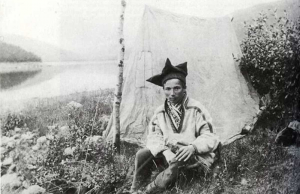
Sámi poet and teacher Pedar Jalvi in 1905. Credit: Armas Launis. Copyright: CC BY SA 4.0.
The educational reforms of the early twentieth century that led, in many individual cases, to the tragic loss of Sámi language, had a brighter side, as well. As in many other instances of minority education, the skills and knowledge Sámi pupils gained in the schools had, at least in some cases, an empowering function. Most of the powerhouses spearheading the early and mid-twentieth century Sámi cultural movements and the Sámi opposition to government policies were teachers, educated at schools and on teachers’ training courses to navigate both the Sámi and the majority culture contexts. These teachers were pioneers of promoting Sámi culture as an active, independent culture that existed alongside and independent of other Nordic cultures and states.
While the TRCs in each country are paramount for the future relations of the Sámi and the majority populations, it is important to keep in mind that the Sámi existed and exist also outside of the frame and borders of each of the three nation states. There is a certain risk of nationalization and further minoritization of the Sámi in Norway, Sweden and Finland if the various Sámi groups are always first and foremost treated as a national minority rather than a transnational population. It is critical that this historical transnational fact, together with the diversity of voices and perspectives within Sámi education, are included in the work of the TRCs in each country. Only by so doing will it be possible to reproduce a rightful picture of historical events as a base for future reconciliation processes.
If you are interested in reading more, check out Otso’s book here.