MSc Interactive Media Technology
The master's programme in Interactive Media Technology provides skills and knowledge in designing, developing and evaluating interactive products and media. You will explore topics related to human-computer interaction, user experience, and sonic and visual media. We encourage students to work on projects that matter to them and respond to societal challenges. Graduates are experts in industry and academia, and some start their own companies.
Interactive Media Technology at KTH
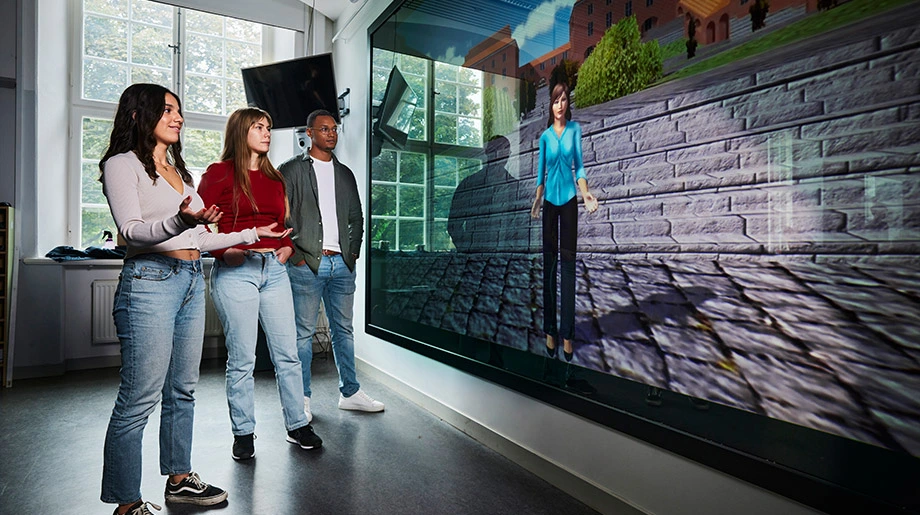
Interactive media technologies shape many aspects of everyday life. We use interactive media technology to support play, create and maintain social relationships, express ourselves, and coordinate and complete work tasks.
This master's programme equips you with the necessary skills and knowledge to participate in the digital economy. It emphasises developing future designers and engineers in the theories, processes, and techniques central to designing, developing, and evaluating interactive media technologies within society. Throughout the programme, you develop a toolbox of methods to support this work, gain expertise in theoretical perspectives that inform technology design, and learn critical approaches to address the challenges facing our future society and ensure your work positively impacts the world around you.
The programme teaches knowledge and skills from computer science, media technology, human-computer interaction and interaction design. You will take mandatory courses in research methods, foundations in media technology and interaction design, and human perception. These courses provide a broad base of knowledge and skills that you can then deepen by focusing on, for example, user experience, sound and music computing, interaction design, or user-centred software development.
The programme engages with the industry through study visits, guest lectures, and dissertation projects. Recent industrial collaborators in our teaching include Spotify, Scania, Google and Epic Games. For example, one industrial collaborator challenged students to design new ways to use AI and user behaviour data to improve the way digital content is recommended and presented to customers. Students then presented their concepts and received feedback directly from the company. Activities like these help students to build networks with industry in Sweden, understand more about what work looks like in different industries, as well as learn how to improve their design skills.
KTH is one of Europe’s leading environments for interaction design, sound and music computing, and media technology research. Here, you develop strong technical and design skills while learning to apply critical perspectives on technology development and use. The programme has close connections to ongoing research, giving you the opportunity to learn from and interact with leading researchers in these fields.
This is a two year programme (120 ECTS credits) given in English. Graduates are awarded the degree of Master of Science. The programme is given mainly at KTH Campus in Stockholm by the School of Electrical Engineering and Computer Science (at KTH).
Programme structure and progression
During the first year, you build a foundation in interactive media technology through mandatory courses in media technology and interaction design, human perception, sustainability and research methods. Programme-integrating activities and research seminars run throughout the programme.
From the second semester onwards, you shape your own profile through elective courses. The programme offers considerable flexibility, allowing you to tailor your studies according to your interests and combine courses from different areas of Interactive Media Technology. The programme concludes with a degree project carried out during the final semester in an academic or industrial environment.
Courses in the programme
The courses in the programme cover topics such as Interaction design, physical computing, sound and music computing, graphics and visualisation, social and collaborative computing, multimodal interaction, haptic and tangible interaction, evaluation of interactive systems, and sustainable and critical approaches to technology development.
Courses in the master's programme in Interactive Media Technology


Future and career
After graduation, you can pursue a career as a developer, technical lead, interaction designer, UX engineer, product or project manager in IT and media industries. You can also pursue a career in industrial research or continue your studies toward a doctoral degree. Some recent graduates have pursued doctoral studies internationally at Université Paris-Saclay and IT University of Copenhagen, or in Sweden at Stockholm University and Umeå University.
Former students have found work at companies such as Spotify, DICE, Skype, Netlight Consulting, Tobii, and Voddler. Among our graduates are several founders of companies in the media and IT sectors, including Prezi and SoundCloud, as well as several successful consultancy firms, such as Prototyp and Ocean Observations. Graduates will also be well-positioned to work in emerging fields such as immersive VR/AR experiences, AI-assisted creativity, or multimodal interaction in smart environments.




Sustainable development
Graduates from KTH have the knowledge and tools for moving society in a more sustainable direction, as sustainable development is an integral part of all programmes. The three key sustainable development goals addressed by the master's programme in Interactive Media Technology are:



Good Health and Well-being
You explore how interactive technologies can be adapted to people with physical or cognitive impairments and how interaction design can support participation, accessibility and quality of life. Through your studies, you develop the skills needed to create technologies that are inclusive and accessible to diverse user groups.
Gender Equality
You examine how technologies and digital services affect different user groups and how design choices can reinforce or reduce inequalities. You learn to identify biases in existing technologies and develop more inclusive and empowering interactive experiences.
Responsible Consumption and Production
You learn to critically assess the environmental impact of interactive media technologies and develop solutions that support more sustainable behaviours. For example, you may design visualisations that help people understand complex data on CO₂ emissions, energy use, or food waste, and explore how digital technologies can contribute to more sustainable patterns of consumption and resource use.
Faculty and research
The programme is given by the School of Electrical Engineering and Computer Science. The school conducts research and education in electrical engineering, computer science, and information and communication technology. Faculty involved in the programme mainly belong to the Division of Media Technology and Interaction Design or the Division of Computational Science and Technology and work on a broad range of research topics.
The programme is hosted by Media Technology and Interaction Design division. It is a lively research community which research expertise across a number of topics, including:
- Interaction Design
- Sustainability
- Sound and Music Computing
- Technology Enhanced Learning
- SPACE - Social, Physical and Cultural Environments
- Creative Media Technology
- Media Lab
Faculty involved in the programme





Facilities
The department has access to several research and teaching facilities where students and researchers can work on both work-related and private projects.
The Division of Media Technology and Interaction Design manages four research environments: Multisensory Studio, MIDDLA, Haptic Lab and KTH's R1 (reactor hall) .
The Division of Computational Science and Technology manages three large research environments: PDC Center for High Performance Computing, SciLifeLab and the VIC Visualization Studio . The VIC studio in particular is used by both researchers and students within the programme.