
Francisco Beltran's Final Pre-Defence Paper on Solar PVT for Urban Heating
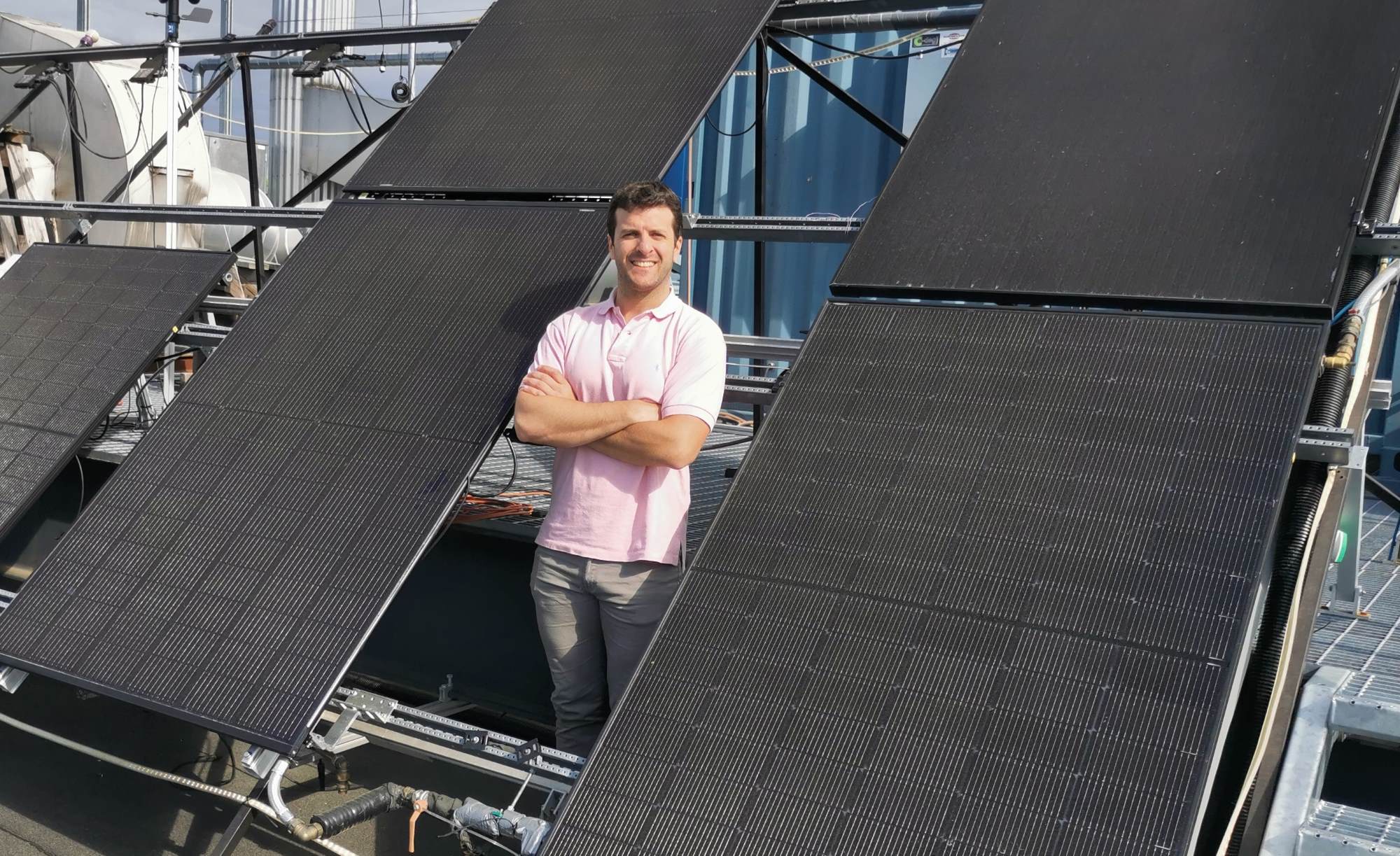
How do you deploy clean, quiet heating in dense cities with almost no available land?
That’s the challenge tackled in a new study by Francisco Beltran, PhD researcher at the department of Applied Thermodynamics and Refrigeration, Energy Technology, KTH.
Francisco's newly published paper shows that solar PVT panels – producing both electricity and heat – can make ground-source heat pumps viable even when a building has space for only about one third of a typical borehole field. By sending solar heat back into the ground, the PVT array effectively “pre-warms” the subsurface, boosting efficiency and lowering long-term costs. Think of it as warming a thermos before pouring in the coffee.
What the study found:
Francisco Beltran evaluated a wide range of collector designs, field sizes, hydraulic strategies, and electricity tariff structures. The results provide clear, practical guidance:
-
Unglazed collectors performed best, regardless of absorber material or geometry; glazed collectors should be avoided.
-
Around 60 m² of finned aluminum PVT (similar to today’s DualSun design) offered the strongest techno-economic performance.
-
In some cases, just ~24 m² was enough to cut peak electricity demand by around 10%.
-
High flow rates (~80 l/h·m²) improved efficiency and reduced system cost.
-
Capacity-based tariffs lowered annual cost by 4–6%.
-
Compared with alternatives, the PVT-assisted GSHP system was:
-
23% cheaper than district heating
-
11% cheaper than an air-source heat pump
-
4% cheaper than PV-assisted GSHP without thermal harvesting
-
In densely built districts where drilling space is scarce and noise restrictions are strict, traditional heat-pump solutions often fall short. This research shows that solar PVT, borehole storage, and ground-source heat pumps can work together to create heating systems that are cleaner, quieter, and more cost-effective than the alternatives — even under severe land constraints.
The paper, “Cutting peaks and costs: Techno-economic design guidelines for solar PVT and GSHP in land-constrained multi-family buildings,” is now published in Energy Conversion & Management.
It is the final scientific article in Francisco Beltran’s doctoral work, with thesis defense planned for spring 2026.
Co-authors and supervisors: Nelson Sommerfeldt and Hatef Madani.
Full-text article published here: Cutting peaks and costs: Techno-economic design guidelines for solar PVT and GSHP in land-constrained multi-family buildings - ScienceDirect