
Towards Zero-Waste: Sweden–India Project Shares Early Insights on Circular Bio-Waste Solutions
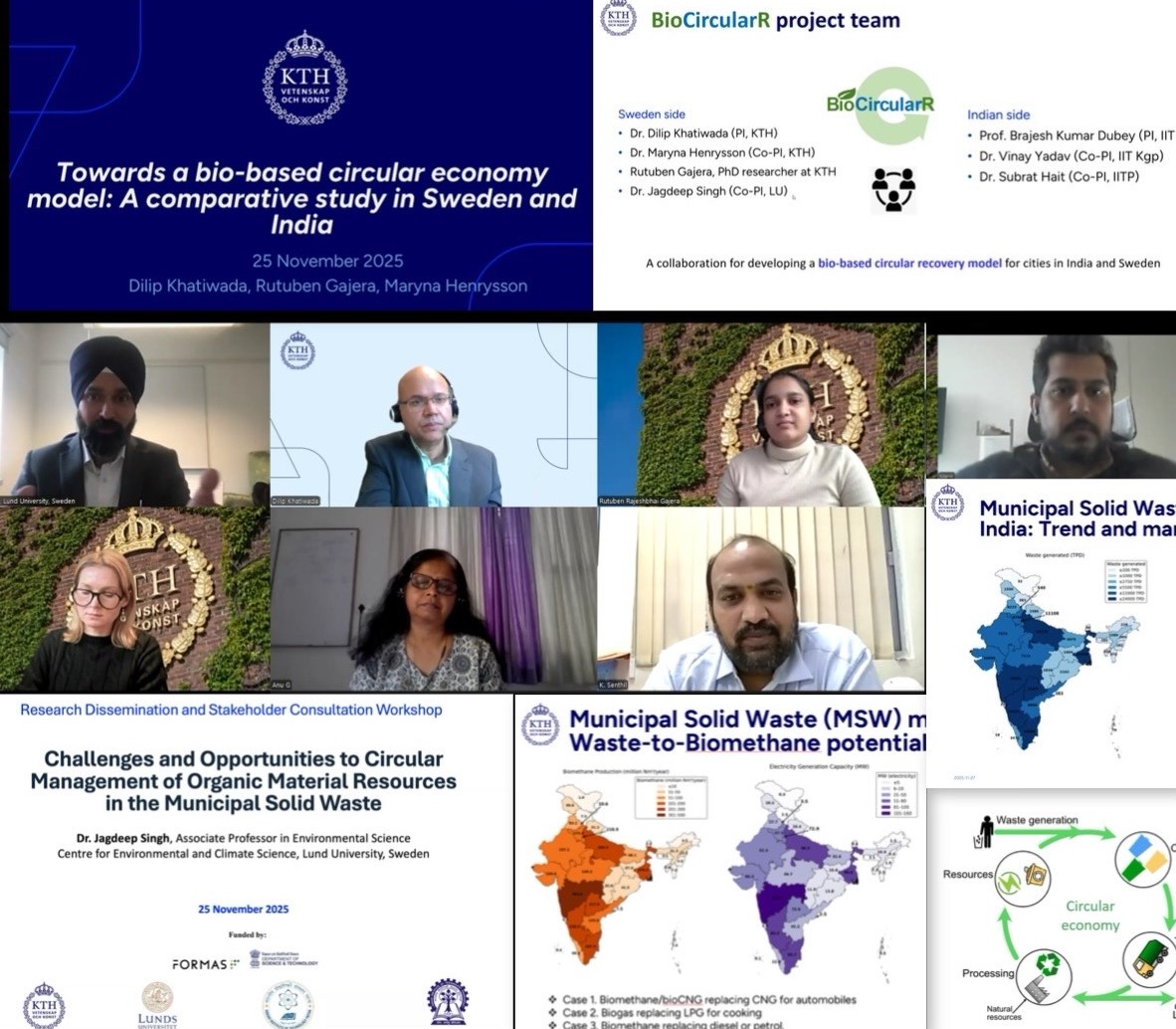
On 25 November 2025, researchers and stakeholders from Sweden and India gathered for a joint dissemination and consultation workshop under the project Towards Zero-Waste through a Bio-based Circular Recovery Model (BioCircularR).
The initiative, funded by Formas and India’s Department of Science and Technology, brings together the Indian Institutes of Technology (IIT) Kharagpur and Patna, Lund University, and KTH Royal Institute of Technology to address one of the most persistent challenges of rapidly urbanising societies: how to manage growing volumes of municipal solid waste without locking cities into linear, high-emission pathways.
Urban centres now generate roughly two billion tonnes of waste each year, with a third of it handled in ways that fall short of environmental standards. The traditional “take–make–use–dispose” model is proving untenable. Against this backdrop, the project aims to develop a circular recovery model for managing the organic fraction of municipal solid waste, combining technology assessment, scenario modelling, and policy analysis across Swedish and Indian contexts. Bringing these two settings together is essential: Sweden offers mature infrastructure and regulatory experience, India offers scale, pace, and innovation under constraint. Learning across such contrasting contexts helps avoid costly mistakes and highlights where solutions can travel and where they must adapt.
The workshop opened with a project overview by Associate Professor Dilip Khatiwada (KTH) and Professor Brajesh Kumar Dubey (IIT-Kharagpur), followed by three research presentations. Associate Professor Jagdeep Singh (Lund University) outlined the structural challenges and emerging opportunities for more circular management of municipal waste. PhD candidate Rutuben Gajera (KTH) presented a scenario-based life-cycle assessment of waste management systems in India, highlighting the implications of different technology choices. A comparative analysis of Swedish and Indian practices, delivered by Associate Professor Khatiwada and Assistant Professor Maryna Henrysson, explored what a net-zero waste roadmap could look like when both countries’ experiences are considered side by side.
Across the discussions, several themes emerged clearly. First, the trade-offs among energy recovery, emission reductions, and material circularity require careful evaluation rather than reliance on any single waste-treatment technology. Incineration may perform well economically, yet lags behind alternatives in terms of emissions and environmental impact. Second, no universal solution exists: the parameters that matter most differ across technologies, cities, and policy environments. And third, circular economy model-based approaches offer a powerful route to recovering value while reducing environmental burdens, provided that sorting, recycling, and stakeholder engagement are embedded from the outset.
The BioCircularR project continues to refine its assessment tools and policy options, building an evidence base to help cities in both countries transition toward integrated, zero-waste systems. For researchers and urban stakeholders, it offers a compelling example of how cross-border collaboration can generate practical insights for one of the defining sustainability challenges of our time.