MSc Integrated Product Design
The master's programme in Integrated Product Design teaches students how to create sustainable products, services, systems and business models. In one of two distinct specialisations, students either explore product, service and system design in relation to users and markets, or management of innovation and product development processes. Graduates have the expertise for careers in a wide range of industrial and business sectors.
Integrated Product Design at KTH
In today’s fast-changing global market, you need advanced engineering knowledge and highly developed skills to create competitive and sustainable products, services, and business models. In this programme, you will also develop a strong understanding of the complexity of sociotechnical systems at different levels, learning how to navigate development processes that are often ambiguous, involve conflicting requirements and expectations, and must sometimes be approached as wicked problems. The master's programme in Integrated Product Design offers two specialisation tracks: Industrial Design Engineering and Innovation Management and Product Development. The programme comprises a combination of mandatory and elective courses within the two specialisation tracks, allowing you to tailor your studies according to your interests and career goals. During the programme, you will have contact with industry, and projects are often conducted in cooperation with companies or organisations, providing you with valuable practical experience.
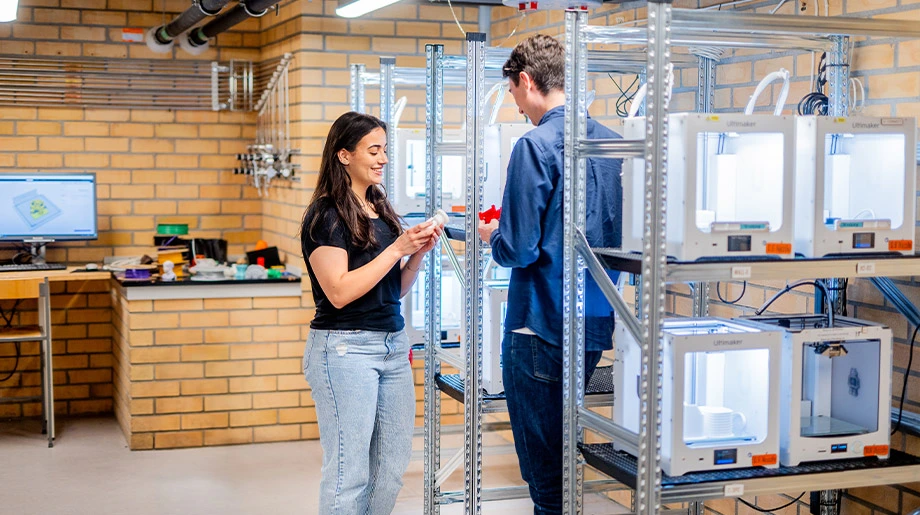
The two-year programme (120 ECTS credits) is in English. Graduates are awarded a Master of Science degree. Activities within the programme are mainly held at the KTH Campus in Stockholm by KTH’s School of Industrial Engineering and Management, with access to facilities at the Department of Engineering Design and the KTH Prototype Centre.
Industrial Design Engineering track

The Industrial Design Engineering (IDE) track focuses on the design, functionality, and communicative aspects of products in relation to users and markets. You will study and work in product, service, and system design. You will improve your skills in product development by merging a mechanical engineering perspective with an industrial design perspective. The activities covered in the design process include user insights, ideation, concept screening, form-giving and visualisation, branding, prototyping, overall systems design, material selection, manufacturing, and sustainable development.
In development projects across the programme track, you will collaborate closely with companies and organisations that have identified a potential new product or service, or an improvement to an existing one. From an IDE perspective, these cases should include a range of user interactions and technical complexities to ensure that industrial design and mechanical engineering knowledge are required. The solutions you develop should address user needs and be adapted to user behaviour. In previous years, students have, for example, redesigned urban bicycle services for Stockholm and designed sustainable clothing service systems.
As IDE integrates industrial design and mechanical engineering, the teachers at IDE have backgrounds in either field. This also requires that the students who apply have completed both industrial design and mechanical engineering courses in their bachelor's degree.
Innovation Management and Product Development track

The Innovation Management and Product Development track focuses on managing innovation and product development processes. You will study and work with innovation in three ways: you will develop results in terms of new products, services, and business models, you will organise and manage innovation processes from both a development project perspective and an organisational structure perspective, and, finally, you will work on innovation strategies in terms of new business development. In this track, you will engage with cutting-edge research in innovation management and product development, and you will collaborate closely with industry.
Courses and projects in the track explore innovation from several perspectives:
- The innovation process, including all activities from understanding the user and customer needs, idea creation, product and service development and understanding the business model (value creation activities).
- The innovation strategy sets the direction for an organisation, project portfolio and business strategies.
- Innovation results in products, services and business models relating to different levels of newness.
Different types of innovation place different demands on organisations and project teams. Some projects focus on improving existing products and services, while others challenge existing knowledge and explore entirely new solutions. In this track, you develop the tools and methods needed to organise, lead and manage innovation processes across both contexts. In previous years, students have analysed urban e-bike services to improve user adoption and developed autonomous drone systems for sustainable forest management and circular resource use.
Programme structure and progression
Industrial Design Engineering
During the first year, you build a foundation in product development through integrated mandatory courses in machine design, service design, mechatronics, sustainability and research methodology. Project-based courses allow you to apply design methods and engineering principles to real-world development challenges.
In the second year, you continue through mandatory courses in advanced industrial design engineering. The programme concludes with a degree project carried out during the final semester in an industrial or academic environment, allowing you to specialise further within your chosen area.
Innovation Management and Product Development
During the first year, you build a foundation in product innovation, research and development, systems engineering and innovation processes through a set of integrated mandatory courses. The courses provide perspectives on innovation from product, organisational and strategic viewpoints.
In the second year, you continue through mandatory courses in innovation management and product development, complemented by elective courses. The programme concludes with a degree project carried out during the final semester in an industrial or academic environment, allowing you to specialise further within your chosen area.
Courses in the programme
The courses in the Industrial Design Engineering track cover topics such as product development, user studies, product design, service design, branding, sustainable design and engineering design.
The courses in the Innovation Management and Product Development track cover topics such as innovation management, R&D management, strategy, organisation, product development and related processes, methods and tools.
Courses in the master's programme in Integrated Product Design


Future and career
The master's programme in Integrated Product Design offers you a comprehensive education and refined expertise applicable to a wide range of industrial and business sectors as well as to organisations and consultancies. Graduates demonstrate advanced knowledge and understanding of design and innovation processes, as well as the ability to organise and manage them effectively.
The Industrial Design Engineering track provides the skills necessary to work in product development and design, user-driven design, and related positions, including creative engineer, technical expert, project manager, and design commissioner.
The Innovation Management and Product Development track provides opportunities for a variety of jobs in areas related to innovation, including project management, business development and product planning. You also instil competence to work on complex multidisciplinary product development projects as a technical expert, project manager, R&D manager, or consultant.



Sustainable development
Graduates from KTH have the knowledge and tools for moving society in a more sustainable direction, as sustainable development is an integral part of all programmes. The three key sustainable development goals addressed by the master's programme in Integrated Product Design are:


The challenge of transforming the industry into a fully sustainable system is paramount. In our programme, we try to tackle this on at least three levels;
- On a system level, we push a circular approach. This means moving to a service paradigm, with business models based on providing shared functionality rather than just pushing stuff to market.
- On a product level, meaning that the products need to be designed for use, repair, refurbishment and reuse. We also need to take the choice of materials and production methods into close consideration.
- Finally, our research has pointed to the need to be innovative regarding management, organisation and business models to change the present linear paradigm into a circular one.
Faculty and research
At the Unit for Integrated Product Development and Design , the research area covers organisational and technical processes for the efficient and effective development of innovative technology-oriented products, services and systems. This includes technology, tools, procedures, and work organisation for increased efficiency and learning in industrial product development processes.
The division's research focuses on critical factors for competitive and innovative processes in the industry, including the utilisation of tools and procedures, organisational cooperation, parallel processes, and interdisciplinary teamwork. The research is also focused on sustainable design, health, and well-being.
Many of our researchers are engaged in, and have been engaged in, the challenges of sustainable mobility in cities. One focus area is accessibility, i.e. providing more of the services people need within walking distance from their homes. Another focus area is providing Mobility as a Service, MaaS, to break the dependency on car ownership.
The research group Green Leap addresses sustainability challenges using design methods, often in collaboration with companies, organisations and design practitioners. We often use a Living Lab method to discover valuable insights regarding people's behaviour and their openness to change in a sustainable direction.
Faculty involved in the programme