MSc Sports Technology
The master's programme in Sports Technology is an interdisciplinary collaboration between KTH and the Swedish School of Sport and Health Sciences (GIH), Sweden's leading actors in their respective fields of science. The programme provides a unique understanding of the areas of sports science and engineering. Graduates gain the skills to develop new technologies for measuring sports performance and advanced healthcare.

Sports Technology at KTH
The two-year master's programme in Sports Technology provides interdisciplinary expertise in sports science and engineering. Sports technology focuses on measuring, simulating, and analysing human motion outside the laboratory, while providing actionable, real-time feedback to athletes, coaches, and audiences.
The programme combines courses in computer science, electrical engineering and biomechanics with an increasing focus on AI and data-driven methods. You also study entrepreneurship, innovation and design, together with a sport and exercise physiology course at GIH. Through project work, often conducted in collaboration with research institutions and companies, you develop the ability to formulate problems, search scientific literature and present your work both orally and in writing.
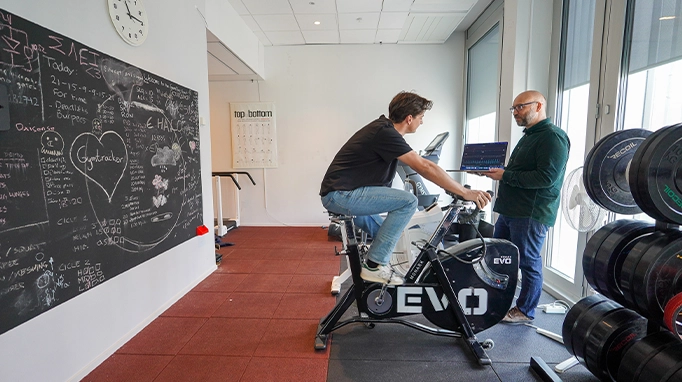
After graduation, you can contribute to the development of new technologies and solutions within sports technology, healthcare and rehabilitation. The labour market primarily consists of small enterprises specialising in specific products, and the expanding field also offers good opportunities to start one's own business. The education also provides a solid foundation for research.
This is a two-year programme (120 ECTS credits) in English. Graduates are awarded the degree of Master of Science. The programme is given at KTH Campus and KTH Flemingsberg in Stockholm by the School of Engineering Sciences in Chemistry, Biotechnology and Health (at KTH).
Programme structure and progression
During the first year, you build a foundation in sports technology through courses in health and sports instrumentation, biomechanics, sport and exercise physiology, and technology in health applications. You also choose from a range of elective courses that allow you to develop expertise in areas such as machine learning, data mining and mobile applications.
In the second year, you deepen your studies through advanced courses in biomechanics, AI, health systems, interaction design, and entrepreneurship. The programme concludes with a degree project carried out during the final semester, often in collaboration with research groups, healthcare organisations or companies within the field.
Courses in the programme
The courses in the programme cover topics such as sports technology, sport science, biomechanics, electrical engineering, software engineering, mechanics, health and sport instrumentation, project management, entrepreneurship, innovation and design.
Courses in the master's programme in Sports Technology


Future and career
After graduation, you can work as a development engineer, product developer or data analyst in sports technology, healthcare, rehabilitation and other technology-intensive fields. You may develop technologies for measuring, simulating and analysing human movement, such as wearables, motion-analysis systems, training equipment and digital tools for performance and health. Other career paths include ergonomics, assistive technology, computer games, VR/AR and vehicle safety.
The programme’s combination of engineering, modelling and data analysis can also prepare you for advanced roles beyond sports technology. Graduates may pursue careers in technology and management consulting or in other data-intensive industries, including companies such as Accenture and JPMorgan.
These skills can contribute to solutions that help people live healthy and active lives, regardless of age or functional ability. Potential employers range from healthcare providers and research organisations to international sports and technology companies such as Toptracer, Exxentric, Qinematic, Challengize, Suunto, Garmin, Adidas and Nike.




Sustainable development
Graduates from KTH have the knowledge and tools for moving society in a more sustainable direction, as sustainable development is an integral part of all programmes. The three key sustainable development goals addressed by the master's programme in Sports Technology are:



SDG 3. Good health and well-being:
The goal of the programme is to measure, simulate and analyse human movement outside a laboratory, enabling health, well-being, and medical care solutions beyond the hospital. These capabilities also play a crucial role in ergonomics by detecting hazards in the workplace, helping prevent injuries, enhancing rehabilitation outcomes, and promoting long-term physical health.
SDG 4. Quality education:
Through interdisciplinary learning between engineering and sports science, the programme fosters cross-disciplinary knowledge sharing and empowers graduates to educate others on applying sports technology for health and performance.
SDG 8. Decent work and economic growth:
Graduates contribute to a rapidly expanding global industry, developing innovative technologies that create new business opportunities in sports performance, health tech, and rehabilitation.
Faculty and research
Research in the programme focuses on accurately measuring performance, modelling movement, and providing real-time feedback. These themes feed directly into student projects, where you may work with movement analysis, physical modelling and feedback systems in collaboration with researchers and companies in the field.


Faculty involved in the programme