MSc Macromolecular Materials
The master's programme in Macromolecular Materials prepares you to lead the development of future sustainable fibre and polymer-based materials. You gain in-depth understanding of the relationships between molecular structure and macromolecular and material properties, coupled with extensive practical experience. Our courses let you specialise in, for example, circular materials, polymer design and technology, pulp and paper technology, biorefinery, bio-based composites and surface coatings.

Macromolecular Materials at KTH
In the master’s programme in Macromolecular Materials, you learn how polymer- and fibre-based materials are designed, synthesised, characterised and developed for different applications. You will acquire the knowledge and skills to manage the selection of raw materials (renewable versus fossil), choice of production processes, material combinations and manufacturing methods to achieve the desired characteristics of the finished product. We strongly emphasise environmental issues, such as environmentally friendly material production and the development of sustainable materials.
The programme gives you a solid foundation in the chemistry and physics of organic materials and their real-world applications. The broad range of courses combines a comprehensive understanding of macromolecular materials with opportunities to tailor your studies towards your specific interests. The programme also provides opportunities to learn and utilise state-of-the-art laboratories and instrumentation, and is closely linked to research at the Department of Fibre and Polymer Technology. Throughout the courses, you will develop skills in problem-solving, teamwork, and oral and written presentations.
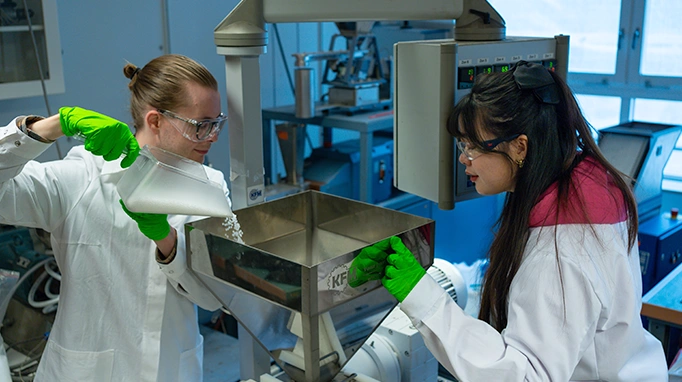
This is a two-year programme (120 ECTS credits) in English. Graduates are awarded the degree of Master of Science. The programme is mainly offered at the KTH Campus in Stockholm by the School of Engineering Sciences in Chemistry, Biotechnology and Health (at KTH).
Programme structure and progression
During the first semester, you build a foundation in the chemistry and physics of macromolecular materials through courses in polymer and fibre-based materials. You then tailor your studies towards your areas of interest through elective and recommended courses.
The programme concludes with a master’s degree project carried out during the final semester at KTH, at a research institute, company or university in Sweden or abroad. Topics previously explored include synthesis of sustainable polymers, design of biobased adhesives, fibre-solution interactions, regenerated cellulose, lifetime predictions and generation of microplastic, nanocomposites, 3D-printing, and materials for biomedical applications.
Courses in the programme
The courses in the programme cover topics such as polymer chemistry and physics, biofiber chemistry, pulp and paper chemistry and technology, materials in a circular economy, polymeric materials structure and properties, fibre technology and biomedical materials.
Courses in the master's programme in Macromolecular Materials


Future and career
Graduates from the programme have broad and international career opportunities and advanced fibre and polymer technology skills, combined with a clear environmental focus, are an excellent foundation for careers in industry, research institutes, government agencies, and academia. Expertise in fibre- and polymer-based materials is in demand across a very broad range of industries, including paper and forest products, plastics, medical technology, pharmaceuticals, coatings, adhesives, packaging, transport, and electronics. The transition to sustainable materials and circular production is expected to further increase demand for specialists in the field.
Programme graduates are found in traditional Swedish industry, small start-ups, consulting firms, government institutions, research institutes, and universities. Employers of graduates include ABB, AstraZeneca, Beckers, Billerud, Borealis, Carmeda, Coloplast, Cytiva, Essity, IKEA, IVL, KTH, Nestlé, Nynas AB, RISE, PRV, Scania, Stora Enso, Tetra Pak, Volvo Cars. Typical roles include project leader for development and production, research and development engineer, quality assurance engineer, consultant, project manager, product specialist and process engineer. The programme also prepares you for doctoral studies at KTH and other universities worldwide.




Sustainable development
Graduates from KTH have the knowledge and tools for moving society in a more sustainable direction, as sustainable development is an integral part of all programmes. The three key sustainable development goals addressed by the master's programme in Macromolecular Materials are:

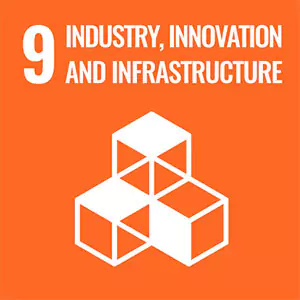

You learn to design and develop sustainable fibre- and polymer-based materials and production processes that can replace less sustainable alternatives and how fibre- and polymer-based materials contribute to a sustainable society. You also learn how raw material selection, material properties, processing methods, product lifetime, material use, and end-of-life considerations influence the economic, social and environmental impact of fibre- and polymer-based materials.
Faculty and research
Research at the School of Engineering Sciences in Chemistry, Biotechnology, and Health covers a broad spectrum. It includes developing solar and fuel cells and other sustainable energy sources, designing new polymers for medical applications, protecting metal surfaces from corrosion and utilising natural materials in innovative products.
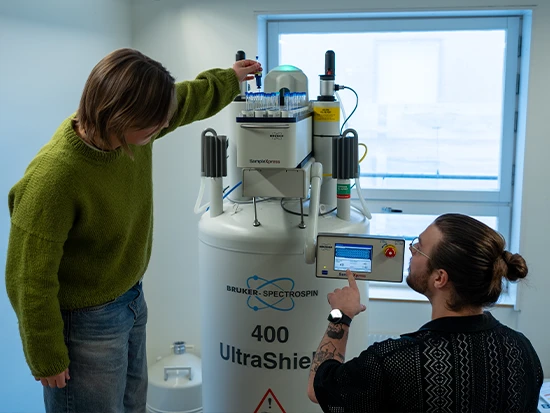
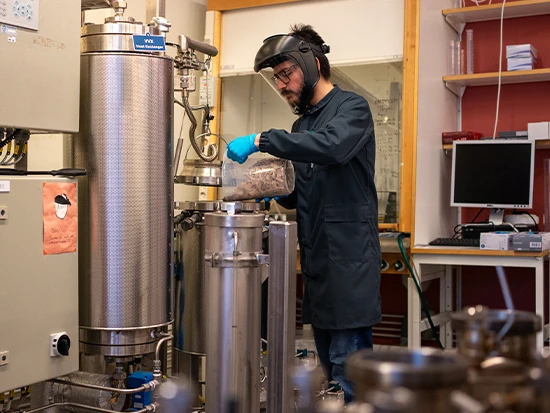
The Department of Fibre and Polymer Technology conducts research in biopolymers, natural fibres, bio-based and synthetic polymers. Research spans areas from polymer synthesis and characterisation to processing, modelling, recycling, composites and material performance, with applications in sustainable materials, medical technology, energy and pulp and paper technologies.
Materials from renewable resources, nanostructured materials, materials for medical applications and materials for the energy field are identified as strategic research areas closely connected to the Sustainable Development Goals and the transition towards a more sustainable society.
- Research carried out at the School of Engineering Sciences in Chemistry, Biotechnology and Health
- Research carried out at the department of Fibre and Polymer Technology
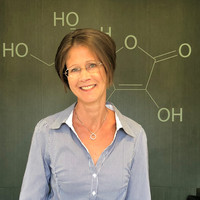
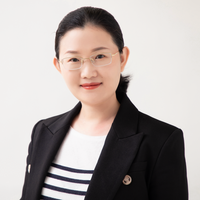
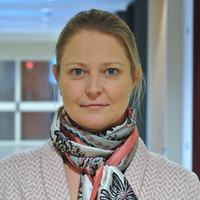
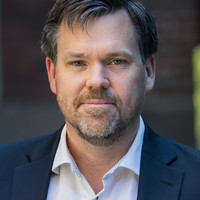
Faculty involved in the programme







Research stories
- Coconuts and lemons enable a thermal wood for indoor heating and cooling
- Citrus derivative makes transparent wood 100 percent renewable
- Plastic from Wood (Deutsches Elektronen-Synchrotron DESY)
- The world's strongest biomaterial
- Water purification system engineered from wood, with help from a microwave oven
- With a kitchen freezer and plant cellulose, a material for therapeutics is developed
- Repairing Bone Fractures Using High‐Performance Thiol-Ene Adhesive (video)