MSc Railway Engineering
The master's programme in Railway Engineering explores railways from a systems perspective, blending mechanical, civil and electrical engineering. You will study at KTH and the University of Illinois at Urbana-Champaign and learn to design vehicles, infrastructure and control systems for safe, efficient and sustainable transportation. Investments in railways are rising worldwide to decarbonise passenger transport and freight, creating a vast demand for skilled railway engineers.
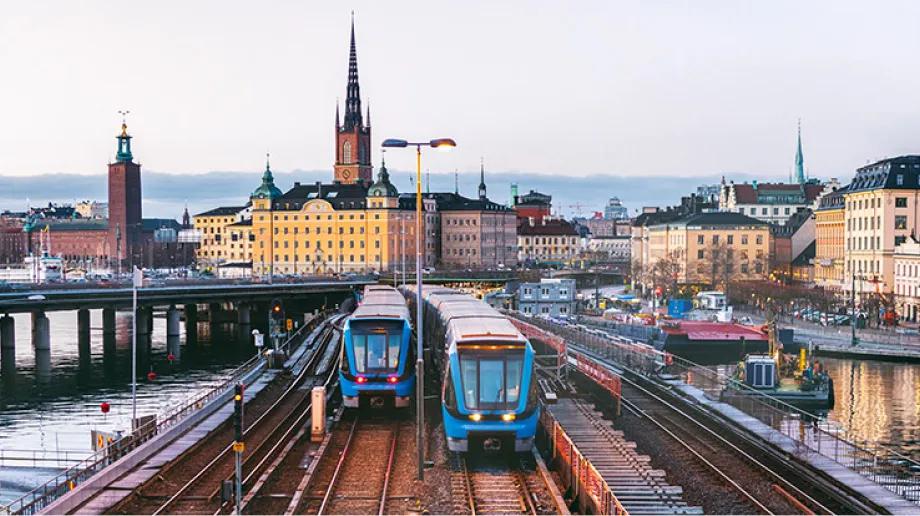
Railway Engineering at KTH
Rail transport is expanding worldwide as countries invest in more efficient and sustainable ways to meet growing demand for passenger and freight mobility. Rail systems can help reduce emissions and congestion while supporting increasingly urbanised societies. This development is creating demand for engineers who understand how railway infrastructure, vehicles and traffic control interact and who can optimise the performance of the system as a whole. The programme gives you this integrated systems perspective and prepares you for work in an international industry. Railway Engineering is offered as a track within the master’s programme in Vehicle Engineering. This means that you specialise in railway engineering but graduate with a degree in Vehicle Engineering.
The master's programme in Railway Engineering is among the few programmes in the world and in Europe taught in English that cover all aspects of rail engineering, and none offers the international perspective afforded by this one. KTH offset the programme in collaboration with the University of Illinois at Urbana-Champaign (UIUC), where it is mandatory for all students in the programme to spend one semester.
The programme focuses on the system aspect, which is extremely important in railway systems. Vehicle, infrastructure and control systems have to be designed to work optimally together. Therefore, the programme contains courses in mechanical, civil and electrical engineering. Courses delivered by KTH and UIUC complement each other, providing you with knowledge spanning the technical, operational, and economic aspects of railway systems. You study topics such as the economics of rail transportation, decision-making and optimisation, rolling stock design, running gear, train braking systems, and commuter train design.
The programme is mainly based on classes, with lectures, assignments and exams, but also includes projects and individual studies. All teachers are active researchers and will include new research trends in their course content. Throughout the programme, you meet active researchers and work with design and analysis tools used in modern railway engineering. Field trips provide additional insight into the railway sector, and many students carry out their degree project in collaboration with railway operators, consultancy companies, or other industry partners, working on challenges relevant to today's railway systems.
This is a two-year programme (120 ECTS credits) given in English. Graduates are awarded the degree of Master of Science. The programme is given mainly at KTH Campus in Stockholm by the School of Engineering Sciences (at KTH).
Collaboration with the University of Illinois at Urbana Champaign (UIUC)
About half of the courses are given by the University of Illinois at Urbana Champaign (UIUC) and KTH, respectively, and the programme includes mandatory international mobility. At least 15 ECTS credits must be taken on-site at the partner university. Many courses in this programme are taught exclusively online by KTH and UIUC. Please note that, due to US visa regulations, there is no guarantee that fee-paying students will be able to study in the US. If the visa is denied, these students will be offered an alternative study plan.
Programme structure and progression
During the first semester, you build a foundation in railway engineering through mandatory courses covering rail vehicle technology, electric transportation, scientific methodology, and sustainable development. In the second semester, you deepen your knowledge in rail vehicle dynamics while combining mandatory and conditionally elective courses that allow you to begin tailoring your studies. The third semester is a mandatory exchange semester at the University of Illinois Urbana-Champaign (UIUC), where you continue your specialisation through two mandatory courses and elective courses. The programme concludes with a degree project carried out at KTH or in collaboration with industry.
Courses in the programme
The courses in the programme cover topics such as vehicle and track design, vehicle-track interaction, traction systems, railway signalling systems, high-speed rail systems and railway traffic planning.
Courses in the master's programme in Railway Engineering


Future and career
The technical challenges associated with meeting the growing demand for railway transportation in an efficient and sustainable manner require a considerable number of engineers with an education in the field of railways worldwide. A large percentage of railway industry engineering staff are nearing retirement; consequently, there is a strong and growing demand for graduates with an education in railway engineering. With one focus of the programme being systems aspects, it is anticipated that many graduates will hold management positions within their organisations.
After graduation, you can for example, expect to take on roles such as vehicle or track design engineer, rail systems engineer or project manager, signalling engineer, procurement or maintenance or asset engineer at an operator, researcher or railway consultant. The programme provides an excellent basis for pursuing a career in the global automotive industry at consultancy firms, research institutes, and universities. The cooperation between the Swedish industry and the Department of Engineering Mechanics is very close. There are several major ongoing research programmes in which KTH, key manufacturers and the transport administration are involved. Both universities also offer the opportunity to continue as a PhD student. Graduates from the programme are strong candidates for the limited number of positions available.




Sustainable development
Graduates from KTH have the knowledge and tools for moving society in a more sustainable direction, as sustainable development is an integral part of all programmes. The international environment of the master's programme in Railway Engineering offers diverse societal perspectives that will be very helpful in understanding global sustainability challenges. The three key sustainable development goals addressed by the programme are:


Due to the inherent climate-positive qualities of railway systems, all courses incorporate sustainability-related knowledge. You will acquire a systems perspective that forms the basis for rethinking transportation and allows you to design innovative solutions to various challenges, such as tackling climate change. You will learn how to contribute toward global sustainable development by using your expert knowledge, technical breadth and international experience. The railway is also vulnerable to the effects of climate change, such as extreme weather events, flooding, and heat waves, which can damage infrastructure and disrupt operations. Throughout your studies, you will acquire the skills to make the railway more resilient and adaptable to these challenges.
The broad array of courses in the programme will engage you in different technical and societal aspects directly related to sustainability, such as designing technical solutions with constraints on energy and material consumption, or human-centred aspects such as comfort, interoperability, and smart transport ecosystems. In the master's degree project, you will expand your knowledge about technological development and project management in relation to sustainability.
Railways will play an essential role in the sustainability of our societies as we know them. As a railway systems expert with a strong international perspective, you can join any work group around the world, work with other experts in adjacent fields, and lead the development of technical innovations that contribute toward a sustainable infrastructure system, energy-efficient transportation and climate-friendly technical innovations.
Faculty and research
The multidisciplinary nature of the master's programme in Railway Engineering is reflected in the research groups that compose KTH Railway Group. The programme is hosted at the School of Engineering Sciences. Still, railway-related research is carried out at four of KTH's schools: Engineering Sciences, Architecture and Built Environment, Industrial Engineering and Management, and Electrical Engineering and Computer Science.
All these groups work on projects from different sources: EU-funded projects such as Europe's Rail, independently funded projects and even own research interests. Some of the most research-intensive groups participate in research projects with first-line railway companies, research centres and administrations in Europe in this context. The professors involved in these groups actively participate in the courses offered in the programme, providing a direct and up-to-date link between research and education. For instance, some of these and their research groups are:

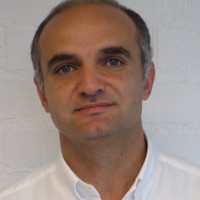
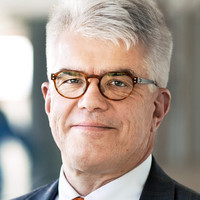


The research by the center KTH Railway group covers a number of different areas such as driverless trains, conversion from diesel operation to battery or hydrogen gas, seamless freight transport, concepts for more attractive and competitive train traffic in low-traffic areas. For thorough information about the research carried out at the railway centres hosting the programme, see KTH Railway Group and RailTEC at UIUC .