KTH Logo

Recognising the complexity of conflict(s) and cooperation is key for the sustainability of urban drinking water provision in the Global South

New publication: What is good drinking water?: 41 Years of risk perception on water quality in the vicinity of the Nuclear Research Centre Karlsruhe, 1956–1997

Alicia Gutting is a PhD candidate in the ERC-project Nuclearwaters at the Division of History of Science, Technology and Environment. In her thesis „The Nuclear Rhine“ Alicia is researching transnational nuclear risk perception in Austria, Switzerland, France and Germany from the 1960s to 2018. In January Alicia was published in Risk, Hazards & Crisis in Public Policy with the article What is good drinking water?: 41 Years of risk perception on water quality in the vicinity of the Nuclear Research Centre Karlsruhe, 1956–1997. Follow the link below for open access!

What is good drinking water?: 41 Years of risk perception on water quality in the vicinity of the Nuclear Research Centre Karlsruhe, 1956–1997
In: Risk, Hazards & Crisis in Public Policy, ISSN 1944-4079, E-ISSN 1944-4079, p. 1-23Article in journal (Refereed) Published

Abstract [en]

This article traces the historical evolution of risk perception around the Nuclear Research Centre Karlsruhe, Germany, from 1956 to 1997. It does so by targeting the evolution of water-related risks. Federal hopes in the postwar era that the Nuclear Research Centre would bring progress and prosperity clashed with local values and local perception of nuclear engineering as dangerous to health and the environment. Various conflicts arose and opponents made use of their past lived-knowledge to foster their arguments against future decision-making, mobilizing stories from the past to shape the future. The conflict culminated in the 1990s, when the municipality decided to lease the Centre’s waterworks for future drinking water supply. The main argument of the article is that even though the public discourse shifted over the years from water pollution toward greater risks such as nuclear meltdowns, the local risk perception stayed with the water-related risks. The article shows how the locals perceived and narrated their risk perception against the decision-making of authorities as well as against the reasoning of scientists and experts.

Place, publisher, year, edition, pages

Hoboken: Wiley , 2023. p. 1-23

Keywords [en]

drinking water, Rhine river, risk narratives, risk perception, water quality

What is Deep Sea Mining?

What is Deep Sea Mining? will start up the festival this year. The five episodes are screened at a brownbag seminar and followed by a discussion lead by the Divison’s Tirza Myer. In the panel we have Robert Blasiak, researcher at the Stockholm Resilience Centre (focuses on the sustainable management of ocean resources, and ocean stewardship) and Staffan Lindberg, author and journalist at Swedish paper Aftonbladet (focuses on foreign and climate news).

The What is Deep Sea Mining? project was developed in collaboration with Margarida Mendes, curator, educator and activist from Lisbon, Portugal. Margardia is a founding member of Oceano Livre, the environmental movement against deep sea mining. She is dedicated to understand how a shifting climate impacts society’s capacity for imagination. We will also show a recording of Margarida during this event.

Go here for the full program with more information on this session and to register: https://crosscuts.se/program-2022/ 

Drought or low water availability as an historical preparedness problem

Division researcher Fredrik Bertilsson has recently written a blogpost for the WaterBlog@KTH on the basis of his new research project “Beyond ‘unprepared’: Towards an integrative expertise of drought” (Formas 2022-2025). Here is a repost of his text, focussing on a very pressing issue for all of us living in a context of climate crisis.

Blomma, Liv, Gul Blomma, Spricka, Öken

Drought and the lack of access to clean water constitute serious threats to human and natural wellbeing in many places of the world. Over the last century, drought has faded from quotidian life in many parts of Scandinavia and northern Europe. However, experiences of extreme weather in recent years have advanced a new awareness and preparedness agenda. Issues concerning water use and availability are now among the priorities of risk management, climate change adaptation, and preparedness efforts.

Sweden’s weather was fairly stable for much of the 20th century. The problems of drought were usually regarded as difficulties affecting local agriculture and drinking water supplies. In addition, concerns related to the climate and weather were commonly overshadowed by threats linked to the politics of the Cold War. In the 1990s, crisis management interventions were formulated around weather-related contingencies. Among other things, scenarios for dealing with flooding were being worked out.

The drought and the subsequent forest fires during the summer of 2018 ushered in a new discussion about Swedish preparedness against drought. The historical aspects of what was usually referred to as the extreme weather were highlighted by the fact that the drought and the subsequent forest fires were described as the worst in “modern times”. The abstract notion of long-term and large-scale global climate change was made concrete and meaningful here and now, as it were, in contrast to being viewed as a potential disaster happening in the future and mainly affecting other parts of the world.

Drought as preparedness problems is multi-facetted. Public agents, policy makers, and researchers underscore the large amount of work that needs to be done, the importance of facilitating a much-needed collaboration between different stakeholders and a holistic view of the issues at hand. The formulation of preparedness problems involves a kind of battle over the narrative of which threats are most serious, how they have developed, what may happen in the future, and necessary activities.

History is a fundamental component of the efforts of upholding vigilance against threats that may or may not materialize in the near or distant future. Learning from past events is crucial. However, while historical narratives help societies understand, manage, and cope with present vulnerabilities and challenges, it is impossible to devise effective preparedness measures based exclusively on historical experiences. In an era of climate change, the scale and speed of natural events have the potential of reversing understandings of historical development and build a foundation for a reformed narrative of Swedish readiness.

Profilbild av Fredrik BertilssonA historical perspective on drought as a contingency problem includes but also goes beyond mapping and analyzing past episodes of low water availability. It also brings light on the human subjectivities, relationships, and forms of governance that have emerged in response to previous occurrences. Focusing on people, it brings into focus the efforts to cope with uncertainty rather than the historical development of specific technologies for turning potential dangers into controllable and calculable risk.
This contrasts with a narrative about the ever-increasing safety and certainty of modern society. Rather than illuminating the many ways in which science and technology have improved the protection of human and non-human life, health, and vitality, other actors and issues come to the fore. Through studying actors that have taken the existential concerns of low water availability as their primary concern, it is possible to contribute new understandings of drought as an historical preparedness problem.

This may contribute new perspectives on the present, a kind of genealogy of uncertainty. In this perspective, “unpreparedness” against drought is not merely seen as an inability or inadequacy of certain institutions or technical instruments. It highlights a lack of historical narratives that can give meaning to what is currently happening and relate contemporary problems to a longer history of how society has functioned in difficult circumstances. It may help to inform the kind of coping strategies needed to deal with a volatile relationship between humans and water, or lack thereof.

Originally posted on the WaterBlog@KTH, 2022-03-21

Does water have a soul? Voices and reflections from the Symbiosis exhibition

Text by Katarina Larsen

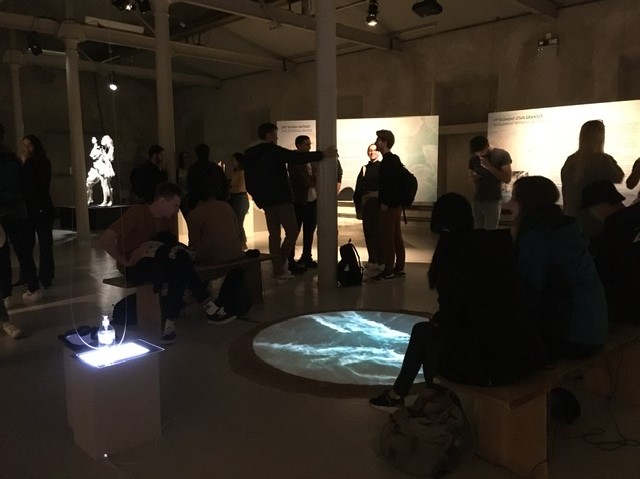
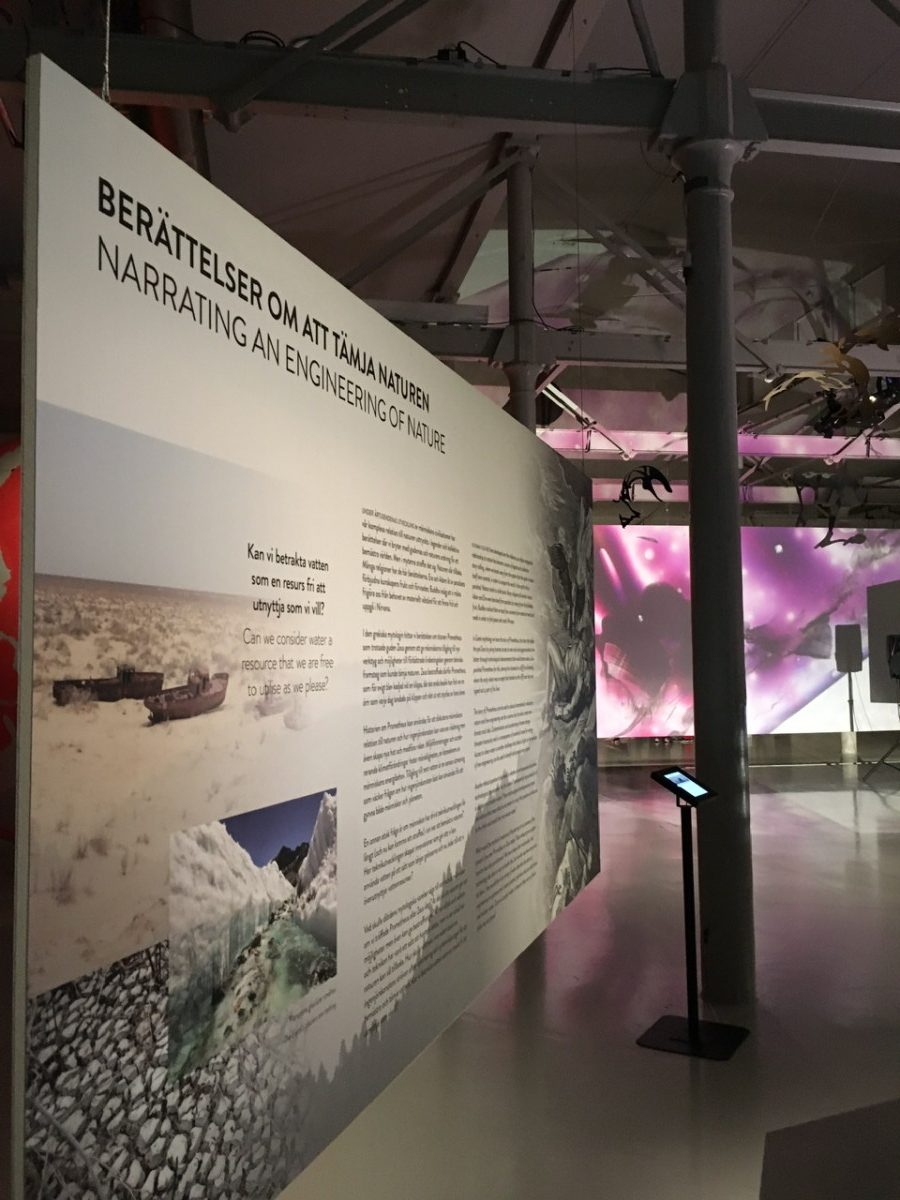
As a part of the activities in the project NATURE, we wanted to have an interaction with visitors that came to the exhibition “Symbiosis” during autumn 2021 where a section on water was developed in collaboration with the art institution Färgfabriken.

The exhibition hall is located in an old industrial building in area of Lövholmen, near Liljeholmen in the south of Stockholm. Researchers from KTH working with the water theme included Katarina Larsen, David Nilsson and Timos Karpouzoglou. As a part of the interactive approach, we asked visitors about their relation to water and also challenged them to imagine what messages that they could hear if water itself was given a voice or legal rights. Some of the reflections received from visitors to the exhibition were really thought provoking.

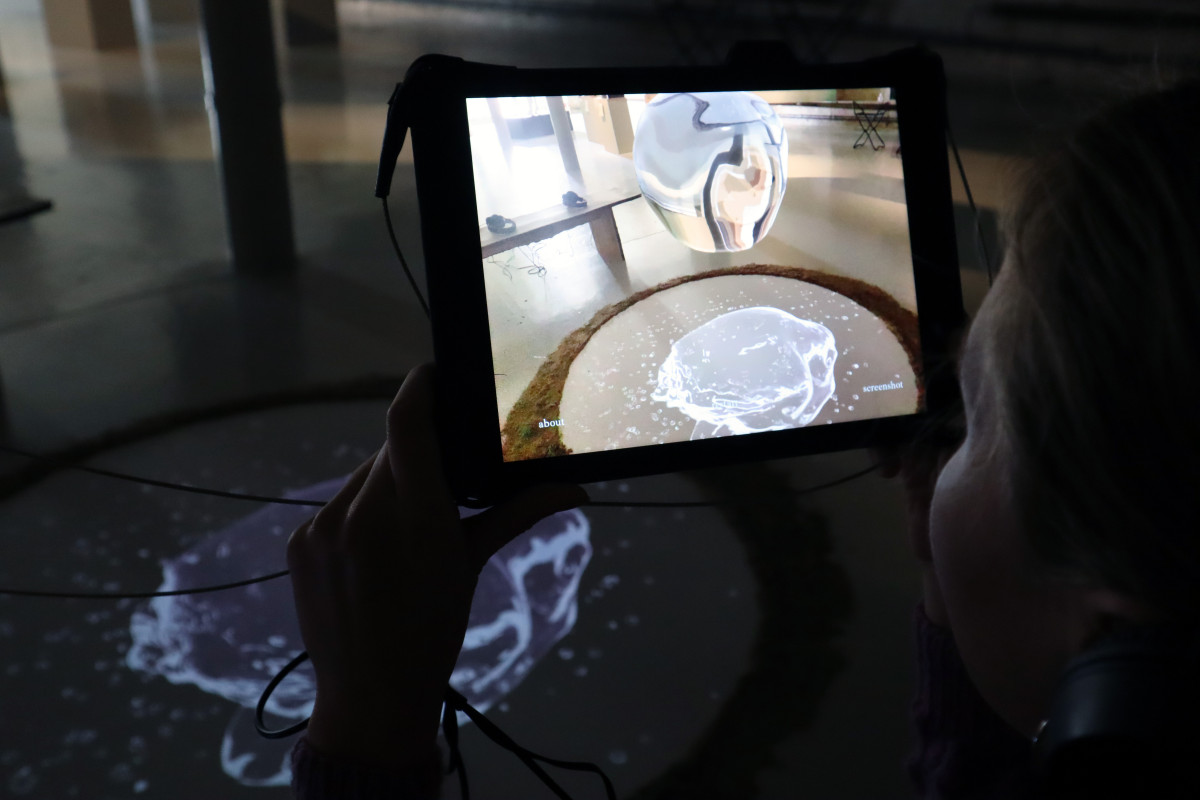
The water component of the Symbiosis exhibition was developed in collaboration with the art institution Färgfabriken and the Stockholm based artist Åsa Cederqvist. The artistic work and collaborative dialogues created ideas for how to communicate different types of water narratives, through texts, images and interactive activities during the exhibition. The art work developed by Åsa was entitled “The Essence” giving water a voice of itself. This was done through an art installation using augmented reality (AR) to create a visual 3D image of a drop of water floating above the floor in the factory of Färgfabriken when visitors looked through the lens of a digital screen.

Photo: ”The Essence – spirit of the water” by Åsa Cederqvist in exhibition Symbiosis at Färgfabriken during autumn 2021. Photo: Färgfabriken

The visitors could also hear the voice of this water spirit through headphones and speakers and were asked what they think the water spirit would tell them. Some of the answers from the visitors expressed a sense of guilt (that we have not taken care of nature like we should have) but also narratives revealing a strong connection with water and nature. Other reflections dealt with idea of control of nature, that there is a struggle between humans and nature and water as a precondition for life on earth.

 “I have existed for millions of years and kept plants and animals alive and developed new life forms. I will always survive and find new life forms. Doesn’t humanity want to be a part of that also?

 “Look at me angrily, maybe punch me” 

 “Get a grip!”

 “Take good care of me, or else….”

 “It’s OK, I love you anyway”

 “I have been inside Björn Borg’s stomach” 

 “Show some respect for my spirit and do not take me for granted!”

Other responses expressed that it would be interesting to take part of the water’s life perspective, both historically and thoughts about the future and how we can we coexist in the best possible way.

We also invited policymakers, engineers and other local actors from the Stockholm area to a series of workshops to discuss their experiences from existing urban water infrastructures and views on future ways to manage systems and infrastructures in cities. The discussions took place in the exhibition hall hosting the exhibition “Symbiosis” curated by Färgfabriken.

During these workshops we wanted to have a dialogue with local politicians, policymakers as well as engineers who are managing existing critical infrastructures for water in Stockholm about their experiences and views on future ways to manage urban water infrastructures in cities. The dialogues also sparked discussions about what the term “infrastructure” actually means. Is it the pipes and wastewater treatment solutions that are in place today? Or does it also include, parks, and other green infrastructures in urban areas that can function as buffer zones for extreme rainfall to manage overflooded existing systems? What are the prospects of different types of nature-based solutions that will make use of circular solutions in the design of future urban systems?

Photo of exhibition hall of Färgfabriken. Photo: Larsen

The workshop participants expressed that they appreciated the workshop initiative also for the opportunity to connect with other local actors being involved in managing different aspects of water in Stockholm. Some comments from participants were that “we should use art more often to communicate” and that working with water requires dialogues between different types of actors to manage cross-cutting aspects of water. Water in different forms are crossing boundaries between municipalities as well as internationally and requires coordination and communication between actors representing a broad range of competences. The participants were also asked to reflect upon what factors that can be drivers for change with a 50-year horizon. Some of the conclusions outline future challenges of different kinds:

  • The waste water systems are, to a large extent, made invisible to the users. As a consequence, they have disrupted the cyclic thinking for water management and treatment.  As long as they are working – they are silent.
  • Even if the systems are among the best ones in the world, they are not optimal. We can increase the circular systems, reduce the environmental impact and use resources better.
  • Future climate change requires preparing for flooding in urban areas. This aspect was highlighted as highly likely by participants to influence a change in managing water supply in the Stockholm region within 50 years.

The workshop participants were also asked to reflect on what measures they thought would be acceptable for consumers. The answers showed that measures such as using rainwater to flush toilets and allowing parks be flooded to act as a buffer zone were thought to be accepted by citizens.  For us researchers from KTH working with developing the water theme in the exhibition this brings some important thoughts onboard for further discussions and studies. Since the work with developing the exhibition was carried out during the pandemic of 2020-21 we were also delighted to be able to organize these workshops on-site in the exhibition hall and create dialogues on how art and science can bring about novel ideas, reflect on circularity of systems, and explore what can happen if water itself is given a voice to talk about future challenges and possibilities for urban water infrastructures in Stockholm.

Photo of exhibition hall of Färgfabriken. Photo: Larsen

Links and additional material:

Nature project: https://www.kth.se/philhist/historia/forskning/environmental-histor/nature-examining-nature-society-relations-through-urban-infrastructure-1.1077111

Symbiosis exhibition: https://fargfabriken.se/en/projects/symbiosis

Urban water imaginaries in exhibition – co-creative dialogues between science, art, and engineering (interview with Katarina Larsen in ABE school newsletter)

https://www.kth.se/en/abe/nyheter/berattelser-om-vatten-i-stader-i-utstallning-med-moten-mellan-vetenskap-konstnarer-och-ingenjorer-1.1102817

Visitors relations to water and their memories shared:

“It is euphoric to swim in the sea and be a part of the element for a while. At the same time, the power of waves and depth is extremely frightening. My stepfather drowned during a dive and it’s awful to imagine that situation, to drown and sink into the dark depths.”

“Drinking cold water that tastes like iron, in the countryside with my friend when we were small, after being out to play.”

“Water is what almost took my life on several occasions, but it is also what I can enjoy in everyday life. It is also my favorite drink although deep water is one of the few things I am afraid of. So a cycle, it gives and takes.”

“I sail and do a lot of boat riding so I have always felt safe on the water, even though I know that every time I am out by boat, the sea can kill me at any time. But I have learned to use the water and live with the water when I am out there. It is some kind of coexistence. I think the sea likes people to sail on it. Just like it likes the animals swimming inside it.”

at an incredibly intense and warm and long concert where I was stuck in the middle completely without anything to drink, I got water from a total stranger and it was the best water I have ever had”

“Fishing trip with grandpa, herring and flounder”

Text by Katarina Larsen, researcher at the Division of History of Science, Technology and Environment

Learning about urban water infrastructure by comparing Northern and Southern cities

Our colleague Timos Karpouzoglou, researcher at the division, will be presenting his work in the current project NATURE – Examining Nature-Society Relations Through Urban Infrastructure at the upcoming Higher Seminar on Monday 14 March from 1.15-2.45pm (Stockholm time). His work within the framework of this project is done together with Mary Lawhon, Sumit Vij, Pär Blomqvist, David Nilsson, and Katarina Larsen.

Timos has also published a new article. Together with Mary Lawhon and Gloria Nsangi Nakyagaba (University of Oklahoma, USA) he has written about the idea of a modern city and the reality in Kampala. It is published in Urban Studies. In the following we have copied the abstract. If you want to read the whole article, you can find it here.

Timos Karpouzoglou | Doctor of Philosophy | KTH Royal ...

Abstract

The idea of the modern city continues to inform urban policies and practices, shaping ideas of what infrastructure is and how it ought to work. While there has long been conflict over its meaning and relevance, particularly in southern cities, alternatives remain difficult to identify. In this paper, we ‘read for difference’ in the policies and practices of sanitation in Kampala, purposefully looking for evidence of an alternative imaginary. We find increasing acceptance of and support for heterogeneous technological artefacts and a shift to consider these as part of wider infrastructures. These sanitation configurations are, at times, no longer framed as temporary placeholders while ‘waiting for modernity’, but instead as pathways towards a not yet predetermined end. What this technological change means for policies, permissions and socio-economic relations is also as yet unclear: the roles and responsibilities of the modern infrastructure ideal have limited significance, but new patterns remain in the making. Further, while we find increased attention to limits and uncertainty, we also see efforts to weave modernist practices (creating legible populations, knowing and controlling nature) into emergent infrastructural configurations. In this context, we consider Kampala not as a complete instantiation of a ‘modest’ approach to infrastructure, but as a place where struggles over infrastructure are rooted in competing, dynamic imaginaries about how the world is and what this means for the cities we build. It is also a place from which we might begin articulating a ‘modest imaginary’ that enables rethinking what infrastructure is and ought to be.

The metaphor of ocean “health” is problematic

Susanna Lidström (researcher at KTH), Tirza Meyer (postdoc at KTH) and former division’s PhD-colleague Jesse Peterson (now postdoc at Sveriges Lantbruksuniversitet) have published an exciting opinion piece about our approach towards the ocean in the context of climate change and increased pollution. The authors argue that the health metaphor would be problematic in regard to describing the state of oceans.

In the following you can read their introduction. If you are interested in working through the original article, visit Frontiers in Marine Science – Global Change and the Future Ocean from 15 February 2022 by clicking on the link!

Fische, Meer, Graffiti, Streetart, Mauer, Wandkunst

Introduction of the article:

The state of the ocean is increasingly described in terms of ocean “health.” The Implementation Plan for the United Nations Decade of Ocean Science for Sustainable Development describes the aim of the decade as achieving “a sustainable and healthy ocean” and refers to the ocean’s “health” throughout, including references to an overall “decline in ocean health” [Intergovernmental Oceanographic Commission (IOC), 2020], p. i, 6. Likewise, Sustainable Development Goal no. 14 aims “to achieve healthy and productive oceans” and “to improve ocean health” [United Nations General Assembly (UNGA), 2015, p. 23, 24]. In addition, scientific studies from all disciplines routinely use the same metaphor, including statements such as “the many benefits that society receives from a healthy ocean” (Duarte et al., 2020, p. 39), “the health of marine ecosystems” (Hagood, 2013, p. 75), and the “importance of ocean health” (Borja et al., 2020, p. 1).

However, we argue that the health metaphor (Suter, 1993; Jamieson, 1995) continues to be imprecise, ambiguous, and problematic. We suggest that the idea of ocean “health” misrepresents the Earth’s history of ever-changing and adapting ecosystems through time, wrongly suggests that ocean health is an apolitical and objective state and obscures how conditions in the ocean are irreversibly intertwined with human activities.

Sonne, Strand, Müll, Plastik, Natur, Meer, Ozean


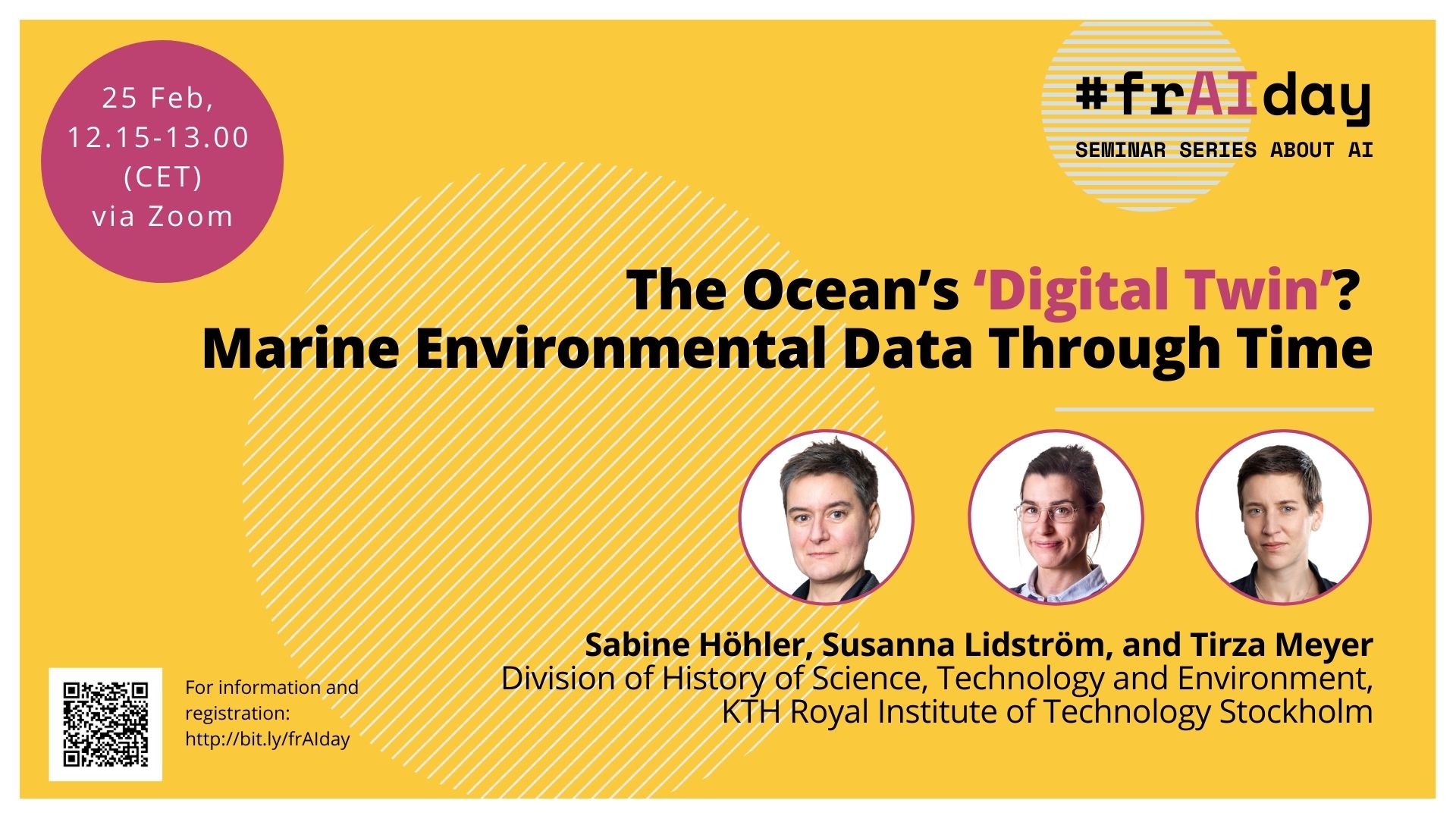
The Ocean’s ‘Digital Twin’? Marine Environmental Data Through Time

Sabine Höhler, Susanna Lidström and Tirza Meyer from the Mediated Planet project at the Division will present in the WASP-HS seminar series #frAIday, organized by Umeå University. In their presentation they aim to sketch the history of opening the ‘black box’ of the ocean.

Seminar poster.

The Ocean’s ‘Digital Twin’? Marine Environmental Data Through Time

Sabine Höhler, Susanna Lidström, and Tirza Meyer

Division of History of Science, Technology and Environment, KTH Royal Institute of Technology Stockholm

Much hope is tied to the creation of a digital twin of the ocean based on an ever more extensive body of ocean data. Representing the ocean in the digital space is a way of analyzing and modeling the ocean in a ‘laboratory’ setting. Studying the ocean stripped from its natural complexity, so the idea, can better inform and instruct humans on how to interact with the ocean environment. Our twentieth century understanding of the ocean as a central ecosystem in the planetary environment would not have been possible without long-term information gathering. However, also ocean data generation is a messy and contested process. Its history is even more important to study since we ‘know’ the ocean mostly in mediated ways. We observe the ocean almost exclusively through scientific instruments, and we formulate ocean policies, legislation, and development goals based on data and increasingly on digital information. That this data has a history makes the past, present, and future of the digital ocean not just a scientific but a political issue.

Our presentation aims to sketch the history of opening the ‘black box’ of the ocean. We use examples of the Challenger expedition in the 1870s, of satellite oceanography in the 1990s, and of present-day autonomous ocean sensor systems. We ask how the specific tools and the information they generated mobilized different understandings of the ocean as resource and territory, as climate moderator and as carbon sink. Dredges, satellites and deep-ocean floats created new ocean knowledges, politics, and also new ontologies. No matter how inclusive, refined, and versatile the databases are, so our argument, the digital ocean will not be a simple 1:1 representation or “twin”. While the data corpus may be quite functional to model ocean behavior, it will always rest on selections serving particular purposes and interest

Click here for information and registration!


A multi-criteria analysis of building level graywater reuse for personal hygiene – new article co-authored by Timos Karpouzoglou

Timos Karpouzoglou has been with the Division since 2018, and is working closely with the KTH WaterCentre, where he previously was a research coordinator. His current research is focused on urban water infrastructure and is informed by social sciences and the humanities. In a new article, together with Jörgen Wallin (KTH) and Jesper Knutsson (Chalmers), Timos investigates how water demand globally exceeds over available water supply, and takes a closer look at the reuse of bathroom graywater for shower and bathroom sink hot water. The investigation focuses on water and energy savings, water treatment, economic benefit and investigates the main actors and institutions that are involved. “A multi-criteria analysis of building level graywater reuse for personal hygiene” was published in the 2021 December issue of Resources, Conservation & Recycling Advances.
Water Infrastructure. Photo: iStock

Abstract

Globally an increasing number of people are facing water scarcity. To address the challenge, measures to reduce water demand are investigated in the world. In the present paper, a novel approach to reuse bathroom graywater for shower and bathroom sink hot water is investigated. The investigation focuses on water and energy savings, water treatment, economic benefit and investigates the main actors and institutions that are involved.

The main results are that there is significant potential for water and energy savings with a positive economic benefit. Water savings of domestic hot water up to 91 % and energy savings up to 55 % were observed. The investigated treatment plant produces recycled graywater with a quality close to drinking water standards.

The investigation also presents that the reason for the positive economic benefit will depend on the utility tariffs. Therefore, two locations with different utility rate structures were investigated, Gothenburg, Sweden and Settle, USA. In Gothenburg, the utility cost for energy was the driver of economic benefit and in Seattle it was the water and wastewater cost that was the driver. The return of investment for the system and installation was shown to be 3.7 years in Gothenburg and 2.4 years in Seattle.

Keywords

Graywater recovery, Graywater reuse, Heat recovery in graywater, Energy conservation, Water saving, Water reuse, Recycled water

Links:

Exploring nuclear Germany

This text was first published by Per Högselius on the Nuclearwaters-Blog on 3 December 2021.

Exploring nuclear Germany

As the most recent wave of the corona pandemic rolls in over Europe, it seems that much of the past summer and autumn was a narrow window of opportunity for international travel. I now feel happy that I managed to make use of that window.

Profile picture of Per Högselius

In late September I went to Regensburg to participate in a conference on infrastructures in East and Southeast Europe (see my separate blogpost on that). After the conference, I stayed on in Bavaria for a couple of days. I rented a car and a bike and went to take a close look at the water supply arrangements for three German nuclear power plants and the nuclearized landscapes that have emerged as a result of nuclear construction there from the 1960s to the 1980s.

Gundremmingen is the only German nuclear power plant situated directly on the Danube. It started to be built already in 1962 and was one of Germany’s first nuclear power plants. There was a fierce debate during construction about possible contamination of the region’s drinking water. Less known is that plant construction demanded a complex reengineering of the Danube, which was dammed upstreams and also a few kilometres downstream to create a reliable and regular water flow for cooling the reactors. This generated an artificial water reservoir, the shores of which, as I was able to experience directly, are nowadays still very popular places for various leisure activities. Nuclear hydraulic engineers also built a canal to divert Danube water to the nuclear plant. The early pioneering reactor at Gundremmingen was shut down long ago. However, the plant was expanded through the addition of two much more powerful reactors: one boiling water reactor (seen to the left in one of the pictures below) and one pressurized water reactor (seen to the right), which today makes the plant area look very diverse. The pressurized water reactor was closed in 2017. The boiling water reactor, supported by one cooling tower, is still in operation, but like all remaining German NPPs, its days are numbered.

The Isar nuclear power plant is named after the Danube tributary on which it was built. Here, too, nuclear construction was intimately linked to other hydraulic projects aimed at “taming” the river. The Isar was dammed and equipped with hydroelectric turbines (see the image to the upper left), which now still contribute to the safety of the nuclear station, because they ensure that electricity will always be available locally even in the case of a regional power failure. This made it unnecessary for the nuclear operators to invest in emergency diesel generators. The Isar plant was originally designed for one boiling water reactor only, for which a less powerful and very compact type of cooling towers were built (lower left, to the right of the reactor building); these were used only when the Isar’s water flow was insufficient. The high-rise cooling tower that can be seen across much of Bavaria was constructed only when a further reactor, of the pressurized water type, was added later on (right). The boiling water reactor was shut down immediately after the 2011 Fukushima disaster. The pressurized water reactor is supposedly still in operation, but apparently not on the day of my visit, judging by the lack of “smoke” (water vapour) from the cooling tower.

The Grafenrheinfeld NPP is also in Bavaria, but further north, in Lower Franconia, where the inhabitants usually don’t think of themselves as “Bavarians”. This cultural divide largely coincides with the physical drainage divide between the Rhine and the Danube river basins. Hence this nuclear station, which is no longer in operation (having been shut down in 2015), is situated not in the Danube basin, but on the Main, the Rhine’s most important tributary. When construction started in 1974 the Main was already a suitable river for cooling water supplies. This was because Germany had invested enormously in the 1950s and 1960s in making the Main navigable all the way up to Bamberg, taming the river and regularizing its water flow with the help of no fewer than 34 weirs and locks. The river is now part of a system that interconnects the Rhine and Danube river basins, the centrepiece of which is the Rhein-Main-Danube Canal.

A month later I returned to Germany. I first spent a few days at the German Federal Archives in Koblenz, which turned out to be a treasure trove for nuclear-historical research. I then went up (or rather down) to northern Germany and the Lower Elbe region. There I went to see how the Stade, Brokdorf and Brunsbüttel nuclear power plants (of which only Brokdorf is still in operation, but only until the end of this year) were integrated into this North Sea estuary. In contrast to the plants erected along the Danube, Isar and Main further south, the main challenge here seemed to be flood (rather than water scarcity) management. The Lower Elbe region is historically very much a marshland and all nuclear – indeed, all industrial – projects are dependent on a reliable drainage infrastructure. Like in the Netherlands, that infrastructure is critically dependent on large pumps for lifting water, in this case into the Elbe (see the image below, far left). The nuclear stations along the Lower Elbe also made use of a pre-nuclear infrastructure of earthen dikes, which are typically 5 meters tall (upper and lower right). These have always formed the centerpiece of nuclear flood protection and hence they can be regarded as components in the nuclear safety system. However, after the 1999 flooding of the Blayais NPP in France, a plant that is located in an estuary very similar to that of the Elbe, German regulatory authorities started looking into the deeper history of flooding events in the North Sea and how new such events might potentially cause havoc to the Lower Elbe NPPs: would they be able to cope with an event on a par with the famous Storegga slide, which is believed to have caused a huge tsunami throughout the North Sea region back in 6200 BC?

Isar Nuclear Power Plant 2021, by Per Högselius

In early 2022 I will publish an article in Technology & Culture which discusses, in further depth, some of the above-mentioned issues relating to nuclearized landscapes, water scarcity management, flood protection, the complex interplay between nuclear and non-nuclear hydraulic construction. Have a look in our list of publications.