KTH Logo

Recognising the complexity of conflict(s) and cooperation is key for the sustainability of urban drinking water provision in the Global South

Drought or low water availability as an historical preparedness problem

Division researcher Fredrik Bertilsson has recently written a blogpost for the WaterBlog@KTH on the basis of his new research project “Beyond ‘unprepared’: Towards an integrative expertise of drought” (Formas 2022-2025). Here is a repost of his text, focussing on a very pressing issue for all of us living in a context of climate crisis.

Blomma, Liv, Gul Blomma, Spricka, Öken

Drought and the lack of access to clean water constitute serious threats to human and natural wellbeing in many places of the world. Over the last century, drought has faded from quotidian life in many parts of Scandinavia and northern Europe. However, experiences of extreme weather in recent years have advanced a new awareness and preparedness agenda. Issues concerning water use and availability are now among the priorities of risk management, climate change adaptation, and preparedness efforts.

Sweden’s weather was fairly stable for much of the 20th century. The problems of drought were usually regarded as difficulties affecting local agriculture and drinking water supplies. In addition, concerns related to the climate and weather were commonly overshadowed by threats linked to the politics of the Cold War. In the 1990s, crisis management interventions were formulated around weather-related contingencies. Among other things, scenarios for dealing with flooding were being worked out.

The drought and the subsequent forest fires during the summer of 2018 ushered in a new discussion about Swedish preparedness against drought. The historical aspects of what was usually referred to as the extreme weather were highlighted by the fact that the drought and the subsequent forest fires were described as the worst in “modern times”. The abstract notion of long-term and large-scale global climate change was made concrete and meaningful here and now, as it were, in contrast to being viewed as a potential disaster happening in the future and mainly affecting other parts of the world.

Drought as preparedness problems is multi-facetted. Public agents, policy makers, and researchers underscore the large amount of work that needs to be done, the importance of facilitating a much-needed collaboration between different stakeholders and a holistic view of the issues at hand. The formulation of preparedness problems involves a kind of battle over the narrative of which threats are most serious, how they have developed, what may happen in the future, and necessary activities.

History is a fundamental component of the efforts of upholding vigilance against threats that may or may not materialize in the near or distant future. Learning from past events is crucial. However, while historical narratives help societies understand, manage, and cope with present vulnerabilities and challenges, it is impossible to devise effective preparedness measures based exclusively on historical experiences. In an era of climate change, the scale and speed of natural events have the potential of reversing understandings of historical development and build a foundation for a reformed narrative of Swedish readiness.

Profilbild av Fredrik BertilssonA historical perspective on drought as a contingency problem includes but also goes beyond mapping and analyzing past episodes of low water availability. It also brings light on the human subjectivities, relationships, and forms of governance that have emerged in response to previous occurrences. Focusing on people, it brings into focus the efforts to cope with uncertainty rather than the historical development of specific technologies for turning potential dangers into controllable and calculable risk.

This contrasts with a narrative about the ever-increasing safety and certainty of modern society. Rather than illuminating the many ways in which science and technology have improved the protection of human and non-human life, health, and vitality, other actors and issues come to the fore. Through studying actors that have taken the existential concerns of low water availability as their primary concern, it is possible to contribute new understandings of drought as an historical preparedness problem.

This may contribute new perspectives on the present, a kind of genealogy of uncertainty. In this perspective, “unpreparedness” against drought is not merely seen as an inability or inadequacy of certain institutions or technical instruments. It highlights a lack of historical narratives that can give meaning to what is currently happening and relate contemporary problems to a longer history of how society has functioned in difficult circumstances. It may help to inform the kind of coping strategies needed to deal with a volatile relationship between humans and water, or lack thereof.

Originally posted on the WaterBlog@KTH, 2022-03-21

Learning about urban water infrastructure by comparing Northern and Southern cities

Our colleague Timos Karpouzoglou, researcher at the division, will be presenting his work in the current project NATURE – Examining Nature-Society Relations Through Urban Infrastructure at the upcoming Higher Seminar on Monday 14 March from 1.15-2.45pm (Stockholm time). His work within the framework of this project is done together with Mary Lawhon, Sumit Vij, Pär Blomqvist, David Nilsson, and Katarina Larsen.

Timos has also published a new article. Together with Mary Lawhon and Gloria Nsangi Nakyagaba (University of Oklahoma, USA) he has written about the idea of a modern city and the reality in Kampala. It is published in Urban Studies. In the following we have copied the abstract. If you want to read the whole article, you can find it here.

Timos Karpouzoglou | Doctor of Philosophy | KTH Royal ...

Abstract

The idea of the modern city continues to inform urban policies and practices, shaping ideas of what infrastructure is and how it ought to work. While there has long been conflict over its meaning and relevance, particularly in southern cities, alternatives remain difficult to identify. In this paper, we ‘read for difference’ in the policies and practices of sanitation in Kampala, purposefully looking for evidence of an alternative imaginary. We find increasing acceptance of and support for heterogeneous technological artefacts and a shift to consider these as part of wider infrastructures. These sanitation configurations are, at times, no longer framed as temporary placeholders while ‘waiting for modernity’, but instead as pathways towards a not yet predetermined end. What this technological change means for policies, permissions and socio-economic relations is also as yet unclear: the roles and responsibilities of the modern infrastructure ideal have limited significance, but new patterns remain in the making. Further, while we find increased attention to limits and uncertainty, we also see efforts to weave modernist practices (creating legible populations, knowing and controlling nature) into emergent infrastructural configurations. In this context, we consider Kampala not as a complete instantiation of a ‘modest’ approach to infrastructure, but as a place where struggles over infrastructure are rooted in competing, dynamic imaginaries about how the world is and what this means for the cities we build. It is also a place from which we might begin articulating a ‘modest imaginary’ that enables rethinking what infrastructure is and ought to be.

A multi-criteria analysis of building level graywater reuse for personal hygiene – new article co-authored by Timos Karpouzoglou

Timos Karpouzoglou has been with the Division since 2018, and is working closely with the KTH WaterCentre, where he previously was a research coordinator. His current research is focused on urban water infrastructure and is informed by social sciences and the humanities. In a new article, together with Jörgen Wallin (KTH) and Jesper Knutsson (Chalmers), Timos investigates how water demand globally exceeds over available water supply, and takes a closer look at the reuse of bathroom graywater for shower and bathroom sink hot water. The investigation focuses on water and energy savings, water treatment, economic benefit and investigates the main actors and institutions that are involved. “A multi-criteria analysis of building level graywater reuse for personal hygiene” was published in the 2021 December issue of Resources, Conservation & Recycling Advances.
Water Infrastructure. Photo: iStock

Abstract

Globally an increasing number of people are facing water scarcity. To address the challenge, measures to reduce water demand are investigated in the world. In the present paper, a novel approach to reuse bathroom graywater for shower and bathroom sink hot water is investigated. The investigation focuses on water and energy savings, water treatment, economic benefit and investigates the main actors and institutions that are involved.

The main results are that there is significant potential for water and energy savings with a positive economic benefit. Water savings of domestic hot water up to 91 % and energy savings up to 55 % were observed. The investigated treatment plant produces recycled graywater with a quality close to drinking water standards.

The investigation also presents that the reason for the positive economic benefit will depend on the utility tariffs. Therefore, two locations with different utility rate structures were investigated, Gothenburg, Sweden and Settle, USA. In Gothenburg, the utility cost for energy was the driver of economic benefit and in Seattle it was the water and wastewater cost that was the driver. The return of investment for the system and installation was shown to be 3.7 years in Gothenburg and 2.4 years in Seattle.

Keywords

Graywater recovery, Graywater reuse, Heat recovery in graywater, Energy conservation, Water saving, Water reuse, Recycled water

Links:

Baltic Sea Water Talks on Utö

Utö, one of the major islands of the Stockholm archipelago, recently hosted the Baltic Sea Water Talks. David Nilsson, Associate Professor at our division and Director of the WaterCentre@KTH, has been a key participant of this conference. Many researchers, entrepreneurs, and environmentalists have joined to discuss how the island tackles the upcoming challenges of a changing Baltic Sea and ecosystem.

David has written the following report, which was first published on the WaterBlog@KTH on 29 September 2021.

~*~

On pikes and potatoes

On the island Utö in Stockholm’s southern archipelago they grow pikes and potatoes next to each other. You don’t believe me? Go see for yourself!

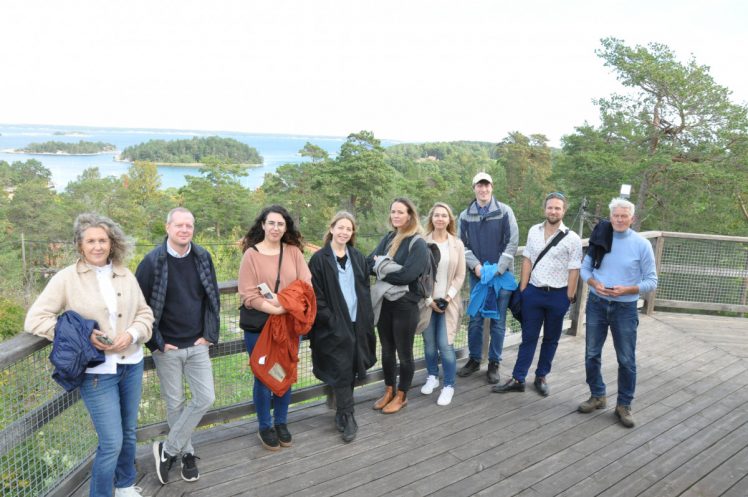
In the beginning of September I returned to this wonderful spot, along with some 50 academics, entrepreneurs, investors and environmentalists. The occasion that brought us here was the first Baltic Sea Water Talks; a meeting of diverse professionals in search of practical solutions for challenges in the Baltic Sea.

KTH researchers visiting Utö’s famous windmill

People on the island of Utö have always depended on what nature gives, in one way or the other. While this might be said for all of humanity, it is never more obvious than on an island at sea. Already from the 12th century, it was the iron ore on the island that brought prosperity. After the mining was abandoned in the 19th century, all the trees were cut down to supply timber to the growing city of Stockholm. But fish was plenty and by the early 1900s, there were some 70 fishing boats stationed on Utö. Now there is only one part-time fisherman left. Instead, the island has become a popular tourism destination thanks to its unique nature, its heritage and birdlife. Yet again, nature provides the basis for local livelihood. But how do we make life in the archipelago sustainable after centuries of predatory resource extraction?

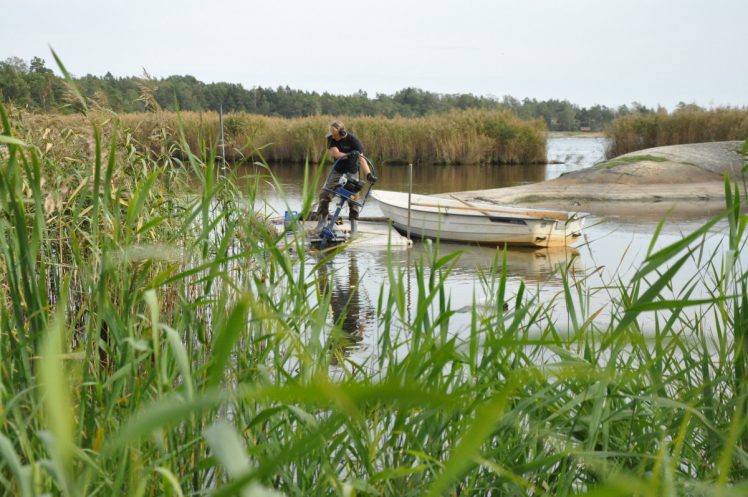
This is where the pikes and the potatoes come in. Initiativ Utö, a local NGO and also the host of the WaterTalks, has started to build “pike factories”. In these constructed wetlands and estuaries they aim to both restore the fishing stock and reduce nutrient loads. Nutrients in the run-off and sediments are collected through mechanical and biological methods and the estuaries are breeding places for pike. The pikes restore some balance in the local marine ecosystems and attracts sports fishers. The recovered nutrient is used in local small-scale farming, and seems to be particularly good for potatoes.

Restoration work in the estuary

Currently, two research groups from KTH are actively doing research on the pike factory wetlands. A team led by Guna Rajarao Kuttuva looks into monitoring techniques and optimisation of the wetland. Another team led by Zeynep Cetecioglu Gurol is investigating the potential of phosporous “mining” from the estuary sediments, where valuable phosphorous could be extracted as a commercial product. Research and innovation like theirs moves us towards “closing the loop” for food production on a whole new scale. Could the polluted seas become a source for valuable and scarce nutrients? Can we move towards a balance with nature and stop exhausting nature’s resources one after the other?

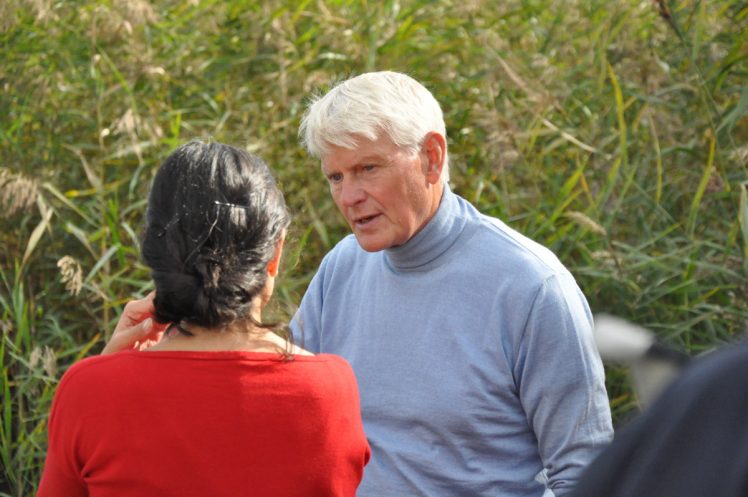
Thomas Hjelm of Initiativ Utö talking to Zeynep Cetecioglu Gurol in the wetlands

And most importantly, what to do with the potatoes? For my part, I prefer the Swedish traditional dish “raggmunk”, a type of potato pancake. I can tell you that the Utö potatoes grown on sludge from the pike factory, are particularly well suited for raggmunk. Bon appétit!

Oooh those raggmunks!

Utö-Raggmunkar

10 Utö potatoes

3 eggs

2 dl flour

4 dl milk

1 teaspoon salt


Grate potatoes coarsely

Mix egg, flour, salt and milk and add grated potatoes

Form small “beefs” into saucepan and fry on medium-high, rich with butter

Serve with lingonberries

Le chef at work – grating away in the kitchen

When Research Interests Mix

The WaterCentre@KTH is a hub of expertise in water research at our university. Its director and longstanding researcher at our division, David Nilsson, is working together with several scholars from the fields of EKV Kraft- & Värmeteknologi, Vatten- och Miljöteknik, Industriell Bioteknologi, Resursåtervinning, and Hållbarhet, Utvärd och Styrning. Furthermore, it cooperates with Stockholm Vatten och Avfall. Partners of the centre are ivl – Svenska Miljöinstitutet, Stockholms Stad, Stockholm Environment Institute and Värmdö Kommun. Multiple researchers at our division are also involved in the centre’s work or have been in the past, such as the Water Centre’s Research Coordinator Timos Karpouzoglou.

Water is crucial not only for the survival of living organisms, but also for many industrial purposes. It is here that the research interests of the Water Centre converges with ongoing projects at our division. Since the research project Nuclear Waters tries to put water at the centre of its historical nuclear studies, common interests occur frequently. The following is a repost from a text published on the Water Centre’s Blog, highlighting one example where both interests came together.

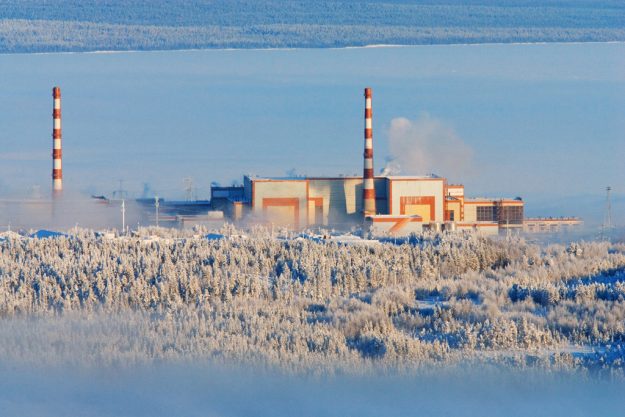
Kola Nuclear Power Plant at Lake Imandra, above the Arctic circle. RIAN Archive, Licence CC BY-SA 3.0.

Repost from the WaterBlog@KTH

Why Water Matters for Nuclear Power

We tend to associate nuclear power plants with many different things: smoking cooling towers, Homer Simpson-like operators, or dramatic TV series like HBO’s Chernobyl. But something people generally do not associate nuclear power plants with are massive amounts of water. Still, water is at the centre of nuclear power’s historical development, contemporary challenges, and further future.

The connection between water and generating nuclear power goes back to the Industrial Revolution, when steam technologies such as boilers and steam generators were used to heat up water, turn that water into steam, and use the energy of that steam to generate power. However, this led to many steam explosions with deadly casualties. Countries like the U.S., France and Sweden enforced safety rules, which stipulated how the boilers had to be designed and what the allowed pressures and temperatures were.

In the 1950s, more and more countries saw the potential of using nuclear technologies to generate power. With its Atoms for Peace-program, the U.S. took the lead and promoted the reactor type they developed: the light water reactor. This reactor type uses normal water as a coolant and had its origins in both naval propulsion and fossil fuel power generation. This continuity thus made water-cooled reactors a relatively simple way of rolling out nuclear power fast.

The safety in nuclear power plants was therefore determined by the control of water and the understanding of thermal-hydraulic phenomena, such as transients and steam explosions. The pressure vessels, steam generators, valves, pipes, tubes, and pumps of nuclear power plants suddenly became subjected to the steam regulations of the Industrial age. This created new risks since these codes and regulations did not consider radiation. One of the codes that underwent revision was the Boiler and Pressure Vessel Code of the American Society of Mechanical Engineers (ASME). The Code started travelling and was, for instance, almost directly implemented in all Swedish nuclear power plants. Gradually but surely, nuclear safety regulations in the West became more ‘nuclear’ as the intersection between water, steam, steel, and radiation became better understood and nuclear accidents, such as Three Mile Island, pushed governments for more safety legislation.

For the USSR water was equally crucial along all steps of the nuclear lifespan, such as mining, fuel element production, exploitation, and the storage of spent nuclear fuel and radioactive waste. In general, all nuclear power plants were placed next to either a river, a lake or the coast – the latter being an exception. The most common source of coolant was river water. Interestingly, those rivers usually had to be previously ameliorated and often artificial water reservoirs were created.

A specific setup was used for so-called energy complexes, a special form of nuclear-hydrotechnical combine. They embodied the combination of nuclear and hydro power, agricultural irrigation, and fish cultivation in one location. Furthermore, constructing them meant to manipulate water bodies with newly created dams. In this way an energy complex was created to procure valuable synergies through the multiple usage and partial recycling of water.

Finding the right location was crucial for an envisioned energy complex. It needed to be a location with sufficient water supply, with suitable ground conditions, without earthquake or flood dangers. In addition, the complex needed to be within reasonable distance towards a (potential) industrial settlement to provide this population centre with electricity. Safe and ample water supply had to be considered during site selection and was one of the essential criteria for their construction. If there was not enough water, the complex could not be built.

A leading institute for the creation of energy complexes was Gidroproekt (Hydroproject). As the name suggests, Gidroproekt was a Soviet hydraulic research, design and construction agency. By joining its hydraulic expertise with newly introduced nuclear engineering, this institute was the very place where knowledge transfer between these two prestigious engineering communities took place. Here, the water-focused perspective prevailed and embedded nuclear technology into hydro-ameliorated aquatic systems. It promised prestige as well as quick results – and Gidroproekt readily delivered.

In sum, both in the East and the West, water played a crucial role in the development of nuclear power. In the West, knowledge about water was essential for developing nuclear safety practices. In the East, water was seen as a crucial resource, for powering energy complexes in the struggle for building a Communist state. Nuclear’s reliance on water meant that nuclear power plants and energy complexes were meeting places of different long-standing traditions and communities. Given the large number of water-cooled reactors in the world today, and including those under construction, it is fair to say that this crucial connection is there to stay.

By Achim Klüppelberg & Siegfried Evens
Doctoral students at the division for History of Science, Technology and the Environment, within the research project Nuclear Waters.

The power to define resilience in social–hydrological systems

Timos Karpouzoglou, researcher at the division, has published an article together with Art Dewulf, Jeroen Warner, Anna Wesselink and nine other scholars on the social implications of hydrological systems.

If you are interested in their work, you can find the abstract below and the full text here.

Abstract

Since the early work on defining and analyzing resilience in domains such as engineering, ecology and psychology, the concept has gained significant traction in many fields of research and practice. It has also become a very powerful justification for various policy goals in the water sector, evident in terms like flood resilience, river resilience, and water resilience. At the same time, a substantial body of literature has developed that questions the resilience concept’s systems ontology, natural science roots and alleged conservatism, and criticizes resilience thinking for not addressing power issues. In this study, we review these critiques with the aim to develop a framework for power-sensitive resilience analysis. We build on the three faces of power to conceptualize the power to define resilience. We structure our discussion of the relevant literature into five questions that need to be reflected upon when applying the resilience concept to social?hydrological systems. These questions address: (a) resilience of what, (b) resilience at what scale, (c) resilience to what, (d) resilience for what purpose, and (e) resilience for whom; and the implications of the political choices involved in defining these parameters for resilience building or analysis. Explicitly considering these questions enables making political choices explicit in order to support negotiation or contestation on how resilience is defined and used.

A Water Conference in spite of Corona – WaterBlog@KTH: Reflect, Rethink, Refill

“Water is everywhere in our economy, in nature and culture. Billions of years ago our planet had cooled down enough for the surrounding gas clouds to condense, fall down to Earth’s surface, and form the oceans. Everything started with water and water is still a precondition to all life. No wonder that World Economic Forum in 2016 listed water as the largest risk factor for sustained well-being on the planet.” https://www.kth.se/water/about

With the focus on water, one thing led to another a few years ago and in 2017 the WaterCentre was initiated at KTH Royal Institute of Technology – linked to our Division through center director David Nilsson, and research coordinator, Timos Karpouzoglou, both researchers with us. The Centre is a collaboration with a “mission to bring about water innovations for a sustainable future of the Earth”.

In line with their own motto “expect the unexpected”, the WaterCentre managed to sum up their four first year in a covid-19 safe conference last week. Read all about it in their blog, and visit their homepage for more news, research and other interesting pieces:

WaterBlog@KTH: Reflect, Rethink, Refill

https://www.kth.se/water/

The Water Centre Report 2017-2020

The WaterCentre@KTH has already existed for four years. Wow, time flies! To mark the ending of our first mandate period, we had decided to organise a water conference showcasing research, water inn…

Source: A Water Conference in spite of Corona – WaterBlog@KTH: Reflect, Rethink, Refill