MSc Technology, Work and Health
In this programme, you will learn how to plan, design and analyse work environments from a sustainability and performance perspective. Ergonomics and Work Environment management enable functional and well-designed work systems, organisations and environments. With skills in applying occupational safety and health management, our graduates make vital contributions to a healthy and productive workforce. The programme is accredited by IOSH, the Institution for Occupational Safety and Health.


Technology, Work and Health at KTH
This master's programme provides a deeper understanding of the interplay between humans, technology and organisation, from the perspectives of sustainable work and organisational performance. You will gain knowledge and proficiency in proactive occupational safety and health (OSH) management, as well as in planning, designing and analysing work environments. You will acquire advanced theoretical and applied knowledge of physical, cognitive and organisational ergonomics, which is needed to address issues of worker health and work sustainability in all sectors of society. You will learn how to develop organisations and work processes that contribute to a more sustainable working life.
The programme combines on-campus sessions with independent study, project work and digital learning activities. Throughout the programme, you engage with real workplaces and organisations in both the public and private sectors.
During the first year, you have the opportunity to specialise in either Work Environment Engineering or Human Factors and Ergonomics.
Work Environment Engineering
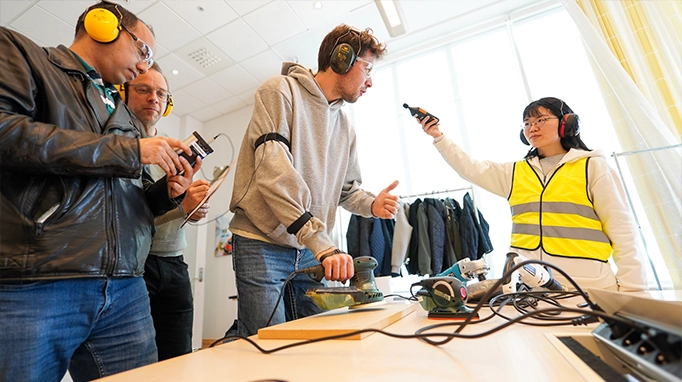
The Work Environment Engineering coursework includes both theory and practice. It allows graduates to identify, measure and evaluate physical, chemical, and biological risks in the workplace. It also allows them to develop, implement, and evaluate control measures that make the workplace safer. Furthermore, this specialisation includes coursework in systematic work environment management, leadership, and change management. This enables graduates to communicate risks and motivate improvements when proposing workplace solutions.
After completing your studies, you will have the relevant knowledge and proficiency to work as a Work Environment Engineer (formerly called Safety Engineer). To learn more about Work Environment Engineering as a job role in Sweden, please see the
job description listed by SACO, the Swedish Confederation of Professional Associations (In Swedish)
.
Human Factors and Ergonomics
The Human Factors and Ergonomics specialisation focuses on identifying, measuring, and evaluating musculoskeletal and cognitive loading. You will learn to apply theory, principles, data and methods to design work environments and systems that optimise human well-being and overall system performance. In addition to systematic work environment management, leadership, and change management, this specialisation includes practical skills in planning and designing work environments and intervention evaluation.
After completing your studies, you will have relevant knowledge and proficiency to work as a Human Factors Specialist or Ergonomist. To learn more about Ergonomics and Human Factors professions, please see the professional scope described by IEA, the International Ergonomics Association .
The programme is
accredited by the Institution of Occupational Safety and Health (IOSH)
, a chartered body for health and safety professionals with over 50,000 members worldwide. The accreditation confirms that the programme meets internationally recognised standards for professional competence in occupational safety and health education.
This is a two-year programme (120 ECTS credits) in English. Graduates are awarded the degree of Master of Science. The programme is given at KTH Campus and KTH Flemingsberg in Stockholm by the School of Engineering Sciences in Chemistry, Biotechnology and Health (at KTH).
Programme structure and progression
During the first year, you build a foundation in technology, work and health through mandatory courses in occupational health and safety management, work environment economics, human-technology-organization systems, change management, and scientific methodology. Depending on your chosen track, you also take courses that deepen your knowledge within Human Factors Ergonomics or Work Environment Engineering.
In the second year, you continue to specialise within your chosen track through advanced courses in areas such as planning physical worksplaces, product development, and measurements of air contaminants, noise and vibrations. You also take a mandatory course in system safety. The programme concludes with a degree project carried out in your area of focus. The project may be done individually or in groups of two.
Courses in the programme
The courses in the programme cover topics such as occupational safety and health; physical, cognitive and organisational ergonomics; musculoskeletal, physical, chemical, and biological hazards in the workplace; human factors; change management; risk assessments; product and production development; design for safe and sustainable work; leadership and sustainable work.
Courses in the master's programme in Technology, Work and Health


Future and career
Graduates work as work environment engineers, human factors specialists, ergonomists, labour inspectors, occupational safety and health consultants or project managers in public authorities, inspectorates, consultancies and private organisations. The IOSH accreditation supports global professional recognition in the field, and the programme provides a strong foundation for roles that involve investigations, risk assessments, change management and work-environment design.
A master's degree in Technology, Work and Health gives you:
- the capacity to actively influence and manage change and development projects within the field of technical work environments.
- knowledge of and competence in risk assessment methods, safety strategies and project management within production development.
- the ability to make a difference in the health and economic productivity of people, companies, and society.
- entrée into a dynamic, high-demand career.




Sustainable development
Graduates from KTH have the knowledge and tools for moving society in a more sustainable direction, as sustainable development is an integral part of all programmes. The three key sustainable development goals addressed by the master's programme in Technology, Work and Health are:



The programme addresses SDG 3, SDG 8 and SDG 9 by focusing on safer work environments, healthier workplaces and sustainable work systems. You learn how to identify and reduce physical, chemical, biological and psychosocial risks, and how to design work environments that support both human well-being and organisational performance.
Faculty and research
The programme is closely linked to research in the Division of Ergonomics, and many student projects are based on data from real workplaces. Teaching is supported by academic staff and workplace specialists with direct experience of occupational safety, ergonomics and organisational development, which gives the programme a clear connection to practice.


The senior researchers are: