KTH Logo

New Article: Media: The Case of Spain and New Spain

Adam Wickberg, researcher in our division, has published a new article together with John Durham Peters (Yale Univesity) in the esteemed journal “Critical Inquiry”, published by the University of Chicago.

In “Media: The Case of Spain and New Spain” Peters and Wickberg develop the new concept of “environing media”. They are focussing on the rich cultural heritage of Mexico, looking back over the last 500 years of its media history.

Profile picture of Adam Wickberg

Here is the abstract of this intriguing piece. If it catches your interest, check out the whole article here.

Abstract

This article develops the new concept of environing media against the case of Mexico’s complex history over the past five centuries. To do this, it stakes out a theoretical development consisting in a shift in understanding from media as content-delivery systems to data processors, combining it with a processual understanding of environment as an ongoing and historical process of environing.

In addition, the article discusses examples of indigenous media, an area that has so far received very little attention. The Aztec empire was as dependent on media forms as the Spanish colonizers who replaced it, and there are numerous cases of knowledges and practices surviving in hybrid forms, for example as part of maps. For much of its history, the field of media studies has been biased toward questions of (1) ideological or attitudinal influence caused by (2) modern or emergent technologies.

This article goes in another direction by thinking about media as (1) environing and (2) residual. Media are agencies of civilizational and environmental order. The rise of digital media in recent decades has reinforced the fundamental logistical role of media as agencies that arrange, catalog, organize, network, and index people, places, and things. Our understanding of media as fundamental constituents of organization joins the recent interest in infrastructures. Calendars, clocks, towers, names, addresses, maps, registers, arms, and money are all infrastructural media. Such media become second nature, morphing biorhythms and altering ecosystems.

Today’s planetary digital infrastructure builds upon the long legacy of resource management via databases. We argue for a longer genealogy of the nature shaping logistical role of media that is so evident today. In this article, we refine and exemplify these claims via a case study of some environing media in Mexico, a country with a deep and rich media history.


”Två fel gör inte ett rätt” – How China is taken as an argument to not act for the climate

Nina Wormbs, Professor of History of Technology at the division, has published an article relevant in the context of the recent COP26 climate summit in Glasgow in the daily newspaper Dagens Nyheter on 17 November 2021. In the following we will present a short summary of its main points in English, while you can read the original in full length and in Swedish here.

Profilbild av Nina Cyrén Wormbs

Summary:

When climate issues are discussed in Sweden, China is often taken as a comparison. In fact, people use China as an argument to not act in regard to climate change.

During the recent COP26 summit in Glasgow, the focus was also on China, since the country is highly invested in coal both at home and abroad. It is obvious that we need to work with China together, since its emissions are enormous. Despite this, China has recently undertaken steps towards a sustainable society.

In particular, it has become normal to point to China in a debate, if one does not want to engage with those questions the current climate crisis is bringing up. This can include coal power plants but also a justification for flying to Mallorca or Thailand for fun, because Chinese tourists could be seen in Gamla Stan. In order for this practice not to spread further, we have to understand why those arguments are not valid and what they result in.

First, it makes no sense to motivate one’s own harm-doing by arguing that someone else would produce even more harm.

Secondly, the comparison with China’s emissions are an eternal but nevertheless problematic way of relativising one’s own influence. Because you are always able to find someone who produces more emissions than yourself. More than Sweden. More than Europe. Of course it is important how much we emit as humanity, but the China-argument suggests that there would be some form of give- and take, like as if life would be a zero-sum-game. Instead, it is the opposite: every ton of CO2 counts.

Additionally, the China-argument points to an understanding, in which one does not have to do a tiny bit of right, while someone else does so much wrong. Maybe this argument is spreading, because more and more people repeat it. People in Sweden have limited knowledge of China. China is bigger, has more people, and all of them are striving towards a better life. That’s why it might be easy to point to China, in order to relativise one’s own responsibility.

Thirdly, China is often portrayed as an enemy in Swedish media. It can therefore be seen as a nation different from Sweden, being imagined like the negative “other”.

Why are the USA never mentioned in this context, despite their higher historical and per-capita-emissions (IPCC and carbonbrief.org)? Qatar, Kuwait and the United Arab Emirates are also hardly ever named, even though they are leading the per-capita-emissions statistics.

If one looks into the emissions of production chains of consumer goods, of which a lot are produced in China but used somewhere else like in Sweden, the territorial basis for emission-calculations seems off.

Furthermore, within most individual nations the gap between rich and poor gets bigger, which means that the individual emissions are not what the average suggests, but rather high if you are rich, or low if you are poor. Therefore, it would be a great idea to change the focus from nations to individuals, like Chancel and Piketty suggested in 2015.  This makes even more sense, since the richest 10% of the world’s population accounted for 50% of emissions since 1990. Those 10% can be found in every country, but they are not evenly distributed. More so, since 40% of those live in the USA, while only 10% live in China. It might be a cold shower for a Swedish discussant that every Swede with a monthly income of over 27,500 SEK belongs to this group.

This is not being written to support China’s climate policies. Instead, it is to show that China is not relevant if one wants to discuss a domestic climate action plan, as the relationship between being rich and producing lots of emissions is evident – and Sweden is one of the richest countries on earth.

Profit from Sverker Sörlin’s book on crisis became new scholarships for even more books on crisis!

In early summer 2020, Sverker Sörlin published the book “Kris! Från Estonia till Corona” (Crisis! From Estonia to Corona) on Bokförlaget Atlas. Here he puts the Corona pandemic as a crisis in a historical perspective along with other big crises in our society. He also shares his own experience from being ill with Corona. The publisher together with Sverker decided early on that the income of the book would go to scholarships for those who writes about crises. Last week the two reciepients of the scholarship was announced: Rasmus Landström, who will write a book about the hidden solutions to the climate crisis, and Ingrid Eckerman, Jan Stattin, and Karin Fridell Anter that will write about the refugee crisis, civil society and the rule of law. The two projects will recieve a total of 25 000 sek each.

Read more about the project in a Swedish article from Arena Idé, or translated to English below: https://arenaide.se/stipendier-till-bocker-om-klimatkrisen-och-flyktingkrisen/

“Rasmus Landström’s project Ustopi: The Hidden Ways of the Climate Crisis will result in an essay and a subsequent book. Rasmus is a literary scholar, critic and author of the critically acclaimed book Arbetarlitteraturens återkomst (2020). In his application, he writes that utopias are often criticized for “advocating over-planned model societies. That critique is based on a misunderstanding of utopia as a literary genre. But also that the concept of ‘planning’ is in such a state of disrepute today. The climate crisis shows an enormous need for democratic planning of the economy. That we expand the welfare sector to more parts of society and disconnect parts of the economic life from the market’s chaotic price signals. ” Ustopia is a combination of utopia and dystopia, coined by author Margaret Atwood.

Jan Stattin, Ingrid Eckerman and Karin Fridell Anter’s project Flyktingkrisen – Civilsamhället, rättssäkerheten och de unga flyktingarna 2015–2020 (The refugee crisis – Civil society, the rule of law and the young refugees 2015–2020) will result in a book. A historian, a doctor and an architect have chosen to come together to critically examine one of the crisis understandings that have characterized our time most deeply. In the application, they write that “refugee crisis” is a word that has been used extensively in debate and the mass media since 2015, but which is rarely given a more precise meaning. “We who are involved in the civilian work of civil society see the crisis of asylum seekers and our own, when we try our best to support people whose lives are being torn apart. We also see an ever deeper social crisis where the handling of refugees exposes major shortcomings in what is claimed to be legal certainty, and where the public debate is based on untruths that are never questioned,” the authors write further.
Translation of the article: Intäkterna från Sverker Sörlins bok Kris räckte till två stipendier: Rasmus Landström ska skriva om klimatkrisens dolda utvägar. Ingrid Eckerman, Jan Stattin, och Karin Fridell Anter ska skriva om flyktingkrisen, civilsamhället och rättssäkerheten published in Arena Idé, February 2021.


Adam Wickberg and Johan Gärdebo introducing the concept of “Environing Media”

How has the relation between humans and Earth developed over the centuries? How have colonial and capitalist agendas operated globally, while the view of the planetary environment was shaped by the media?

Wickberg and Gärdebo see this relation as a “profound renegotiation” which continuously is reshaped, but which definitely encountered a “fundamental shift” after 1500 with the acceleration of human globalisation. The concept of environing media shall contribute to the scientific understanding of the role of media as a mediator to how the world is being seen on the basis of an ever-increasing collection of data in an age of digitisation. This can be used to understand the internal and ideological mechanics of colonial empires in a historical perspective. It also allows to understand today’s discourses on international flow of commodities and the movements of people on the background of the influence of modern mass media.

Check out this innovative approach in the journal Humanities!

Teaching the film ONE TABLE TWO ELEPHANTS: A resource for online teaching about postcolonial ecologies and Southern urbanism

by Jacob von Heland and Henrik Ernstson, Co-directors of The Situated Ecologies Platform

We have made the film One Table Two Elephants (84 min, 2018) free for use and remixing, except for commercial purposes (CC-BY-NC). This website on our Situated Ecologies Platform provides a link to the full film as well as educational resources, key references, questions for students and reviews, and notes on cinematic ethnography and our trilogy of films on postcolonial ecologies. The website will be updated continuously with new materials as we ourselves—and hopefully you—share your teaching experiences with the film.

Filmed in Cape Town, One Table Two Elephants provides a textured and nuanced account of knowledge politics in a postcolonial city, which we have found translates well to many other places. It opens up important questions about nature, urbanization, class, race and the living remains of colonialism. The film deliberately does not tell an easy story, because that is now how things are. Instead we trust the audience to engage and make up their minds and feelings, reading it in diverse ways to engage with one another. Many students have found it intriguing and engaging.

We also believe the film can assist in developing ONLINE TEACHING in these times of COVID19. The film will suit the use of a “flipped classroom,” allowing students to watch the whole or parts of the film before class and read one or two texts, which we have suggested. This preparation provides conditions for a rich discussion. However, there are various other ways of using the film in teaching and learning and we hope you will share with us your teaching experience, either through an email to us, or by posting on social media with the following hashtag: #Teaching1T2E .

We especially thank Paul Munro and Jim Igoe for using the film in their courses on Political Ecology and Indigenous Landscapes/Anthropology, respectively. We also like to thank Sachiko Ishihara, Asma Mehan and Ruben Hordijk for engaging critically with the film in their own course work. We have learnt from these scholars and students.

LINK to #Teaching1T2E: http://www.situatedecologies.net/one-table-two-elephants.

About the film: One Table Two Elephants (84 min, CPH:DOX, 2018) is a cinematic ethnography created by Jacob von Heland and Henrik Ernstson that deals with race, nature and knowledge politics in the postcolonial city (Official trailer). The film has been nominated to several prizes and screened at film festivals in Copenhagen, Cape Town, Tirana, Nijmegen and Stockholm.

Accolades:

Scholarly reference:

  • Heland, Jacob von, and Henrik Ernstson. 2018. One Table Two Elephants (84 minutes, cinematic ethnography, Color, HD, Dolby 5:1). World Premiere in Competition at CPH:DOX 2018, March 20. Published by The Situated Ecologies Platform (CC-BY-NC) at this fixed URL: bit.ly/1T2Ethefilm

Cosmopolitanism in the Anthropocene (with a Postscript on the coronavirus)

By Prof. Miyase Christensen (Stockholm Univesity & Royal Institute of Technology, Sweden)

This is a moderated version (see Postscript at the end) of a chapter published in “The Sage Handbook of Media & Migration” (Sage, 2020). Editors: Kevin Smets, Koen Leurs, Myria Georgiou, Saskia Witteborn & Radhika Gajjala.

Introduction

In early 2019 it was announced that Greta Thunberg, a 16-year old Swedish climate activist, had been nominated for the Nobel Peace Prize. Thunberg originally gained national and international fame with her (then) solo climate-protest outside of the Swedish parliament building in Stockholm, a protest that grew in fame to the point where it developed into the ‘School Strike for Climate’ movement and the genesis for tens of thousands of student ‘strikes’ worldwide. The question, for some, was what Thunberg’s environmental protests had to do with peace. The answer can be found in, among other places, Africa where disputes over access to water along the Nile continue to escalate (with the threat of military intervention). In addition, and just a few days after Thunberg’s nomination, a cyclone hit the African countries of Mozambique, Zimbabwe and Malawi, killing large numbers and causing floodwaters in excess of 20 feet, destroying 90 percent of Mozambique’s fourth largest city, Biera. Thus, the concept of ‘peace’ cannot be separated from nature, as we witness both military conflict and humanitarian catastrophe in the Anthropocene (the current geological age marked by human influence on the environment), nor can it be separated from how human impact on the environment shapes migration, mobility and peace.

As Burke (2013) has noted in relation to what he calls the ultimate failure of a ‘moral community’, recent events such as those in north and east Africa are stark reminders of the futility of considering rising global temperatures, resource depletion or natural disasters simply as issues of national relevance:

When states draw on the same water sources, experience a common climate, depend on global prices and currency values, transmit conflict and weapons beyond their borders, and threaten and affect the lives of others far away, enclosed or circular models of moral community — however generous — fail to reflect an urgent reality. It is no longer a matter of deciding whether national interests and global goods must clash, but of honoring the common space of life and death that we have created.
Clearly, in all of these cases — from warfare to famine to human/natural disasters — mobility and migration are central components. It is the purpose of this chapter to offer a discussion of cosmopolitanism vis-à-vis mobility and migration from the standpoint of planetary politics and the Anthropocene, rather than within a global framing. Here, cosmopolitanism and mobility are considered in an integrativemanner in which the material and symbolic aspects can be considered together to open up new cosmopolitan horizons.

A Brief History Of Cosmopolitan Thought

In her 1980 collection of essays, Under the Sign of Saturn, Susan Sontag wrote a chapter on the Bulgarian-born writer Elias Canetti, who was taken from Austria to Britain in 1938 to escape the incoming Nazi regime. Canetti, described as the ‘son of a family of wandering Sephardic Jewish merchants’ and inspired by Goethe, wrote of his experiences in war-torn London. Sontag saw the connection between Canetti’s personal history, his writing and his connection to cosmopolitanism, and wrote of him:
He has, almost by birthright, the exiled writer’s easily generalized relation to place: a place is a language. And knowing many languages is a way of claiming many places as one’s territory. Canetti has the privilege and the burden of understanding, Jew that he is, the higher cosmopolitanism. (Mitgang, 1981)

Sontag continued by writing that a great deal of Canetti’s works point toward the importance of ‘how to pay attention to the world’ and that, in his work, ‘there is no doctrine’. Of course, the very form of cosmopolitanism that Sontag ascribed to Canetti — the fluid, exiled Jewish artist able to adapt and understand multiple cultural contexts — was the same form reviled by Stalin in the late 1940s and early 1950s Soviet Union. Employing the term ‘rootless cosmopolitan’ (originally used in 19th century Russia against Jewish writers), an anti-Semitic campaign to smear Jewish intellectuals was put into action in which their loyalty to both party and nation were questioned.

The flexibility and utility of the terms cosmopolitanand cosmopolitanism — there were, after all, only 30 years between the pejorative Stalinist use and Sontag’s celebration — speak to the long, rich (and often problematic) history of the terms. The concepts of cosmopolitanism and the cosmopolitan have, in various iterations and for various political and social ends, been woven into the intellectual history of humankind: from early Chinese Confucianism, to the ancient Greeks to Stalinist Russia. Ancient Greece is perhaps most famous for what was clearly not a cosmopolitan political and social project, namely evident in the political philosophies of Plato and Aristotle, in which men (and only men) swear their allegiance to a specific city (‘polis’) and its inhabitants alone. This essentially anti-cosmopolitan ideology — where sharing or collaborating with those who resided outside of polis was frowned upon, and where the only foreigners with whom one could/should interact were those already living within the walls of the polis — was juxtaposed by the philosophy famously attributed to the Cynic Diogenes, a 4th century BC resident of Sinope (now part of the Black Sea region of Turkey) who, when asked where he came from, answered: ‘I am a citizen of the world (kosmopolitês)’. This philosophy was then adapted by the Stoics and crystalized by the philosopher Hierocles who envisioned Stoic cosmopolitanism in the form of concentric circles with the human mind at the center, expanding outward to encompass family, extended family, local community, wider community, country/nation and, at the outer edge of the circles, the entirety of the human race. The goal, Hierocles posited, was to pull these various circles inward, thereby making the human, the national and the local issues of the person and the mind.

The ‘citizen of the world’ position taken by Diogenes was later adopted by intellectuals such as Thomas Paine. While in Paris in the late 1790s, Paine argued that, although not French by birth, his opposition to the execution of the deposed king Louis XVI — Paine claimed that capital punishment was inhumane and that the former monarch should be exiled — should be taken seriously because he was a ‘citizen of the world’. As Lamb (2014) writes, there is perhaps no political thinker in the post-ancient era that is so closely associated with the philosophy originally espoused by Diogenes. Lamb (2014: 638) notes that Paine regularly points out the ‘universal validity (and falsity) of moral and political claims’ and that their ‘evaluation can never be confined to one particular national, historical or cultural context’. In a famous line from his pamphlet Common Sense, and in the spirit of universalism and inter-connectedness, Paine (2003) unwittingly presaged questions related to environmental degradation and the Anthropocene when he wrote, ‘the cause of America is in great measure the cause of all mankind’. At almost precisely the same time as Paine was writing Common Sense, Immanuel Kant published Perpetual Peace: A Philosophical Sketch(1970) in whichhe outlined his ideas for a program of global peace to be enforced by national governments. In addition to a list of articles intended to eliminate warfare, three additional articles were included to ensure that peace and stability could be maintained with the third of these directly related to cosmopolitanism: ‘The law of world citizenship shall be limited to conditions of universal hospitality’. This ‘Cosmopolitan Law’ was an addition to constitutional and international law and was predicated on the belief that human beings have inalienable rights as citizens of earth and not just as citizens of states.

What this brief history of cosmopolitanism shows us is not only the flexibility in how the term has been used, but, also, how the conception of being a ‘citizen of the world’ tends to dominate the epistemological framing of being a cosmopolitan. This is a citizenship that is on the surface dynamic, but ultimately static and rooted in time. Interestingly, however, it was the original proponent of cosmopolitanism, Diogenes, who provided the most forward-thinking and radical conception of the term. For Diogenes, cosmopolitanism was more than simply the acceptance of ‘the other’, it was about active (rather than theoretical) participation in dissent: to challenge prevailing wisdom, to question power, to expose excessive consumption and greed and to live a life free of material possessions and waste. The ‘anti-elite and anti-institutional notions of belonging and citizenship’ held by Diogenes and the Cynics were in opposition to the more conservative Stoic tradition (Delanty, 2012: 3). It is this conception of cosmopolitanism that is perhaps most useful when considering the relationship to the Anthropocene and environment as it foregrounds the long-term, temporal impact of human action (and inaction) rather than focusing on short-term impact. For example, Marxist notions of dominating nature and expanding production to benefit workers were geared toward an ultimately cosmopolitan end: the erosion and collapse of nation-states and the emergence of a classless, humanitarian society. Yet, this end is untenable and can result in the destruction of earth if no governed tightly and sensibly. In the subsequent sections, how cosmopolitanism must embrace not only a philosophy of inclusion, but one of dissent and activism in the face of radical environmental change, will be addressed.

Cosmopolitanism in the Mediated Anthropocene

How might we conceive of a cosmopolitan vision connecting the concepts of the Anthropocene and migration within the more radical tradition of Diogenes and the Cynics? One way to start would be to challenge the ways in which media and communication studies have traditionally addressed questions of cosmopolitanism and the media. To date, the mediated ‘cosmopolitan vision’ has usually been discussed within the parameters of consumption of various forms of representation: from popular culture to news (Robertson, 2019). Such a focus, however, runs the risk of reducing media ‘consumption’ to the act of reading, listening or seeing. It doverces the acts of producing and purchasing media hardware from the act of absorbing representation. This conception also ignores what Parikka (2012; in Christensen & Nilsson, 2018) described as the ‘dirty matter’ produced in modern society. This matter includes the chemicals and minerals required for the production of contemporary communication technology hardware: chemicals and materials that are mined in predominantly poorer nations, with catastrophic environmental effects. In addition to the devastating consequences of the extraction of these materials, there exists similarly devastating environmental consequences for the disposal of the same materials. Cultural imperialism studies (e.g. Boyd-Barrett, 1977; Schiller 1976; 1991) addressed the ‘core-periphery’ relationship between ‘developed’ and ‘developing’ nations, yet reduced the material that would flow back from core (wealthy nations) to periphery (poorer nations) to media/cultural products (TV programs, films, music). This analysis, while canonic and highly insightful, overlooked the extent to which the discarded hardware of media, including vast quantities of toxic material (in the case of, for example, computers), are also dumped in poorer nations, again leading to environmental degradation (Christensen & Nilsson, 2018: 271–2).

In relation to the Anthropocene and migration, therefore, a radical cosmopolitan perspective must take into account the material impact of the consumption of media hardware upon the environment, and the potential of that consumption to contribute to the conditions that lead to forced and involunatry migration. This follows the longitudinal perspective, embraced by Diogenes, within which all stages and all forms of media ‘consumption’ — from the mining of the materials required to produce media hardware to their eventual disposal in the form of e-waste — must be considered for a truly radical and holistic cosmopolitian understanding of media consumption. This is what Parikka (2012: 97) termed ‘media-natures’, which would be used for the study of the ‘continuum between mediatic apparatuses and their material contexts in the exploitation of nature’.
In media and communication studies, notable perspectives and empirical analyses have been produced over the past few decades. Yet, we have probably just begun to scratch the surface in terms of the potential of cosmopolitan thought. As a result of media and communication studies being the off-shoot of various other disciplines (for example, Literary Studies in the US), as well as being periodically ridiculed in popular press as ‘Mickey Mouse Studies’ in the UK not so long ago, there has, at times, been a tendency to defer to dominant paradigms of thought and research, and not to develop new, radical, progressive theory (related to, for example, issues of central importance to the earth on which we live). It is telling that many of the strands of theory and thought that were perceived as marginal to media and communication research — such as environmental humanities — should, in truth, be at the heart of media and communication studies. It is only this form of thinking that will enable media and communication studies to take the steps required to address the relationship between, for example, the Anthropocene and media consumption. In concrete terms, Peters (2015: 2) has argued that we should ‘conceive of the media as both nature and culture’.

One connective tissue between this new form of theory and research, the Anthropocene and the theme of migration, is that of geo-politics. The traditional conception of geopolitics has been one of ‘the world’ or ‘the global’, yet we need to move beyond these concepts and embrace the notion of planetary politics. Along these lines, Elden (2013) suggests that we think of a ‘politics of the earth’ rather than a ‘politics of the global’. This meshes well with Burke’s (2013) cosmopolitan notion of ‘honoring the common space of life and death that we have created’. Of course, migration is one part of geo-politics and so a cosmopolitan vision should go beyond moral, ethical, legal and representational notions, and develop a more holistic understanding within the framework of the Anthropocene. As Christensen and Nilsson (2018: 272–3) write: ‘bringing in geopolitical perspectives (makes) visible the planetary scale through addressing questions of geographic interplay as well as the human scale through an emphasis on politics and power (such as colonial legacies and contemporary dynamics of subordination)’.

Conclusion

In this short essay, the goal has been to stimulate thought on the relationship between cosmopolitanism, migration and the Anthropocene, but to also consider how media and communication studies can and should adapt to contemporary planetary environmental conditions. The Nobel Prize nomination given to Sweden’s Greta Thunberg was presented as a starting point to consider how climate and peace are interconnected. Thunberg’s Swedish nationality is a good place to end. As has been well documented, Sweden has, per capita, taken more refugees than any other country in Europe and far more per capita than countries such as the United States, Canada and Australia. Much has also been made of the fact that a majority of these refugees have come from war-torn Syria and, just over a decade ago, from war-torn Iraq. The destabilization of Iraq, and the political and military vacuum that followed, contributed to the formation of the Islamic State (IS) which, in turn, led to the de-stabilization of Syria. Sweden’s intake of refugees and immigrants from these nations has a direct relationship to the Anthropocene: the US bombing of Iraq in the early 1990s and the US/UK invasion and occupation of Iraq that began in 2003 were both efforts to secure US and European access to oil. Thus, it can be reasonably argued it was the excessive demand for oil and petroleum products that contributed to Sweden’s considerable intake of refugees from Iraq and Syria.

How does this bring us back to cosmopolitanism and academic research? To take the case of media and communication studies, the analysis of, for example, the representation of migrants from Syria or Iraq has usually defined these groups as fleeing conflict or war. Less common (if at all) is to define them, ultimately, as victims of a hyper-consumption fuelled by the media that cover them, politicians who use them as pawns and media consumers who now read reductionist stories about them. Thus, framing refugees and migrants as the effects of specific conflicts bypasses deeper global environmental and consumption issues in favor of discourses of war which absolve the reader (and researchers) from personal responsibility.
Cosmopolitanism has usually been framed as a question of space, and empathizing with those from other places. What it rarely has been framed as, however, is a question of empathy and engagement across time. As history changes, the work and activism of Diogenes reminds us of the need to think of cosmopolitanism in temporal terms, as our actions today will have effects many years down the road.

Postscript, March 2020

Given the issues raised in this chapter, the current coronavirus (COVID-19) outbreak is a stark reminder of how those who work within the field of Media and Communication Studies (and academia in general) would do well do consider how our own professional practices are often at odds with the (admittedly laudible) egalitarian and pro-social framework within which a great deal of research is conducted. Earlier in this piece, I noted how the technology hardware used in the media industry, and by academics, make a significant contribution to environmental degradation: a fact that often goes without comment in political economic and social analyses of the “impact of media.” By the same token, we might ask how and why these same technologies that, at the very least, allow for instantaneous visual and aural communication over great distances — technologies used on a daily basis in so many other areas of our work — are suddenly abanadoned in favor of highly damaging long-distance travel for events such as academic conferences. That it takes an outbreak like COVID-19 to stop these practices, even in the face of existing overwhelming evidence of the damage caused by things such as air travel, speaks to the chasm between much academic rhetoric on progressive practice and action.

References

  • Boyd-Barrett, O. (1977). Media imperialism: Towards an international framework for the analysis of media systems. Mass Communication and Society, 116–135.
  • Burke, A. (2013). Security cosmopolitanism. Critical Studies on Security, 1(1), 13–28.
  • Christensen, M., & Nilsson, A. E. (2018). Media, communication, and the environment in precarious times. Journal of Communication, 68(2), 267–277.
  • Delanty, G. (2012). Introduction: The emerging field of cosmopolitanism studies. In G. Delanty (ed.), Routledge handbook of cosmopolitanism studies. (pp. 20–27). London: Routledge.
  • Peters, J. D. (2015). The marvelous clouds: Toward a philosophy of elemental media. Chicago, IL: University of Chicago Press.
  • Kant, I. (1970). Perpetual peace: A philosophical sketch(Vol. 1991). Cambridge: Cambridge University Press.
  • Lamb, R. (2014). The liberal cosmopolitanism of Thomas Paine. The Journal of Politics, 76(3), 636–648.
  • Mitgang, H. (1981). Cosmopolitan in tradition of Goethe. New York Times, 16 October. Available at: https://www.nytimes.com/1981/10/16/books/cosmopolitan-in-tradition-of-goethe.html
  • Paine, T. (2003). Common Sense and Other Writings, ed. Gordon S. Wood (New York: The Modern Library, 2003), xxi–xxii.
    Parikka, J. (2012). New materialism as media theory: Medianatures and dirty matter. Communication and Critical/Cultural Studies, 9(1), 95–100.
  • Robertson, A. (2019). Media Cultures and Cosmopolitan Connection. In G. Delanty (ed.), Routledge handbook of cosmopolitanism studies. London and New York: Routledge.
  • Schiller, H. I. (1991). Not yet the post-imperialist era. Critical Studies in Media Communication, 8(1), 13–28.
  • Schiller, H. I. (1976). Communication and cultural domination. White Plains: International Arts and Sciences Press.

Visiting the Cosmos: Science Fiction in the Gallery

by Caroline Elgh Klingborg, Curator, Bonniers Konsthall

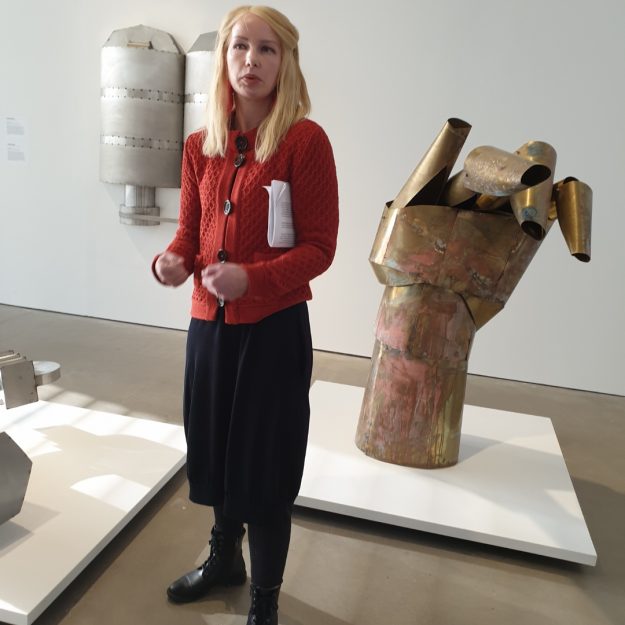
Last fall, I brought a group of researchers and guests from KTH’s Division of History of Science, Technology, and Environment to the exhibit I curated for Bonniers Konsthall, entitled Cosmological Arrows: Journeys through Inner and Outer Space.* Their curiosity in the powers of science fiction and speculative fiction by way of research and teaching (for instance, the course Science Goes Fiction) sparked engagement and conversation, for which I’ve been asked to contribute my thoughts behind the exhibit. As I see it, we are living in a world where we are facing countless ecological, technical, and political challenges. The state of the world is an apparent and important part of the public debate where researchers, activists and other engaged people want to create visibility and change. At the same time, there also seem to be a growing sense of powerlessness, especially among young people, that it might be too late to save our planet. Since we are facing all these challenges together as humans and more-than-humans living on this damaged planet, we need new forms of interdisciplinary knowledge and new forms of collaborations. And here we can turn to the arts.

During recent years, we have seen a growing number of exhibitions and art projects—internationally and in Sweden—that evolve around the state of the world and our present future. Nearby subject areas such as science fiction, space, co-habitation and the more-than-human have interested an increasing number of artists in recent years. Themes like these have been featured in international exhibitions such as Gravity: Imagining the Universe after Einstein at MAXXI in Rome, Is This Tomorrow? at Whitechapel Gallery in London, Tomorrow is the Question at ARoS in Århus, and—not least—May You Live in Interesting Times curated by Ralph Rugoff for the latest Venice Biennale. In Sweden, I need to point at exhibitions such as The non-human Animal at Uppsala Art Museum, Sensing Nature from Within at Moderna Museet in Malmö and Animalesque and Art Across Species and Beings at Bildmuseet in Umeå. It is distinctly clear that visual artists, curators and art institutions feel the need to engage with the rapid technological, ecological and political changes the world is going through—and to rethink the definitions of nature, agency, materiality and what it means to be human.

Caroline Elgh Klingborg, curator, of Cosmological Arrows. Photo by Cecilia Åsberg.

Climate researchers like Keri Facer has spoken about the arts as something we will need more of in the present future and that art can teach us about experimental thinking and how to live with some uncertainty. So, from various disciplines, there seem to be an openness and wish for interdisciplinary collaborations to bring forward new perspectives on human and more-than-human forms of co-habitation. Some of these perspectives were brought forward in the exhibition. The exhibition was shown during autumn 2019 and assembled a group of artists—Allora & Calzadilla, Lee Bul, Agnieszka Brzeżańska, Debora Elgeholm, Johannes Heldén, Anna Hoetjes, Jone Kvie, Lawrence Lek, Caroline Mesquita, Brittany Nelson, Lea Porsager, Larissa Sansour, Arseny Zhilyaev and Asya Volodina—who are all interested in science fiction and humanity’s conception of the cosmos. In keeping with our own time, my intention for this exhibition was to highlight how visual artists are using space and the genre of science fiction as an imaginary laboratory that forms the basis for discussions of today’s ethical, moral, existential and political dilemmas.

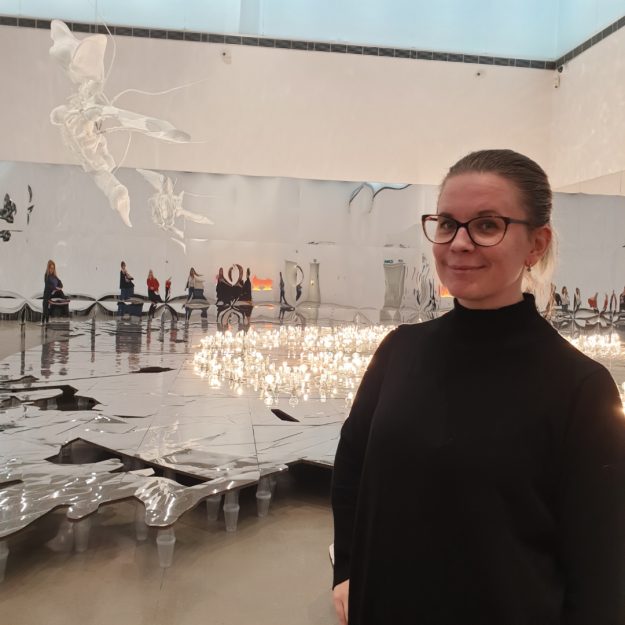
Sofia Jonsson poses with Lee Bul’s, Civitas Solis II, 2014. Photo by Cecilia Åsberg.

Cosmological Arrows showed the connections between contemporary art and science fiction, and how this rather new relationship can contribute to new ways of thinking, being and acting in the world. In the preface to her science fiction novel The Left Hand of Darkness, Ursula K. Le Guin (1929–2018) writes about how she uses science fiction to do leaps of imagination. Le Guin does not believe that her work as an author contributes any kind of evidence-based research into how the future will look (because no divine or visionary prophesies come from science fiction) but instead describes reality and the time in which the book is being written.

This reading was also appropriate for the artworks presented in Cosmological Arrows. The exhibition clearly showed that science fiction does not constitute an escape into another world. Rather the exhibition highlighted and illustrated an intricate interplay between reality and fiction in which science fiction became a tool for testing and conceiving of various historical, contemporary or future scenarios. Even if the works presented were (rather dystopian) portraits of our time—and dealt with our reality on the only planet that is habitable (as far as we know today)—the conceptual worlds that the artists can create with the help of science fiction could perhaps offer us a certain understanding of or preparation for what might await us in the future.

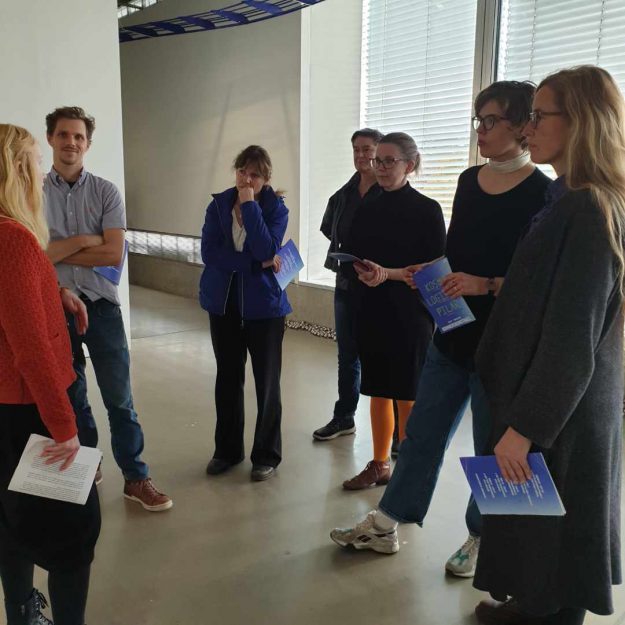
Visiting the exhibit, from left to right: Caroline Elgh Klingborg, Jesse Peterson, Myra Hird, Sabine Höhler, Sofia Jonsson, Silvia Thomackenstein, and Janne Holmstedt. Photo by Cecilia Åsberg.

I am sure we will see more of these perspectives and initiatives within the arts during upcoming years. The genre of science fiction has gained new relevance today and its themes and images bring together artists, film makers, writers and academics—bridging the gap between art, popular culture, activism and academia.

*The exhibition was accompanied by a publication with the same name. The book contains texts by Caroline Elgh Klingborg, Jerry Määttä, Mahan Moalemi, and Cecilia Åsberg, as well as short stories by Aleksandr Bogdanov, Ted Chiang, Karin Tidbeck and Alice B. Sheldon/James Tiptree Jr. and artworks by Agnieszka Brzezanska, Allora & Calzadilla, Anna Hoetjes, Arseny Zhilyaev & Asya Volodina, Brittany Nelson, Caroline Mesquita, Debora Elgeholm, Johannes Heldén, Jone Kvie, Larissa Sansour, Lawrence Lek, Lea Porsager, and Lee Bul.

Author Bio: Caroline Elgh Klingborg is a curator of contemporary art. Her work explores interdisciplinary processes and collaborations across different fields of research. In exhibitions and publications, she has brought forward the meeting between visual arts and fields such as speculative fiction, environment, new materialisms and truth. As a curator at Bonniers Konsthall in Stockholm she has recently curated the group exhibition Cosmological Arrows. Journeys Through Inner and Outer Space and Dora Garcia´s solo exhibition I Always Tell the Truth. Caroline Elgh Klingborg collaborates with The Posthumanities Hub and is also a guest lecturer at Stockholm University´s Curating Program.

Crosscuts Film Festival: In-vision Environmental Humanities

by Sofia Jonsson, festivalgeneral

Den 22-24 november är det dags för Crosscuts att inta Bio Rio i Stockholm igen.

Crosscuts är Stockholms första miljöhumanistiska festival för text och film. Temat för i år är Ruptured Times/Brytpunkter. Genom ​dokumentärfilmer, poesiuppläsning och samtal mellan ledande forskare, filmare och aktivister utforskar vi den brytpunkt där vi befinner oss nu, i en tid av politisk ovisshet, globalisering och klimatkriser.

I programmet har vi Saskia Sassen, sociolog och professor vid Columbia University, speciellt inbjuden som hedersgäst för att presentera Fredrik Gertténs omtalade dokumentär Push, där hon även själv medverkar. I en efterföljande panel samtalar Saskia tillsammans med Erik Stenberg, arkitekt och lektor KTH och Marco Armiero, lektor och miljöhistoriker KTH om städers gentrifiering och konsekvenserna av detta. Samtalet modereras av Miyase Christensen, professor i media och kommunikation vid Stockholms universitet.
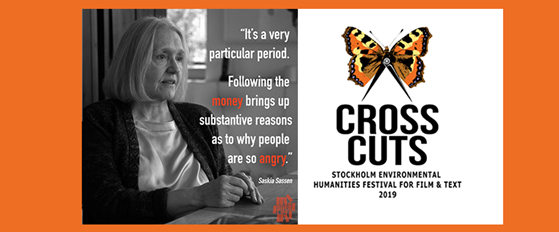

Under söndagen har vi äran att presentera en masterclass i filmskapande med vår andra hedersgäst: författaren och filmskaparen Trinh T. Minh-Ha. Efter masterclassen följer en visning av Minh-has uppmärksammade essäfilm Forgetting Vietnam. Filmen visas tillsammans med ett samtal mellan Minh-ha, Athena Farrokhzad, poet, författare och litteraturkritiker samt Jennifer Hayashida, poet, översättare och artist. Vi bjuder även på poesiuppläsning med Athena och Jennifer.

I programmet finns flera Sverige-premiärer, däribland Grit som visar situationen för lokalbefolkningen i olika byar i Indonesien efter ett jordskalv som begravt stora områden i lera. I dokumentärer får vi följa kampen mellan den drabbade befolkningen och det multinationella företag som kan ha orsakat skalvet med sina borrningar efter naturgas.

Under lördagen visar vi den första dokumentärfilmen som gjorts om den kanske mest inflytelserika, just nu levande, franska filosofen Alain Badoiu. Badiou har gett sig på allt från radikal politik till kärlek och antik filosofi i sina böcker. I filmen talar han själv om sitt liv, sina tankar och sitt verk. Efter visningen följer ett samtal mellan regissören Rohan Kalyan och filosofen Ashley Bohrer, verksam vid University of Notre Dame i USA. Samtalet hålls på engelska.

Festivalen avslutas med premiären av Look Away, en dokumentär med avstamp i Calais där vi får följa och ta del av den verklighet som många människor på flykt upplever. Efter filmen följer ett samtal mellan Roberta Biasillo, forskare på KTH och Fabio Gianfrancesco, flyktingaktivist och kapten på en av de båtar som räddar flyende människor på Medelhavet och Shahram Khosravi professor vid Socialantropologiska Intitutionen på Stockholm Universitetet.

Nytt för i år är sektionen Annals of Crosscuts – en filmgranskningsprocess där dokumentärfilmare från hela världen har skickat in bidrag på temat Ruptured times. En panel av granskare från film-, konst- och forskarvärlden har gjort ett urval av filmer och under festivaldagarna blir det världspremiär för dem. I panelen finns bland annat Kalle Boman, Forum för Visuell Praktik, Issraa El-Kogali, kreatör och filmskapare samt Jan Olsson, professor emeritus i filmvetenskap vid Stockholms universitet.

Varmt välkomna till en helg fylld av spännande dokumentärfilmer och samtal!

***
Fullt program finns på https://www.crosscuts.se och https://www.biorio.se ​
Crosscuts på Facebook: https://www.facebook.com/EHLcrosscuts/
Bio Rio på Facebook: https://www.facebook.com/TheBioRio/

Crosscuts
Crosscuts är en internationell festival för film, konst och forskning inom miljöhumaniora. Varje film visas tillsammans med ett samtal med speciellt inbjudna gäster. Festivalen organiseras i år av KTH Environmental Humanities Laboratory (EHL) i samarbete med den ledande forskningsmiljön vid JMK, Institutionen för mediestudier, Stockholms Universitet och Bio Rio. Crosscuts arrangerades första gången 2018.

EHL: https://www.kth.se/en/abe/inst/philhist/historia/ehl
Forskningsmiljön vid JMK: https://research.ims.su.se/en/environments/1-global-media-studies-and-the-politics-of-mediated-communication

Sagt om Crosscuts:
This Stockholm Environmental Humanities Festival for Film and Text that was held for the first time in the fall of 2018, was an extremely successful and important event for both academic community and the general public. Madina Tlostanova, professor i postcolonial feminism, Linköpings Universitet. Paneldeltagare under Crosscuts 2018.

Vi är väldigt glada och stolta över att få vara samarbetspartner med Crosscuts och att dessa viktiga filmer och samtal kommer att äga rum på vår biograf. Vi befinner oss i en brytpunkt vad gäller klimatet och Bio Rio vill vara med och skapa den förändring som krävs vad gäller vår miljöpåverkan. Jocke Kellekompu, VD Bio Rio
——————————————————————

Kontaktpersoner:
Sofia Jonsson, festivalgeneral, 0739-108787, sofia@crosscuts.se
Jacob von Heland, programansvarig samt chefredaktör för Annals och kontaktperson för Trinh T. Minh-ha, 070-727 24 87, jacob@crosscuts.se
Miyase Christensen, programplanering, ansvarig Stockholms Universitet och kontaktperson för Saskia Sassen, 070-389 20 07, miyase.christensen@ims.su.se

Hemsida av https://www.wrangedesign.se/
Logga av https://carmonamedina.com/​


Why everyone should watch HBO’s “Chernobyl”

By: Achim Klüppelberg, Siegfried Evens, and Johan Gärdebo (Read in Russian: Клюппельберг, Ахим – Эвенс, Зигфрид – Гердебо, Иоган – Чернобыль)

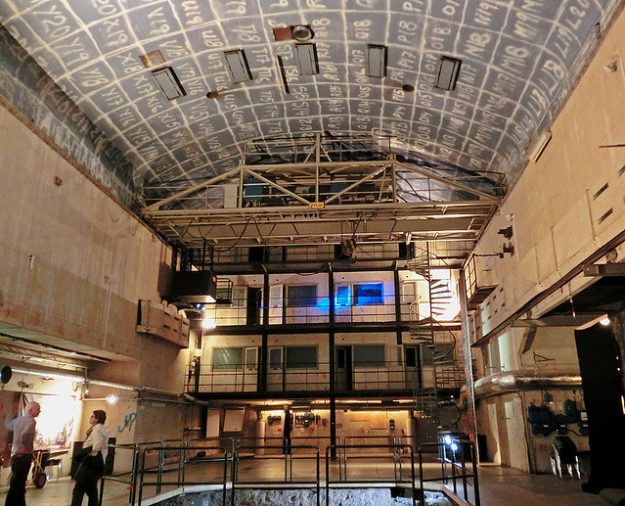
25 meters below Stockholm’s solid bedrock, HBO’s Chernobyl is being screened inside a decommissioned reactor for nuclear weapons. It is dark, a little bit chilly, and the atmosphere is tense. The thrilling music ends, the screen goes black, and the crowd spontaneously starts applauding. Afterwards, the reactor hall became a place of discussion. Can we learn from this show? We, three nuclear historians, think we can. Even more so, we all should. Roughly 451 civil nuclear reactors are online world-wide and 54 are in construction. This concerns everybody.

Displays R1 Reaktor Hallen

Drama or reality?

Let’s be clear about one thing: Chernobyl is a cinematographical masterpiece. Yet, apart from the brilliant acting, production, and music, the merits for the show’s success might ultimately go to reality itself. The show depicts everything; from the apocalyptic specifics of the nuclear disaster to the everyday life in former state-socialist countries. And in the end, even the best screenwriters in the world could not have been able to invent such a tragic and unbelievable story like the Chernobyl disaster.

That being said, entertaining historical fiction does not necessarily mean ‘correct’ historical drama. Is the series realistic? Craig Mazin, the writer of the series, has done a lot of research on the catastrophe. His bibliography provides a sufficient overview of the ever-growing state of the art on Chernobyl. Many of the scenes also correspond to real testimonies.

Yet, the series is and remains a dramatisation of real events. Some characters are made up and act as compilations of different real-life actors. The character of Ulana Khomyuk, for instance, embodies and symbolises a whole army of scientists that travelled to the exclusion zone and surrounding areas. The trial scenes also did not happen in the way depicted. Neither Legasov nor Shcherbina were there, and they certainly did not give heroic, truth-revealing speeches there.

The series’ creators are conscious and honest about these dramatisations. Not only in the podcast, but also in the final scene of the final episode, they reveal honestly how they altered history for dramaturgical effects. But maybe the question of correctness of historical drama is not relevant. The question is rather whether the Chernobyl catastrophe is represented correctly. Or to be more specific, whether the analysis of the disaster is correct.

Unfortunately, the answer is: yes.

What is it about?

The main message of the Chernobyl series seems to be that the catastrophe was a human disaster. It was not only caused by defective technology or operator’s mistakes, but by society, politics and technocratic culture. Hence, Chernobyl was entrenched in the deeper societal structures and safety culture of the Soviet Union.

This renders the show’s message the same as the message we, as historians of (nuclear) technology, try to convey every day: technology is human. Both its benefits and flaws are created by humans and their organisations. And this, in turn, creates risks to human beings.

Managing nuclear risks is then not solved by mere “technofixes.” An extra pipe or another safety procedure may be necessary, but are in themselves not sufficient. If we want to prevent nuclear catastrophes in those plants, we have to look at the human beings operating them. We have to look at how they think, behave and perceive things. We have to look at how they organise, interact, and share information. The causes of nuclear accidents do not stop at the gated fence of a nuclear power plant. If we really want to understand a nuclear accident, we have to look at society in all its facets.

“What is the cost of lies?”

It is both the first and the last sentence in the series, articulated by Valery Legasov on his audiotapes in the series. “The cost of lies” is also Craig Mazin’s explanation for the Chernobyl catastrophe. When people start lying, when transparency is lacking, and when the political system hinders the prevention of risks, then catastrophes happen. Mazin also indicated multiple times that it was not his intention to tell an anti-Soviet story nor an anti-nuclear story. He simply wanted to show the specific contexts in which huge catastrophes happen. And those contexts are profoundly human.

A useful show?

Pro-nuclear voices have already criticised the HBO series. It would overdramatise the accident and overemphasise the dangers of radiation. However, their arguments do not seem to be sound. Furthermore, downplaying the seriousness of Chernobyl or radiation does not help pro-nuclear voices in any way. In fact, every proponent of nuclear energy should talk about the tragic events at Chernobyl and be utmost open about it. It is the demonstration of what happens when a powerful and promising technology gets mismanaged. If there is a lasting future for nuclear energy, then its experts need to speak about, even promote, also the legacy of its mishaps. That’s why we should all talk about Chernobyl.

However, anti-nuclear voices have also taken the opportunity to refer to the series as an argument against nuclear power. Even if Chernobyl shows the enormous risks that nuclear technologies entail, generalising the Soviet situation for the entire world would not be correct. Indeed, the Soviet-bashing claim that accidents like Chernobyl can only occur in state-socialist countries has become redundant after Fukushima-Daiichi in 2011. Once again, it became clear that the social, cultural and political contexts constitute as the true causes of a nuclear accident.

In fact, every national nuclear programme is different, with different safety cultures and contexts but also common characteristics, such as secrecy, dual-use possibilities and a sense of being at the helm of technological progress. A lot of safety standards are now produced on an international level, but countries can still decide on how they implement them. Nuclear accidents can happen and have happened elsewhere as well, also in the West. Why? Because, again, nuclear accidents are protracted by humans. And humans do not only live in the Soviet Union or Japan.

The verdict

Chernobyl is a series that everyone should watch. It teaches us the strong connection between technologies and humans and how that connection can backfire in the form of a catastrophe. It’s a series that teaches us not to make the same mistakes as in 1986.

In fact, it teaches us that Chernobyl is not yet finished. If our discussions in the reactor hall in Sweden have taught us one thing, then it is that the story of Chernobyl is still incomplete. There are still so many things that are unclear or left for debate. Yet, although incomplete, it remains a powerful story. And a story that has been told by HBO in a powerful way.

What should we think about the starving polar bear?

Authors: Justiina Dahl and Peder Roberts

Images of a starving polar bear foraging through trash in a rather green northern Canadian landscape recently went viral. Paul Nicklen of Sea Legacy, who recorded the footage, placed the suffering of this individual bear in the wider context of climate change, “to convey a larger message about how a warming climate has deadly consequences.” Reporting soon became more cautious and the bear was even presented as evidence of how the media keeps getting the Arctic wrong.

There is some truth in both positions. Climate change is affecting sea ice levels, and will almost certainly affect traditional bear habitats for the worse. But what contemporary discussions tend to overlook is that polar bear populations were stressed well before climate change became recognized as an issue. The 1973 Agreement on the Conservation of Polar Bears, signed by all countries that have polar bear populations, was a specific response to a sense that polar bear numbers were in retreat due to recreational human hunting. All this raises a bigger question. What is it about this animal that makes it so symbolically powerful, and how has this shaped its conservation?

Photo taken from http://www.bbc.com/news/world-us-canada-42322346

From individual trophy hunting to international cooperation

Indigenous Arctic residents have long hunted polar bears. The long-term patterns of this subsistence hunt require a high degree of practical knowledge about polar bears and their ways – knowledge that comes from living in surviving in that same Arctic environment. Sport hunting, which was one of the more divisive questions when negotiating the 1973 Agreement, derives much of its appeal from the idea of conquest, the white person (usually but not always a man) who travels to a distant, exotic, and often inhospitable land and comes home with a trophy to prove his superiority. Much the same was true for those who worked in the Arctic and returned to their southern homes with a bear-skin souvenir.

Individual national governments started to impose their own bans on polar bear hunting from the late 1950s, motivated largely by evidence that populations were in decline. These motivations were later accompanied by a wider sense that the winds of public opinion were blowing green, symbolized by the 1972 Stockholm Conference on the Human Environment. The 1973 Agreement did two things. Firstly, it committed its five national signatories to a program of practical action by preventing polar bear hunting with a small number of designated exceptions, and to collecting more data to enable sound management. Secondly, it used the bears as symbols of their of “common will and desire to protect the whole of the Arctic natural environment”, as Norwegian environment minister Tor Halvorsen put it in his opening address to the final negotiating session.

The Agreement proved broadly successful in protecting polar bears from human hunting, and in focusing attention on the ecosystems upon which their survival depended. It did not however lead spill over into larger-scale Arctic environmental cooperation between the five circumpolar states, something Norway in particular desired. In the revision meeting of the parties of the Agreement five years after its ratification in 1981, the Norwegians attempted to enlarge the treaty again. Part of the reason was the political situation in Svalbard. Indeed, Erik Lykke from the Norwegian government delegation confided to a Canadian diplomat during the meeting that his government wanted a multilateral approach to Arctic environmental management because it worried about the USSR isolating Norway in a bilateral agreement over the sensitive Svalbard archipelago.

It was only when Soviet premier Mikhail Gorbachev made a now-famous speech in Murmansk in 1987, calling for a de-escalation of tensions in the Arctic, that space opened for this larger-scale multilateral environmental cooperation. The concept of “charismatic megafauna” offers one explanation for why even though the Arctic states succeeded in multilaterally protecting the polar bear, it took nearly twenty years to achieve this desired spillover effect.

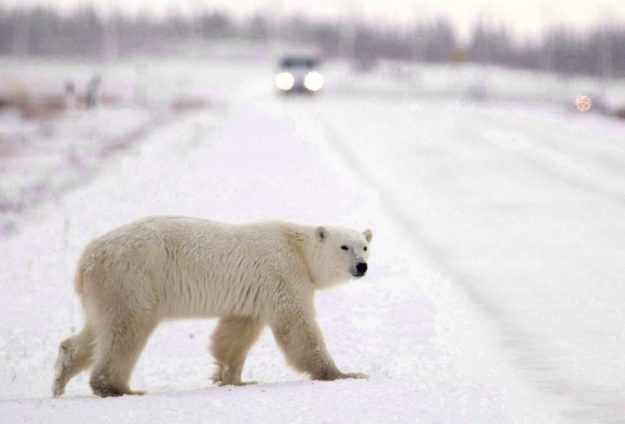
A polar bear walking across a street in Churchill, Manitoba. The idea that a single bear can provide evidence of something as complex as climate change is being rejected, just as an image of a fat bear would not prove that climate change is a hoax. (Jonathan Hayward/The Canadian Press) Photo and caption taken from http://www.rcinet.ca

Charismatic megafauna

The history of the conservation of the polar bear is in many ways a classic example of charismatic megafauna – a term used to described animals whose combination of size, grandeur, and cultural resonance makes them ideal vehicles through which particular values or arguments can be advanced. Cultural resonance is not inherent in the animal: it is a human product that says at least as much about the people for whom the polar bear possesses meaning (and the culture they are part of) as it does about the bear itself. As a recent comment piece in Nature put it, charismatic megafauna are “large, interesting animals that the public — and donors — love.”

In the context of collective Western history with the polar bear, part of the emotional effect of the contemporary Nicklen footage comes from the incongruence of a majestic predator, king of an icy domain, being reduced to an emaciated bag of bones within a landscape defined by human presence (trash and a snowmobile). This is why Nicklen refers to polar bears as “unwitting mascots of climate change”, whose kingdom retreats with the sea ice. The conception of polar bears as vulnerable in turn relies upon a conception of humans as powerful. (This is perhaps why some at the 1981 meeting worried about the effect on public opinion in favor of bear protection if the bears caused too many human fatalities.) In relation to the success factors behind the polar bear treaty, we find it tempting also to wonder whether there is a parallel with the great whales.

The collapse of Antarctic numbers led to the collapse of the Antarctic whaling industry, and ultimately to an international moratorium on commercial hunting that was signed in 1982. In the process whalers have become demonized figures in many (though certainly not all) parts of the world, at the same times as that the whales themselves have ceased to be regarded as floating oil barrels and have even been regarded by some as possessing sentience. Banning whaling has proved much easier than banning the other activities that interfere with their habitats, from waste dumping to sonic pollution. In the same way, banning the commercial hunting of polar bears is far easier than addressing the underlying causes of anthropogenic climate change.

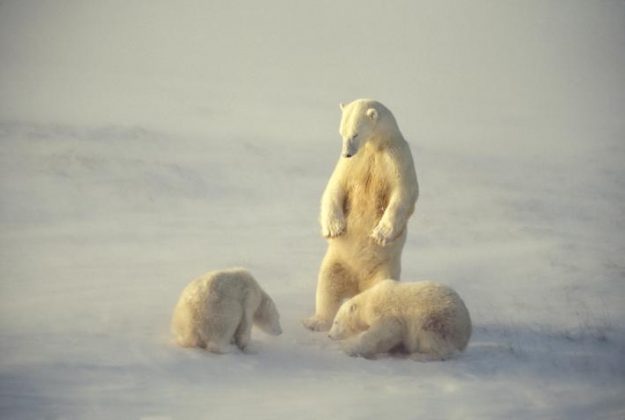
A polar bear watches her cubs on the Hudson Bay in Manitoba, Canada. The bay is famous for polar bears, but their population is in decline. Picture and caption from nationalgeographic.com PHOTOGRAPH BY TOM MURPHY, NATIONAL GEOGRAPHIC

What should we make of the starving bear?

So what should we make of the starving bear? It’s clearly an image designed to evoke emotion, and there is not necessarily anything wrong with that. Climate change is an important issue that will affect polar bears in general – even if this individual bear might have been suffering from cancer rather than being the victim of retreating sea ice. What is more problematic is trying to draw overarching conclusions on polar bears in particular and the role of humans in the Arctic in general based on a single uncertain albeit charismatic data point. The International Union for the Conservation of Nature, which had a leading role in the negotiations for the 1973 agreement, is cautious about making its assessment of polar bear populations appear “more reliable than it really is”, despite considerable effort invested in surveying their numbers. This attitude echoes the Intergovernmental Panel on Climate Change’s reluctance to make aggressively specific predictions. That’s not an attitude that seems to have much traction in the current political and cultural moment.

While it can be hard to stomach, never mind witness, animals starve to death all the time for a million different reasons. Picture and caption taken from slate.com Photo: National Geographic