
Softer and safer social robots
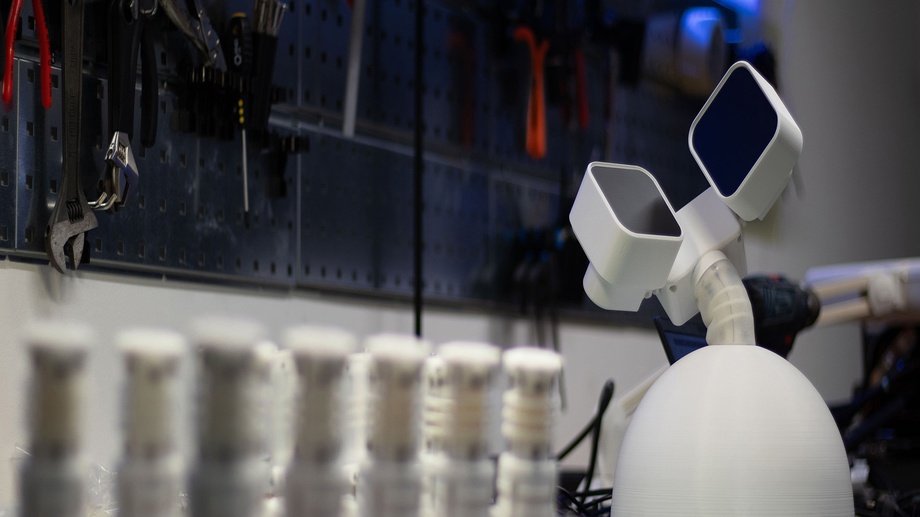
What does it take to make a robot safe for natural human interaction? Beyond AI, social robots need mechanics that enable safe movement, responsive reactions, and reliable operation in real-world environments.
These challenges were at the heart of HARU Meetup 2026: “From Research and Beyond,” a two-day event held end of August at the Honda Research Institute Japan (HRI-JP) in Tokyo. The meeting brought together an international research community working on HARU, Honda’s social robot, to explore how research can move beyond the laboratory and toward real-world applications.
KTH:s Robot Design Lab presented its latest research on soft robotic joints, which reflects several years of development and contributed to discussions about the future development and deployment of HARU.
Making robots safer through softness
One of the key sessions focused on the technical requirements needed to make social robots viable outside controlled research environments. As part of this session, Georgios Andrikopoulos presented “Soft Robotic Joints for Safety and Reliability,” highlighting the Robot Design Lab’s research on the soft robotic mechanisms used in HARU’s neck and eye joints.
“Unlike conventional rigid robotic mechanisms, soft and compliant joints can deform slightly when they encounter external forces. This compliance can help robots interact more safely with people while also opening new possibilities for more natural and expressive movement, says Georgios.”
From research to the real world
The HARU Meetup was about more than individual technologies. Participants discussed the wider challenges involved in bringing social robots into everyday life, including applications in healthcare and education, commercialization, responsible AI, and the technical requirements for future deployment.
For social robots such as HARU, these questions are particularly important. A robot designed to interact closely with people must not only be intelligent and engaging—it must also be physically safe, reliable, maintainable, and capable of operating consistently in unpredictable environments.
Building the future of social robotics
The KTH Robot Design Lab’s participation in HARU Meetup 2026 reflects the increasingly interdisciplinary nature of social robotics. Led by Honda Research Institute Japan, Honda plays an important role in providing the broader research framework for HARU, bringing together expertise in robotics, artificial intelligence, human–robot interaction, and engineering to shape the robot’s future development.
Soft robotic joints may be only one part of this larger picture, but they address a fundamental challenge: how can robots physically interact with humans in a way that is both capable and safe? The Robot Design Lab’s work on HARU’s neck and eye joints contributes to this challenge by exploring compliant mechanisms alongside sensing, vibration control, structural optimization, and reliable operation.
For Honda and its research partners, these technologies are part of a broader effort to understand what is required for social robots to function beyond the laboratory. As HARU research moves toward broader real-world impact, collaboration across institutions and disciplines will be essential for addressing not only technical challenges, but also questions surrounding healthcare, education, responsible AI, commercialization, and deployment.
The discussion in Tokyo therefore represented more than an exchange of research results. It highlighted Honda’s role in bringing an international research community together around a shared vision for the future of social robotics, while also showing how contributions from partner laboratories can help turn that vision into practical robotic technologies.
What matters most is how to explore how we can design robots for human-centered environments, says Georgios Andrikopoulos .
“The HARU Meetup 2026 gathering was more than an opportunity to present what our lab has achieved so far. It gave birth to new ideas, collaborations, and directions for how we can make social robots safer, more reliable, and ultimately more beneficial to society. What matters most to me is exploring how we can design robots that genuinely support people in healthcare, education, and other human-centered environments. The goal should not be to replace human labor, but to complement it, enabling people to focus more on the aspects of their work that depend on human expertise, care, and connection", concludes Georgios Andrikopoulos.
Read more about the KTH Robot Design Lab
Text: Rita Nõu