KTH Logo

Does water have a soul? Voices and reflections from the Symbiosis exhibition

Text by Katarina Larsen

As a part of the activities in the project NATURE, we wanted to have an interaction with visitors that came to the exhibition “Symbiosis” during autumn 2021 where a section on water was developed in collaboration with the art institution Färgfabriken.

The exhibition hall is located in an old industrial building in area of Lövholmen, near Liljeholmen in the south of Stockholm. Researchers from KTH working with the water theme included Katarina Larsen, David Nilsson and Timos Karpouzoglou. As a part of the interactive approach, we asked visitors about their relation to water and also challenged them to imagine what messages that they could hear if water itself was given a voice or legal rights. Some of the reflections received from visitors to the exhibition were really thought provoking.

The water component of the Symbiosis exhibition was developed in collaboration with the art institution Färgfabriken and the Stockholm based artist Åsa Cederqvist. The artistic work and collaborative dialogues created ideas for how to communicate different types of water narratives, through texts, images and interactive activities during the exhibition. The art work developed by Åsa was entitled “The Essence” giving water a voice of itself. This was done through an art installation using augmented reality (AR) to create a visual 3D image of a drop of water floating above the floor in the factory of Färgfabriken when visitors looked through the lens of a digital screen.
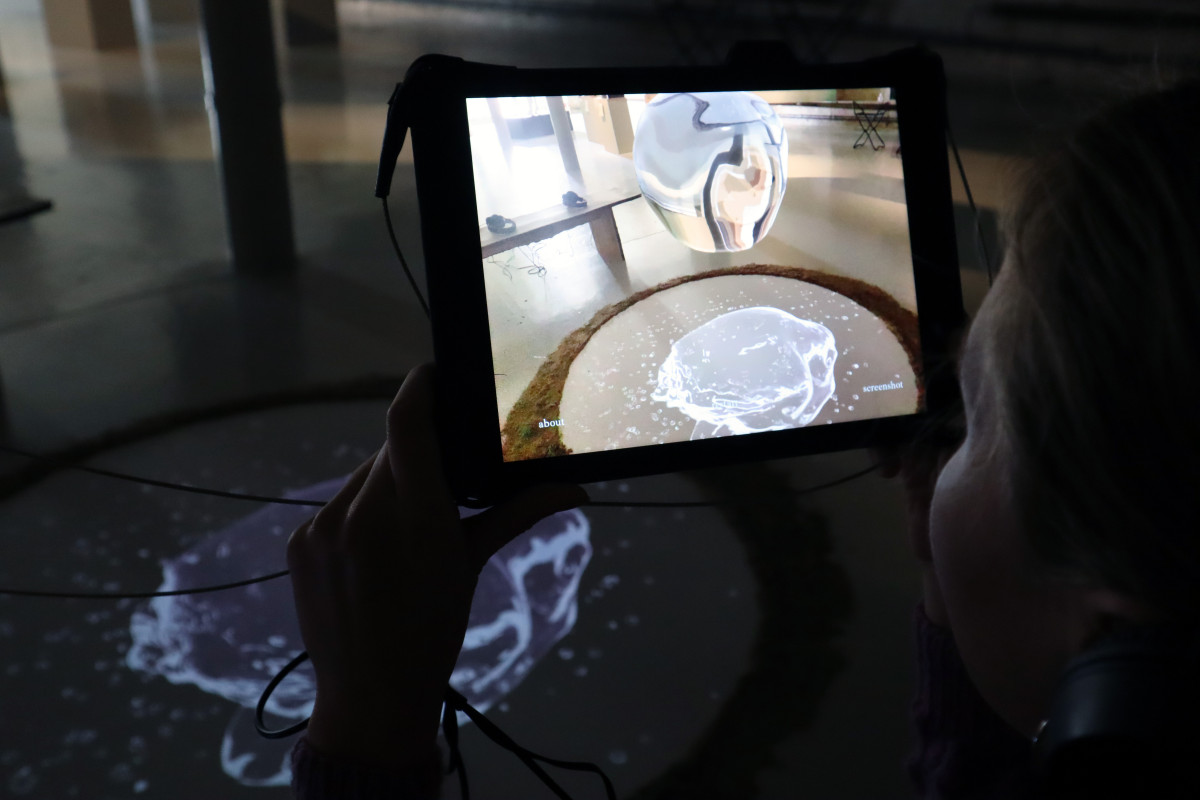
Photo: ”The Essence – spirit of the water” by Åsa Cederqvist in exhibition Symbiosis at Färgfabriken during autumn 2021. Photo: Färgfabriken

The visitors could also hear the voice of this water spirit through headphones and speakers and were asked what they think the water spirit would tell them. Some of the answers from the visitors expressed a sense of guilt (that we have not taken care of nature like we should have) but also narratives revealing a strong connection with water and nature. Other reflections dealt with idea of control of nature, that there is a struggle between humans and nature and water as a precondition for life on earth.

 “I have existed for millions of years and kept plants and animals alive and developed new life forms. I will always survive and find new life forms. Doesn’t humanity want to be a part of that also?

 “Look at me angrily, maybe punch me” 

 “Get a grip!”

 “Take good care of me, or else….”

 “It’s OK, I love you anyway”

 “I have been inside Björn Borg’s stomach” 

 “Show some respect for my spirit and do not take me for granted!”

Other responses expressed that it would be interesting to take part of the water’s life perspective, both historically and thoughts about the future and how we can we coexist in the best possible way.

We also invited policymakers, engineers and other local actors from the Stockholm area to a series of workshops to discuss their experiences from existing urban water infrastructures and views on future ways to manage systems and infrastructures in cities. The discussions took place in the exhibition hall hosting the exhibition “Symbiosis” curated by Färgfabriken.

During these workshops we wanted to have a dialogue with local politicians, policymakers as well as engineers who are managing existing critical infrastructures for water in Stockholm about their experiences and views on future ways to manage urban water infrastructures in cities. The dialogues also sparked discussions about what the term “infrastructure” actually means. Is it the pipes and wastewater treatment solutions that are in place today? Or does it also include, parks, and other green infrastructures in urban areas that can function as buffer zones for extreme rainfall to manage overflooded existing systems? What are the prospects of different types of nature-based solutions that will make use of circular solutions in the design of future urban systems?
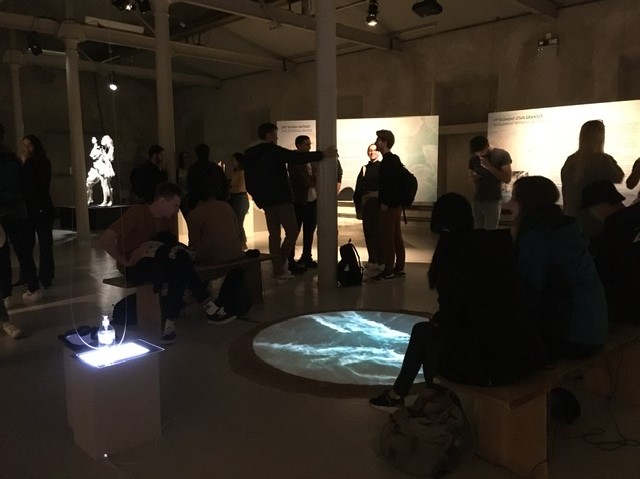
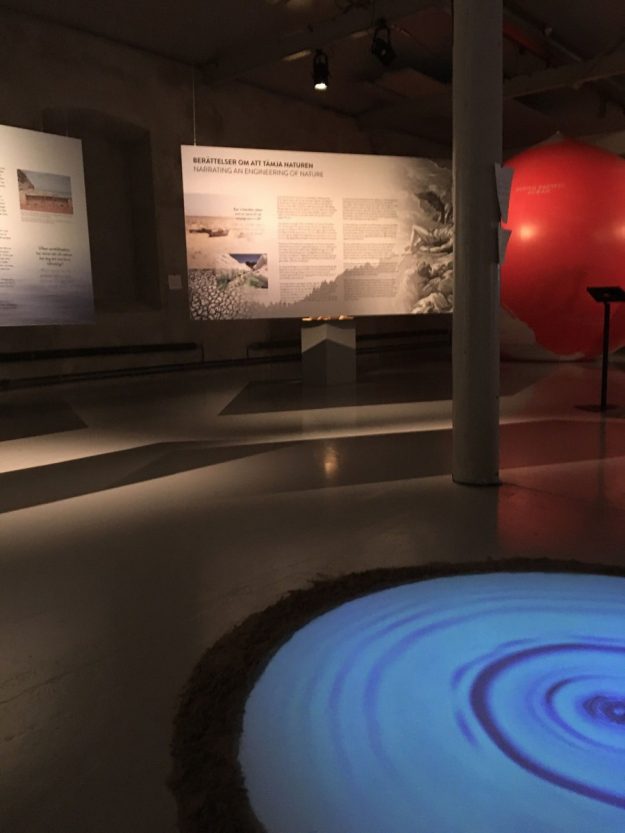
Photo of exhibition hall of Färgfabriken. Photo: Larsen

The workshop participants expressed that they appreciated the workshop initiative also for the opportunity to connect with other local actors being involved in managing different aspects of water in Stockholm. Some comments from participants were that “we should use art more often to communicate” and that working with water requires dialogues between different types of actors to manage cross-cutting aspects of water. Water in different forms are crossing boundaries between municipalities as well as internationally and requires coordination and communication between actors representing a broad range of competences. The participants were also asked to reflect upon what factors that can be drivers for change with a 50-year horizon. Some of the conclusions outline future challenges of different kinds:

  • The waste water systems are, to a large extent, made invisible to the users. As a consequence, they have disrupted the cyclic thinking for water management and treatment.  As long as they are working – they are silent.
  • Even if the systems are among the best ones in the world, they are not optimal. We can increase the circular systems, reduce the environmental impact and use resources better.
  • Future climate change requires preparing for flooding in urban areas. This aspect was highlighted as highly likely by participants to influence a change in managing water supply in the Stockholm region within 50 years.

The workshop participants were also asked to reflect on what measures they thought would be acceptable for consumers. The answers showed that measures such as using rainwater to flush toilets and allowing parks be flooded to act as a buffer zone were thought to be accepted by citizens.  For us researchers from KTH working with developing the water theme in the exhibition this brings some important thoughts onboard for further discussions and studies. Since the work with developing the exhibition was carried out during the pandemic of 2020-21 we were also delighted to be able to organize these workshops on-site in the exhibition hall and create dialogues on how art and science can bring about novel ideas, reflect on circularity of systems, and explore what can happen if water itself is given a voice to talk about future challenges and possibilities for urban water infrastructures in Stockholm.
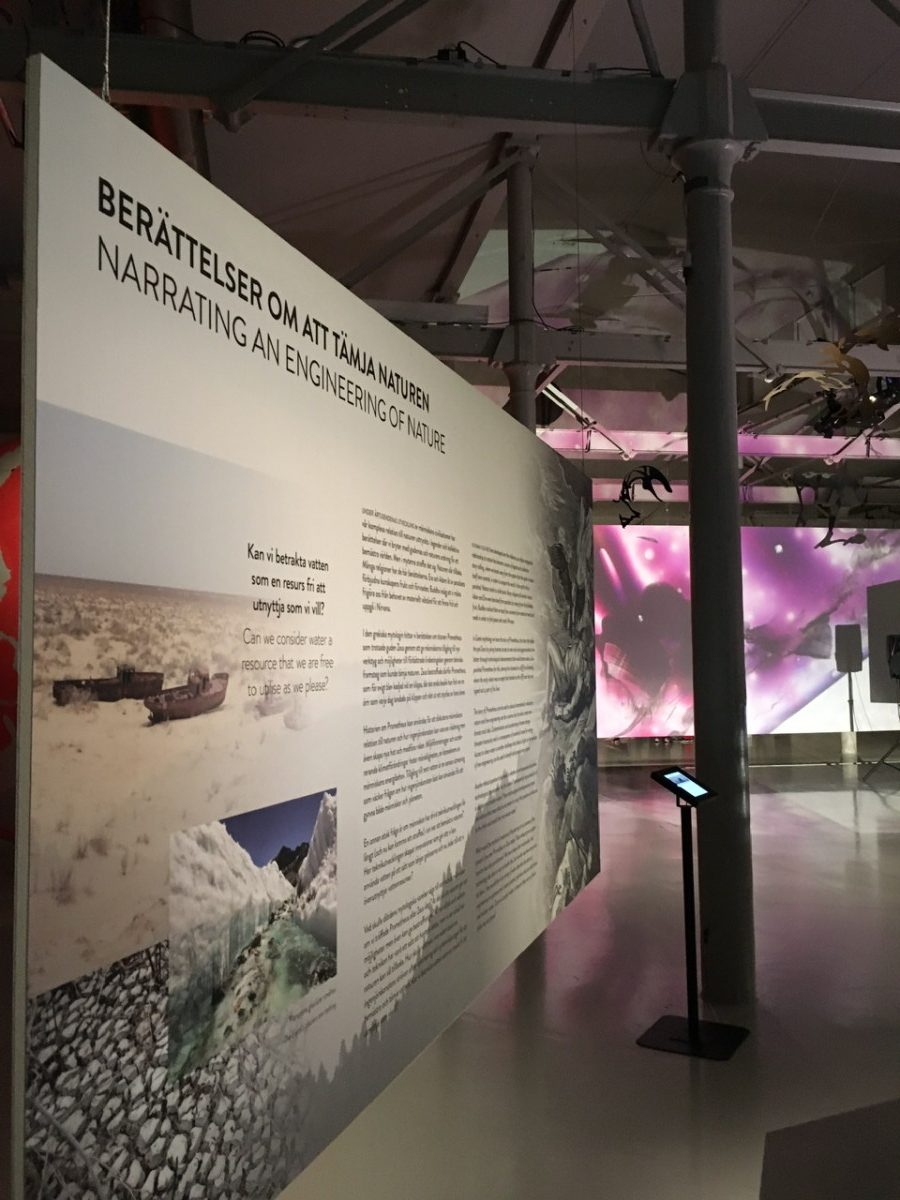
Photo of exhibition hall of Färgfabriken. Photo: Larsen

Links and additional material:

Nature project: https://www.kth.se/philhist/historia/forskning/environmental-histor/nature-examining-nature-society-relations-through-urban-infrastructure-1.1077111

Symbiosis exhibition: https://fargfabriken.se/en/projects/symbiosis

Urban water imaginaries in exhibition – co-creative dialogues between science, art, and engineering (interview with Katarina Larsen in ABE school newsletter)

https://www.kth.se/en/abe/nyheter/berattelser-om-vatten-i-stader-i-utstallning-med-moten-mellan-vetenskap-konstnarer-och-ingenjorer-1.1102817

Visitors relations to water and their memories shared:

“It is euphoric to swim in the sea and be a part of the element for a while. At the same time, the power of waves and depth is extremely frightening. My stepfather drowned during a dive and it’s awful to imagine that situation, to drown and sink into the dark depths.”

“Drinking cold water that tastes like iron, in the countryside with my friend when we were small, after being out to play.”

“Water is what almost took my life on several occasions, but it is also what I can enjoy in everyday life. It is also my favorite drink although deep water is one of the few things I am afraid of. So a cycle, it gives and takes.”

“I sail and do a lot of boat riding so I have always felt safe on the water, even though I know that every time I am out by boat, the sea can kill me at any time. But I have learned to use the water and live with the water when I am out there. It is some kind of coexistence. I think the sea likes people to sail on it. Just like it likes the animals swimming inside it.”

at an incredibly intense and warm and long concert where I was stuck in the middle completely without anything to drink, I got water from a total stranger and it was the best water I have ever had”

“Fishing trip with grandpa, herring and flounder”

Text by Katarina Larsen, researcher at the Division of History of Science, Technology and Environment

The Mediated Planet presents the NordAI Seminar Series 2022

The NordAI spring seminars is a seminar series, curated by Adam Wickberg and Tirza Meyer from the Mediated Planet Research Group at the Division. The series features contributions from leading scholars working with AI at the interface between the human and non-human world, exploring the question of what constitutes the environment through the lens of artificial intelligence.
Earth Science Planet Globe Environment Lights

The first seminar was held in February and featured Christer Andersson, analyst at the Swedish Defence Research Agency, Sweden on AI and analysis of environmental data: a perspective from the Swedish defence researchers?

Next up is Bill Adam. Claudio Segré Professor of Conservation, Graduate Institute, Geneva; Downing College Cambridge, who among many other things has spent a semester at the Division (2017).

The Digital Animal and Conservation by Algorithm

Digital innovation has brought about a revolution in devices to observe, track and locate animals.  These range from fixed devices such as webcams and camera traps (trail cams), through airborne and satellite remote sensing to tracking and imaging devices fitted to living animals (collars and tags).  Digital data from these devices is streamed, shared, archived and analysed, yielding new knowledge and new systems of knowledge accumulation, and enabling new modes of intervention in non-human lives and human society, ‘conservation by algorithm’.  This seminar will discuss some of these innovations, and their implications.  It will explore the new digital lives that animals take on within databases and information networks, and their implications for human understandings of nature, and for conservation management.

Time: Tue 2022-03-29 13.00
Location: Zoom – link can be found here

Discussant: Finn-Arne Jørgensen, Professor in Environmental History, University of Stavanger
Recommended reading:
Adams, William, “Digital Animals,” The Philosopher, vol. 108, no. 1 (2022).
Adams, William, “Geographies of conservation II: Technology, surveillance and conservation by algorithm,” Progress in Human Geography, vol. 43, no. 2 (2019): 337–350.

Follow this link for more information on NordAI

Critiques and Practices of Sustainability – Spring Course for Doctoral Students and Postdoctors

Critiques and Practices of Sustainability:
Environmental Humanities Perspectives on Chilean and Swedish Ecocultures of Water, Land, and Air is 7,5 credit course, established by Division postdoc Nuno Marques, among others. Facing global contemporary environmental challenges and the need to imagine sustainable ways of relating to the environment (outlined by the SDGs), this course analyzes forms of connection with the environment elaborated in ecopoetry, ecofiction and ecocinema from Chile and Sweden. This course will address critiques and practices of sustainability from an environmental humanities perspective combining ecocriticism, cultural studies, sustainability studies, and decolonial theories and practices.

Learning outcomes:

  • identify, understand, and critically and creatively apply concepts such as sustainability, environmental justice, slow violence, sacrifice zones, ecocriticism, environmental humanities, deep time.
  • assess how cultural products and expressions (visual and literary) from Chile and Sweden relate to global environmental concerns, propose situated forms of connection to the biosphere, and how they intervene in environmental discourses.

Practical information

The course entails 5 weeks of synchronous and asynchronous work through Zoom and Canvas. It comprises 5 units: a theoretical and methodological introduction; three thematic blocks dealing with life below water, life on land, and life on air, through the lens of sustainability in cultural productions from Chile and Sweden mainly from the twentieth century to contemporary works in 2021; and a concluding interdisciplinary colloquium with invited discussants.

Read more about the course and how to apply on the course page: Critiques and Practices of Sustainability

Computing the Nordic Way: The Swedish Labour Movement, Computers and Educational Imaginaries from the Post-War Period to the Turn of the Millennium

Lina Rahm investigates how problematisations of the digital have changed over time and how the goal for education on digital technology has been one of political control—either to adapt people to machines, or to adapt machines to people in this article published in the Nordic Journal of Educational History, volume 8, 2021. Abstract and link to open access below.
Binary System Bits Byte Binary Binary Code

Lina Rahm first came to the Division as a Ragnar Holm postdoc in 2020. On Janyary 1 she started an assistant professorship with us, in the History of Media and Environment with specialization in Artificial Intelligence and Autonomous Systems, funded by the WASP-HS Wallenberg AI, Autonomous Systems and Software Program – Humanities and Society. Lina’s research focus is on sociotechnical and educational imaginaries with a span from the 1950s up until today.

Full article: Computing the Nordic Way: The Swedish Labour Movement, Computers and Educational Imaginaries from the Post-War Period to the Turn of the Millennium

Abstract

Based on empirical material from Swedish reformist labour movement associations, this article illustrates how digital technology has been described as a problem (and sometimes a solution) at different points in time. Most significant, for this article, is the role that non-formal adult education has played in solving these problems. Computer education has repeatedly been described as a measure not only to increase technical knowledge, but also to construe desirable (digital) citizens for the future. Problematisations of the digital have changed over time, and these discursive reconceptualisations can be described as existing on a spectrum between techno-utopian visions, where adaptation of the human is seen as a task for education, and techno-dystopian forecasts, where education is needed to mobilise democratic control over threatening machines. As such, the goal for education has been one of political control—either to adapt people to machines, or to adapt machines to people.

A multi-criteria analysis of building level graywater reuse for personal hygiene – new article co-authored by Timos Karpouzoglou

Timos Karpouzoglou has been with the Division since 2018, and is working closely with the KTH WaterCentre, where he previously was a research coordinator. His current research is focused on urban water infrastructure and is informed by social sciences and the humanities. In a new article, together with Jörgen Wallin (KTH) and Jesper Knutsson (Chalmers), Timos investigates how water demand globally exceeds over available water supply, and takes a closer look at the reuse of bathroom graywater for shower and bathroom sink hot water. The investigation focuses on water and energy savings, water treatment, economic benefit and investigates the main actors and institutions that are involved. “A multi-criteria analysis of building level graywater reuse for personal hygiene” was published in the 2021 December issue of Resources, Conservation & Recycling Advances.
Water Infrastructure. Photo: iStock

Abstract

Globally an increasing number of people are facing water scarcity. To address the challenge, measures to reduce water demand are investigated in the world. In the present paper, a novel approach to reuse bathroom graywater for shower and bathroom sink hot water is investigated. The investigation focuses on water and energy savings, water treatment, economic benefit and investigates the main actors and institutions that are involved.

The main results are that there is significant potential for water and energy savings with a positive economic benefit. Water savings of domestic hot water up to 91 % and energy savings up to 55 % were observed. The investigated treatment plant produces recycled graywater with a quality close to drinking water standards.

The investigation also presents that the reason for the positive economic benefit will depend on the utility tariffs. Therefore, two locations with different utility rate structures were investigated, Gothenburg, Sweden and Settle, USA. In Gothenburg, the utility cost for energy was the driver of economic benefit and in Seattle it was the water and wastewater cost that was the driver. The return of investment for the system and installation was shown to be 3.7 years in Gothenburg and 2.4 years in Seattle.

Keywords

Graywater recovery, Graywater reuse, Heat recovery in graywater, Energy conservation, Water saving, Water reuse, Recycled water

Links:

Wrapping 2021

The year 2021 is coming to an end and this blog will have some well deserved vacation over the holidays. But before we go all  in Christmas, let us look back on some of the great things that happened at the Division this year!

While a few colleagues left us for other adventures, we welcomed new members to the Division. Klara Müller joined us as a new PhD student in the Making Universities Matter-project, and Linus Salö re-joined us as her main supervisor at the very start of 2021. About half a year later Erik Ljungberg started his PhD trainging with us aiming on the History of Media and Environment with a focus on AI and autonomous systems.

Nuno Marques started his international postdoc with us and the EHL in July with the project Air Epistemologies: Practices of Ecopoetry in Ibero American Atmospheres. Soon after him, Tirza Meyer join us as a postdoc in the project The Mediated Planet: Claiming Data for Environmental SDGs led by Sabine Höhler. We were also happy to recieve the news that Lina Rahm, who has been with us as a Ragnar Holm fellow since last fall, will start her position Assistant Professor in the History of Media and Environment with specialization in Artificial Intelligence and Autonomous Systems at the Division from January 1 2022.

Three doctoral students successfully defended their thesis this year:

New projects got funding! Harnessing the Heat Below our Feet, with Marco Armiero and Ethemcan Turhan (from University of Groningen). Lize-Marie van der Watt and Kati Lindström received funding from RJ for the project Decay Without Mourning: Future-thinking Heritage Practices. And as reported recently, both Eric Paglia and Fredrik Bertilsson was granted funding from Fromas this fall. To mention just a few projects.

What else happened? Well, Kati Lindström became a member of the Estonian Polar Research Committee. Johan Gärdebo recieved the DHST Dissertation Prize for best dissertation 2019. David Nilsson was elected a member of WaterAid Sweden’s board. Daniele Valisena, received the ESEH Dissertation Prize from the European Society for Environmental History for best doctoral dissertation 2019-2020, Coal Lives: Italians and the Metabolism of Coal in Wallonia, Belgium, 1945-1980 (supervisor Marco Armiero ).

Above all this, Sverker Sörlin was awarded twice during the fall. First with the Grand Gold Medal by the Royal Swedish Academy of Engineering Sciences (IVA), “for outstanding work as an innovative researcher, research leader and active public debater and for his significant contributions and deep commitment to research and higher education.” A few weeks later he was awarded the The Royal Society of Sciences at Uppsala awards Sverker Sörlin the Thuréus Prize, for “outstanding contributions as a pioneer in environmental history, or” environmental humanities “, in Sweden and internationally, and for his extensive activities as a research policy author and debater”

Nina Wormbs received the Nature & Culture popular science work scholarship of SEK 100,000 to write a book on Climate Grief (Klimatsorg).

And finally, on December 9 Kati Lindström was accepted as a Docent in History of Science, Technology and Environment with a specialization in Environmental Humanities and Uses of History.

Not to forget all the events and  publications, opinion pieces and worskhops. Some of them you will find if you scroll down the history of this blog. Again, just to mention a few things. Thank you to everyone who subscribed, shared and followed us during the year. We hope to see you in 2022 again!


Workshop “Climate challenges and the arts: urban time scales, inclusion and future flexibility” @Färgfabriken

​How can European cities prepare for climate challenges ahead? In what ways can co-creative processes between art, science and engineering contribute to novel solutions? These are some questions discussed at the workshop organized in the context of the H2020 initiative “SOS Climate waterfront” aiming at exchange between European cities on urban climate challenges and crafting strategies for future actions. 

Text and Photo: Katarina Larsen, researcher


The workshop included presentations with experiences from Portugal and Sweden on nature-based solutions and green buffer zones in response to climate changes and risks of flooding.

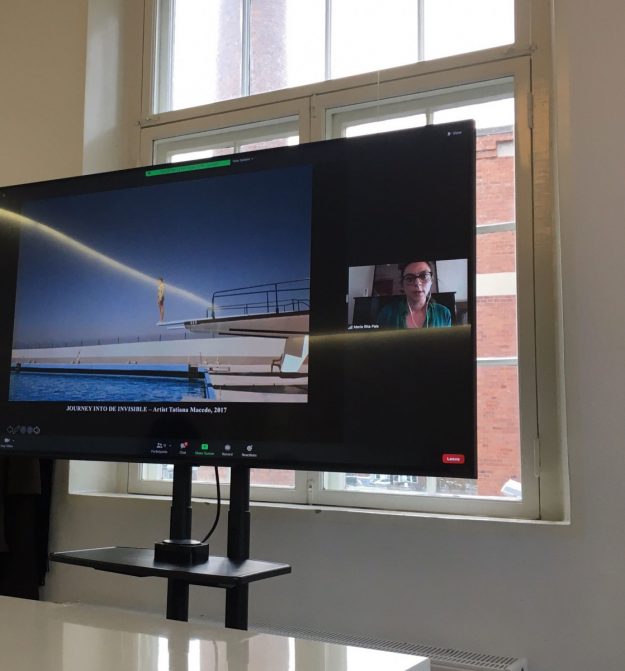
The workshop participants were invited to join a digital trip along the Portuguese coast with Maria Rita Pais (Universidade Lusófona, Portugal) visiting historical sites of bunker defense, now providing a green area stretching along the coast. Lina Suleiman (KTH) presented experiences from nature-based solutions in Årsta as a strategy for moderating the impacts of climate change in Stockholm. The workshop participants also discussed climate change and the arts, urban climate challenges , “seeking solutions for whom”, flexibility and diversity in urban climate solutions. See workshop introduction below.

Workshop introduction

Climate challenges and the arts: urban time scales, inclusion and future flexibility

Urban strategies for managing storm water and crafting robust solutions to cope with future climate challenges are receiving renewed attention with events of heavy rainfall and costly effects from flooding we have seen in Sweden and internationally in the past years.

With this workshop, we look into some of these challenges and also discuss dilemmas with some proposed solutions. These solutions are themselves raising new questions about how to communicate alternative solutions and “solutions for whom” (how can solutions be communicated to citizens, experts, and policymakers?), time scales (what are the time perspective we apply for climate robust solutions in renewal of cities?), inclusion/diversity (how can a diverse set of voices be heard when crafting new solutions?) and flexibility (how can we build solutions that are flexible enough to create room for maneuver needed in the future?) for urban areas when facing new – and sometimes – unexpected climate challenges.

In this hybrid-workshop, the local Stockholm partners (KTH, Intercult) participated on site from Färgfabriken while colleagues from Portugal, Greece, Italy, Turkey, The Netherlands and Poland attended via link. Presentations by colleagues at KTH included Katarina Larsen, Div. History of Science, Technology and Environment (organizer) and Lina Suleiman, Div. Urban and Regional Studies. The event was co-organized with the art institution Färgfabriken in Stockholm and also included an introduction to the work carried out in collaboration between researchers and artists in the exhibition Symbiosis at Färgfabriken, carried out by the project NATURE.

Plans for 2022 in H2020-initiative SOS Climate Waterfront:

During next year there are some planned exchange activities with Greece (Thessaloniki, January), Italy (Rome, March) and a workshop in end of May/June hosted by KTH in Stockholm.

If you are interested to know more about these activities, contact the organizers Katarina Larsen or Lina Suleiman.

For more info on the H2020 initiative, SOS Climate Waterfront, see sosclimatewaterfront.eu

www.kth.se/philhist/historia/forskning/environmental-histor/sos-climate-waterfront-1.1037673

Katarina Larsen

Katarina Larsen
researcher

___

Open Access to Knowledge, Fear, and Conscience: Reasons to Stop Flying Because of Climate Change

Division professor Nina Wormbs researches along with Maria Wolrath Söderberg from Södertörn University, in the project Understanding justification of climate change nonaction. The project runs 2019-2021 and is financed by The Swedish foundation for humanities and social sciences, Riksbankens Jubileumsfond. This June Nina and Marie published the article Knowledge, Fear, and Conscience: Reasons to Stop Flying Because of Climate Change in Urban Planning. Find the link to full text and read the abstract below.

Photo by Marcus Zymmer on Unsplash

Link to Publishers full text.

Link to Understanding justification of climate change nonaction project page 

Abstract

Much research on the societal consequences of climate change has focused on inaction, seeking to explain why societies and individuals do not change according to experts’ recommendations. In this qualitative study, we instead consider people who have changed their behaviour for the sake of the climate: They have stopped travelling by air. We first asked them to elaborate their rationales for the behaviour change. Then, using topos theory to find thought structures, we analysed their 673 open-text answers. Several themes emerged, which together can be regarded as a process of change. Increased knowledge, primarily narrated as a process by which latent knowledge was transformed into insight, through experience or emotional distress, was important. Contrary to certain claims in the literature, fear stimulated change of behaviour for many in this group. Climate change was framed as a moral issue, requiring acts of conscience. Children were invoked as educators and moral guides. Role models and a supportive social context played an important part. Alternatives to flying were brought forward as a motive to refrain from flying. Only a few mentioned shame as momentous. Instead, stopping travelling by air invoked a feeling of agency and responsibility, and could also result in a positive sensation.

Keywords:  arguments; children; climate change; flight shame; inner deliberation; knowledge-action gap; stop flying; topos
Published:   9 June 2021

Ten Stockholm Archipelago Lectures

The Stockholm Archipelago Lectures are part of the public activities of the KTH Environmental Humanities Laboratory and have been since 2012. It was initiated as an event that marks the presence of the EHL at the KTH Campus. This Monday we look forward to our 10th lecture by looking back in time, finishing off with the announcement of this year’s keynote speaker.

In September 2012 the historian and geographer David Lowenthal visited the Division to give a series of talks. They were entitled the Archipelago Lectures, referring in part to the Stockholm Archipelago, but also to David’s career long professional and personal interest in islands, in the Caribbean, the Mediterranean, in the Isle of Man where he had a summer house, and elsewhere. (From: Sverker Sörlin in “Defining Humanities – Division of History of Science, Technology and Environment, KTHReport 2017-2018)

The Archipelago lecture was the first major public event of the KTH Environmental Humanities Lab and has become an annual institution every fall. In the early years the lectures were held at the KTH Campus, but for the 2018 lecture with Amitav Gosh on “The Great Uprooting: Migration and Movement in the Age of Climate Change” we moved to central Stockholm and Kulturhuset Stadsteatern. The event was announced in one of Sweden’s largest morning papers, Dagens Nyheter, and attracted our biggest audience so far. A little over 100 people came to listen to Amitav Gosh.

In 2019 the Archipelago Lecture was organized in collaboration with the workers educational associations ABF and the independent opinion group Arenagruppen. “What should socialism mean in the 21st century? An ecofeminist view” with Nancy Fraiser attracted over 200 people, who came to ABF to listen. The lecture was filmed and also streamed online for the first time without us knowing that this would soon be our new normal. Former EHL researcher Roberta Biasillo writes in the Biennial report “Integrative Humanities from the years 2019 in and 2020” Nancy Fraser “engaged with the audience and with us well beyond the time of the talk – we all sat and stood together, we ate next to each other and shook our hands. One year later, on 25 November 2020, we found ourselves online and it was no coincidence that the talk was on ideas and practices of care, repair, and restitution as ways to ensure just living conditions on Earth.”

In the first year of the pandemic we went online and welcomed Achille Mbembe as our Archipelago keynote speaker. From his home in South Africa he gave the lecture “Reflections on Planetary Habitability”. This became one of the EHL’s and the Division’s most visited single events so far, with over 500 people streaming it in real time.

This year we are happy to announce Kathryn Yusoff as our keynote speaker. Kathryn is a professor of inhuman geography at Queen Mary University of London. She is the author of the acclaimed book “A billion black anthropocenes or none“. So, mark your calendars and check your connection – because on December 1 at 4.30 PM CET we are ready to go online again for the next Archipelago lecture.


Lectures from the past

September 9, 2012
“Reflections on the Environmental Humanities”
David Lowenthal, Professor Emeritus of Geography, University College London

September 11, 2013
“The Meltdown of a High Arctic Hunting Community”
Kirsten Hastrup, Professor of Anthropology, University of Copenhagen

October 9, 2014
“Environmental Racism as State-Sanctioned Violence”
Laura Pulido, Professor of American Studies and EthnicityUniversity of Southern California

November 2, 2015
“The humanities and global change research: relationships necessary, absent and possible”
Noel Castree, Professor of Geography, University of Manchester, England, and the University of Wollongong, Australia

October 27, 2016
“AlterLife in the Aftermath of Industrial Chemicals”
Michelle Murphy, Professor of History and Women and Gender Studies, University of Toronto

October 5, 2017
“Connecting Dots in Toms River and Beyond”
Dan Fagin, award-winning author, and Professor of science journalism,  New York University

September 26, 2018
“The Great Uprooting: Migration and Movement in the Age of Climate Change”
Amitav Ghosh, award-winning writer of historical fiction and non-fiction

October 7, 2019
“What should socialism mean in the 21st century? An ecofeminist view”
Nancy Fraiser, Professor, The New School for Social Research, New York

November 25, 2020
“Reflections on Planetary Habitability”
Achille Mbembe, Professor in History and Politics, University of the Witwatersrand, Johannesburg


Our Image of the Savannah Reveals who we are

In the think piece, “Our image of the savannah reveals who we are” (Vår bild av savannen avslöjar vilka vi är), doctoral student Erik Isberg reflects on how our image of the early people on the savannah has change over the centuries and how it is characterized by its time. The text originally was published in Swedish for Sverigesradio.se. Below is a translated, shorted version.

Full text with references: Vår bild av savannen avslöjar vilka vi är

Our image of the savannah reveals who we are

Erik Isberg

Already 60 years before Christ, the Roman poet Lucretius speculated whether the first humans were of stronger stuff than the spoiled civilized equivalent, and in the 18th century, the philosopher Jean-Jacques Rousseau expressed a similar idea, contrasting an idealized image of a harmonious state of nature against a corrupt contemporary. However, after World War II, theories about the origin of humankind gained new weight: they were to be substantiated scientifically rather than philosophically.

In the book “Creatures of Cain: The Hunt for Human Nature in Cold War America”, the historian of ideas Erika Lorraine Milam writes a kind of savannah’s cultural history from the end of World War II.

The popular science stories of the 1950s about the origins of humanity emphasized cooperation, everyone’s common roots and the ability to communicate as an essential human trait. They were often cheered on – intellectually and financially – by Huxley’s Unesco. However, as the dream of a harmonious world began to fall and the balance of the cold war terror took over, the mood on the savannah also changed.

60’s pay attention to man’s inherent aggressiveness. A new generation of popular science writers highlighted characteristics such as violence and dominance as defining for the first humans. This inherent aggression had dictated the conditions of existence on the savannah, where those who wanted to survive had to establish a violent capital.

This savannah did not become particularly long-lived. Milam places the end of the idea of ​​The Killer Ape, the dominant male as ruler of the savannah, to the 1980s. Who stepped in and took his place? No one, she answers. “When violence and prejudice became personal,” Milam writes, “biological theories of aggression and human nature became inadequate.” Collective explanatory models lost status and when the Cold War regime began to loosen up, the terrorist balance of our ancestors disappeared. Time had run out from the savannah, free individuals who left the stone axes in the grass and did not want to feel any common prehistory replaced The Killer Ape.

Nevertheless, the cultural history of the savannah does not end here after all. We find it everywhere at the bookstores’ top lists, and in TV productions and radio shows, it is an obvious foundation. Rather than disappearing, the savannah just seems to have changed shape. The prehistory that appears in the health literature appears as a continuation of the ideas that Milam describes in her book, but where the individual is more interesting than the common. Today we do not refer to our ancestors in matters of violence and prejudice, instead they are used to answer questions about how to live a better life. In this way, the savannah retains its moral implications, but not for society at large, but for the individual. Huxley’s vision of society has been replaced by self-optimization.

Swedish epidemiologist Anders Wallensten, author of the book The health mystery (Hälsogåtan: evolution, forskning och 48 konkreta råd, Bonnier Fakta, 2020), presents a savannah where the community is larger and the group’s cohesion is crucial for its continued survival. However, the goal of the community is not, as was the case in the utopian descriptions of the 1950s, a new society, but how individuals, through the support of the community, are to create a good life. Cooperation and community do not appear as goals in themselves, but as means for the individual to realize himself. In addition, the individual’s responsibility seems almost absolute.

Since Julian Huxley stood on the steps in Paris, the inhabitants of the savannah have repeatedly changed shape, and the popular science writers of the future will probably let the savannah be populated by additional new inhabitants, where the props remain but the ensemble is replaced. Perhaps the self-optimizing savannah people will have to make sacrifices for each other when pandemics and climate change hit their contemporary counterparts. Or something completely different happens. Perhaps the most interesting thing is not what answers the savannah can give us, but what questions we think it can answer.

Text: Erik Isberg, doctoral student in the project SPHERE