
AI to reduce the number of wildlife accidents
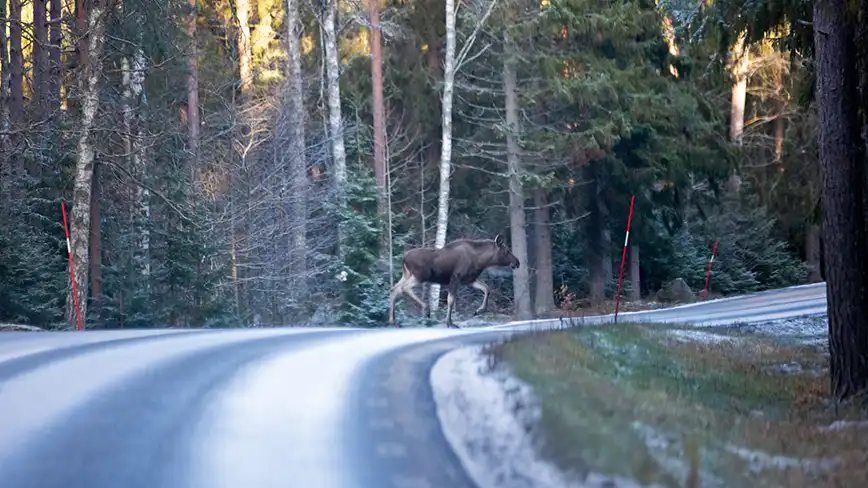
Over 70,000 wildlife accidents were reported in Sweden last year, resulting in a societal cost of approximately SEK 11 billion. Now, start-up Flox is presenting an AI solution that will make roads safer while protecting wildlife. The idea originated from a research project at KTH.
Flox has won the 2025 edition of InfraSweden’s innovation competition, InfraAwards, for its mobile, AI-powered device, Flox Edge. The solution can identify and divert wild animals from roads, railways, airports, and other infrastructure in real time, leading to fewer accidents, more efficient operations, and lower costs.
”Our solution can keep wild animals away from environments where they should not be, which is good for both the wild animals and us humans,” says Tomas Becklin, co-founder of Flox.
Flox solution Flox Edge is a small, battery-powered device with a range of up to 50 metres that can be placed in various environments, such as roads, railways, airports, or other infrastructure. The battery-powered device has built-in AI, sound, motion detectors and a speaker. When something moves nearby, the motion sensor reacts and activates the built-in camera, sending a signal to the AI, which then classifies the object. If an animal needs to be kept away from a specific environment, an acoustic signal is played, causing the animal to react and move away from the area.
Idea originated from a research project at KTH
The idea for Flox Edge originated from a research project at the KTH Royal Institute of Technology, which aimed to test the use of drones to deter wild boars from crops on farms. From drones, the project then moved on to developing the stationary unit, which has now been created. This development was made possible thanks to many employees who have attended KTH and brought in invaluable knowledge.
"The system we have developed is better than wildlife fencing, which is both expensive and prevents animals from moving naturally. The system can be turned on and off, allowing wildlife to cross at specific times, for example. We can also help them find safe passages such as wildlife bridges, which animals may have difficulty finding," says Tomas Becklin.
Together with the Swedish Transport Administration, Flox is now conducting demonstrations and validation of 20 units in different environments. The aim is to demonstrate how shared data can be utilised to mitigate the presence of animals in high-risk environments and enhance road safety.
‘We see that there is a great need to reduce the number of wildlife accidents, so we are grateful for the award and that our solution is receiving attention because it can make it safer for both people and animals,’ says Tomas Becklin.
Text: Emelie Smedslund ( emeliesm@kth.se )