
Polar researcher: Superpowers are taking what they want
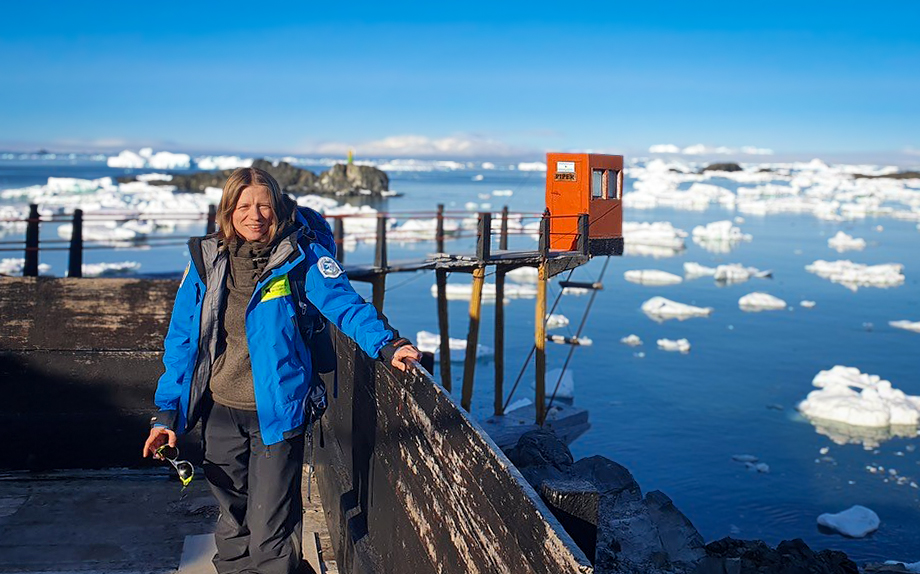
Donald Trump's ambition to take over Greenland does not surprise Kati Lindström, associate professor and polar researcher at KTH Royal Institute of Technology. According to her, it is yet another sign of how superpowers are driving a tougher geopolitical battle over the Arctic and its natural resources.

When superpowers lay claim to polar regions, there is a lot at stake, she says. It risks paving the way for a more power-based world order.
“It's a logic that Putin, Xi and Trump prefer: the strongest takes what it wants. This threatens the international system that emerged after the Second World War, where certain resources are seen as a common heritage of mankind,” says Kati Lindström, who conducts research at Division of History of Science, Technology and Environment, including on international environmental issues relating to the Arctic and Antarctic.
Polar research can play an important role in highlighting these power interests and their historical roots, and through dialogue with local communities contribute to more equitable decisions. But the responsibility for translating knowledge into concrete policy lies with decision-makers, Lindström emphasises.
In a new national polar research school, where KTH is one of five partner universities, training in policy work will be a central part.
“Researchers must have the ability to communicate their research, to highlight the most important aspects to those who make the decisions,” says Lindström, who coordinates KTH's part in the initiative.
The research school, which has received support through a government initiative, will train the next generation of polar researchers with geopolitics as an integral part.
Science diplomacy losing ground
“Nothing happens in the polar regions without geopolitical interests in the background. You have to understand what they are”.
At the same time, science diplomacy – where research is an integral part of international conventions, environmental agreements and international law – has been losing ground.
“It only works where science is valued. I'm not sure that's the case in today's United States, for example, where superpower politics currently carry the most weight," she says, continuing:
"When Trump talks about Greenland, he's referring to the old rivalry with Russia, but the key issue is the rare minerals found there. These minerals are crucial to today's technology and are currently mined in very few places in the world, mainly in China”.
Research nations' responsibility
When it comes to the future, Lindström sees little chance of the polar regions being completely free from geopolitical claims.
“It’s about rare minerals on land and in the deep sea, as well as marine living resources”.
She summarises the situation as the US wanting to secure access to Greenland's minerals to reduce its dependence on China, while Europe has few alternatives. At the same time, the Arctic's resources and sea routes are attracting more players, and the future is uncertain as both China and the US pursue their own agendas.
Nevertheless, she believes that every research nation has a responsibility to help protect both the Arctic and Antarctica.
“That is precisely why it is important for research to continue in the polar regions. Knowledge, a long-term perspective and international cooperation are crucial if we want to protect the polar regions,” says Lindström.
Text: Christer Gummeson ( gummeson@kth.se )