
With gender equality in mind
Theme: Tech for whom?
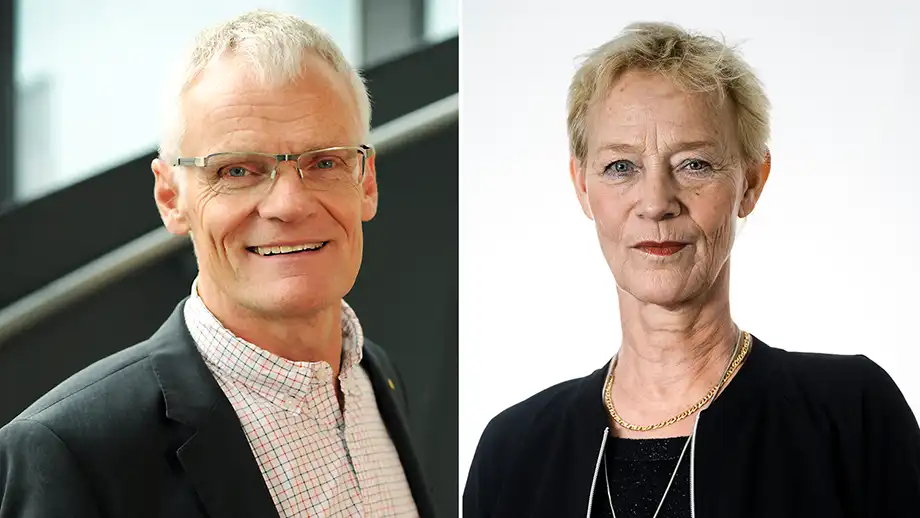
Anna Wahl and Gustav Amberg have extensive experience of working in academia and promoting gender equality in academic environments. In this Zoom conversation, they discuss the current state of gender equality in academia, technology and research.
“There has been a long-standing male norm in science, based on the firm belief that men are better suited to science than women. But a lot has happened in the last 30 years," says Anna Wahl, a business economist and professor of gender, organisation and management. She was also the former Vice President responsible for values and gender equality issues at KTH from 2017 to 2022.
Gustav Amberg, a professor of fluid mechanics, most recently served as President of Södertörn University for nine years and was formerly Vice President for Gender Equality and Faculty Development at KTH from 2008 to 2016:
"The current academic climate is characterised by an individual focus and competition, which risks reinforcing inequality. "
During the discussion, Gustav Amberg acknowledges that he has learned everything he knows about these issues from Anna Wahl.
Male dominance in technology has nevertheless meant that gender equality has been highlighted in the tech sector. After my years at Södertörn, with a focus on the humanities and social sciences, I can see a big difference. Although awareness on paper might be greater in these disciplines, 60 per cent of professors at Södertörn University are men.
What particular challenges and pitfalls arise in academia?
AW: Changing academia requires resources, expertise and time.
GA: It's important to realise that there's a lot to understand in this area. I realised that when I started as vice-chancellor. It's also important to understand the close link between gender equality and leadership.
AW: It's about the power structure. Where work is carried out within an organisation signals its status. In research, we have introduced the term 'academic housework' to describe tasks that do not count towards merit in the same way as publishing. Conversely, many people think these tasks are important and would rather set aside time for them.
GA: Yes, but initiatives such as COARA (the Coalition for Advancing Research Assessment), a European initiative focused on developing common guidelines and principles for assessing research which emphasises that merit should be viewed broadly, have contributed to the ongoing discussion about what constitutes good research and which aspects should be considered.
KTH's work on gender equality, diversity, and equal rights has set an example for other universities in Sweden and around the world. What is the secret behind this?
AW: It is a process of conscious strategic change within research, education and leadership.
GA: However, I believe that the changing social climate is making our work more challenging. The prevailing discourse on social media can silence people. It is therefore extremely important that we continue to research, think about and talk about these issues in relation to science, facts and critical thinking.
Is technology gender-equal?
AW: Technology is not neutral. Its shortcomings are perhaps most apparent in its application. For example, ChatGPT is based on the facts that have been fed into it. If these are skewed, one-sided or downright wrong, then the conclusions will be too. It averages all the texts it has been given and summarises them in a somewhat random manner. It is important to ask some fundamental critical questions when using it, such as: Whose problems does it solve, and what are the consequences for whom?
How can a gender equality perspective be incorporated into research? Is this something that you should or ought to have?
GA: When my doctoral students and I investigate how a drop of water behaves on a surface, there is nothing gender-equal or gender-unequal about it. However, there are things to consider from this perspective in the working environment of the group.
AW: No, of course not. You can't make having a gender perspective a requirement for research, but it is an aspect that, as I said, in the application phase is about making it more user-friendly for different types of people. You have several decades of experience working together on gender equality. Are you satisfied or proud?
GA: It would be presumptuous to say anything about that. The work is not finished yet, but we have come a long way in establishing effective working methods. It is important that these become widely accepted throughout the organisation, and not just the result of a few enthusiasts' efforts.
AW: There has clearly been an increase in awareness among male researchers and leaders regarding these issues and their importance. However, it is also a matter of building on this increased awareness.
Text: Jill Klackenberg ( jillk@kth.se )