KTH Logo

Paper published: The energy piggy bank — A serious game for energy conservation

Finally the proceedings from the SustainIT conference (“The 5:th IFIP Conference on Sustainable Internet and Sustainability” have been published. One of my papers were within the TEL area, and conserved a serious game we developed for learning about household energy consumption.

Abstract:
Serious games have attracted much attention recently and are used to in an engaging way support for example education and behavior change. In this paper, we present a serious game designed for helping people learn about their own energy consumption and to support behavior change towards more sustainable energy habits. We have designed the game for all the four Bartle Player Types, a taxonomy used to identify different motivations for playing games. Engagement of the participants has been evaluated using the Intrinsic Motivation Inventory, and we have measured self-assessed future behavior change. We found a statistically significant positive correlation between self-assessed future behavior change and perceived value/usefulness of the application independent of player type. Our study indicates the player type “Achievers” might perform better using this type of application and find it more enjoyable, but that it can be useful for learning energy conserving behavior independent of player type.

Read the full paper at https://ieeexplore.ieee.org/document/8379794/

Kilowh.at – Increasing Energy Awareness Using an Interactive Energy Comparison Tool

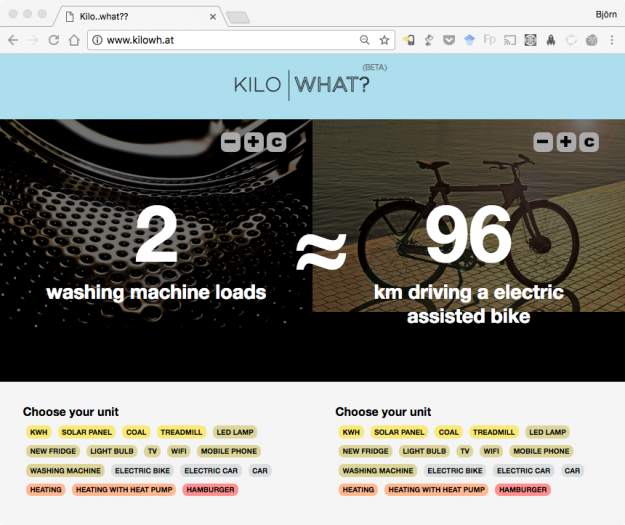
The kilowh.at web page

Reducing the use of energy is important for several reasons, such as saving money and reducing impact on the climate. However, the awareness among non-experts of how much energy is required by different activities is generally low, which can lead to wrong prioritizations. In this study, we have developed an interactive tool to increase “energy awareness”. A group of 58 students first did a test to benchmark their current energy awareness, then tried the tool for 10 min, and then did the same test immediately after trying the prototype and one week after trying the prototype. In addition, they answered questions regarding which, if any, of the energy requirement of different activities surprised them, any thoughts about their own energy use aroused after using the prototype and what they thought about using the tool compared to more conventional methods of learning. The results showed a significant learning effect in energy awareness with a very strong effect size of 1.689, that they were most surprised by the energy required to produce a hamburger, 39 of 58 explicitly said they intended to change one or more aspects in order to improve their energy use, where 24 actions involved changing habits and 18 actions was of a one-time investment character. The attitude towards using such a tool instead of more conventional learning was very good and the words most frequently used to describe the tool was good, simple and easy to use, fun, and interesting, but five users also said they were bored after a while. In total the results indicate that using an interactive tool like this even for a limited time is a good way to in an efficient and fun way increase energy awareness.

The paper is available at https://link.springer.com/chapter/10.1007/978-3-319-55134-0_14