KTH Logo

Initiatives to be proud of

In English further down

Initiativ att vara stolt över
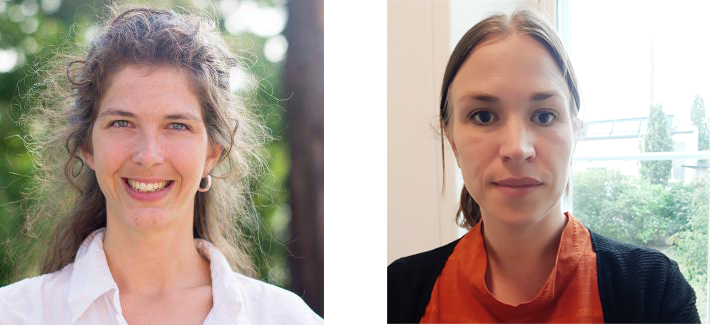
Charlotte Flodin och Anna Berglund

Nu drar hösten igång med en mängd osäkerheter om hur vi får transportera oss och ses fysiskt. Men lika säkert som amen i kyrkan är att ITM-skolans hållbarhetsarbete rullar på som vanligt. Vi, Anna Berglund, ITM:s hållbarhetsstrateg från GVS, och Charlotte Flodin, ITM:s miljöombud, har fått möjligheten att dela med oss av vad som händer.

Visste du till exempel att vi alla, såväl anställda som studenter, kan vara med och påverka KTH:s nya hållbarhetsmål, alltså de som kommer att gälla från nästa år och fyra år framåt? Den 3:e september arrangerar KTH Sustainability Office ett workshoptillfälle där alla på KTH är välkomna att delta i arbetet med att utveckla de nya hållbarhetsmålen.

Läs mer och anmäl dig till workhopen här

Men insatserna kring de senaste tidens arbete för att förbättra miljö och klimat inom ITM ska inte glömmas bort, här är några initiativ:

Digitalisering och resefria möten

Digitalt lärande på ITM ledde den digitala omställningen under den speciella våren som präglades hårt av covid-19. Under bara några veckor lyckades man introducera KTH:s lärare till det digitala utbildningsformatet. Den digitala omställningen ger även en stor del av personalen en större flexibilitet att kunna avstå från resande, vilket inte bara är bra ur ett smittoperspektiv utan ger flera positiva effekter både gällande arbetsmiljöfrågor och minskad klimatpåverkan.

Forskning

Sverige har exporterat järn och stål sedan medeltiden, och nu står vi inför en smärre miljörevolution: En klimatförbättrad produktion! SSAB:s ståltillverkning står för ca 10 % av Sveriges totala koldioxidutsläpp. SSAB, Vattenfall och LKAB såg behovet av att minska stålproduktionens klimatpåverkan och startade då initiativet HYBRIT, med målsättningen att utveckla världens första fossilfria ståltillverkningsprocess. I HYBRIT:s forskningsprogram undersöker Johan Martinsson, forskare vid Institutionen för Materialvetenskap, och tre kollegor till honom hur vätgas kan användas i stålproduktionen för att drastiskt minska utsläppen av växthusgaser. Läs mer om detta enormt spännande initiativ på ITM:s webbplats ”KTH i stålrevolution” och på HYBRIT:s egna webbplats.
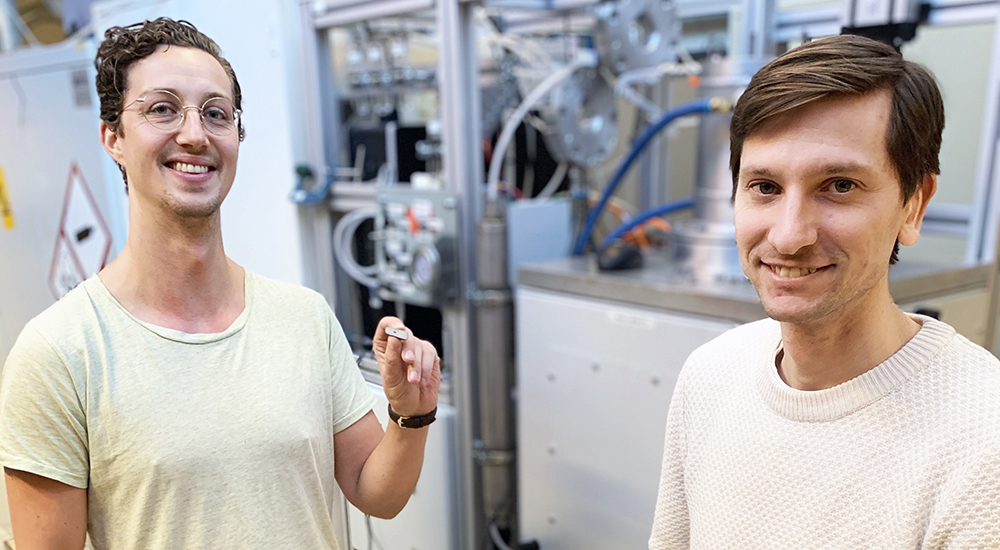
Joar Huss och Johan Martinsson

Utbildning

Anna Jerbrant och Andreas Alm Arvidsson har tillsammans med kursansvariga gått igenom ITM:s kursutbud och sett över vilka kurser som taggats med miljö- och hållbarhetsfokus. Före inventeringen var 70 kurser märkta, efter senaste genomgången har vi 214 märkta kurser. En effekt av inventeringen är att fortbildningstillfällen nu planeras för ITM:s lärare, så att vi kan bli ännu bättre på att inkludera hållbarhetsfrågor i våra kurser och program.

Avfall

Vaktmästare Adde Tabrizi har tillsammans med sina vaktmästar-kollegor från Servicecenter, skolans verksamhetscontrollers och andra nyckelpersoner sett över skolans källsortering och introducerar separat matavfall allteftersom på skolans institutioner. Tillsammans med ABE-skolan leder ITM arbetet med att sortera ut matavfall på KTH.

Under året har vi även sett över hanteringen av elektronikavfall och vi kommer framöver ha bättre möjligheter att återanvända och ta hand om elektronik.

Intern miljörevision

Den 2:a november ska interna miljörevisorer granska vårt miljöledningsarbete. Du kan vara en av dem som bjuds in att delta, i så fall återkommer vi med en inbjudan.

Vi hörs igen!

/Anna Berglund, ITM:s hållbarhetsstrateg från GVS, och Charlotte Flodin, ITM:s miljöombud

Initiatives to be proud of

Charlotte Flodin and Anna Berglund

The autumn brings many uncertainties in terms of travels and physical meetings. But one thing is certain – the ITM School’s sustainability work continues as usual. We, Anna Berglund, ITM’s sustainability strategist from GVS, and Charlotte Flodin, ITM’s environmental representative, got the opportunity to update you.

For instance, did you know that all of us, both employees and students, can influence KTH’s new sustainability objectives, i.e. those that will apply from next year and four years onward? On September 3, KTH Sustainability Office invites to a workshop where everyone at KTH is welcome to participate in the work of developing the new sustainability objectives.

Read more about the workshop and sign up here

However, the recent efforts at ITM to improve the environment and climate should not be forgotten. Here are some initiatives:

Digitization and travel-free meetings

The unit of Digital Learning at ITM led the digital transition during the special spring that was marked by covid-19. In just a few weeks, they succeeded in introducing KTH’s teachers to the digital education format. The digital transition also gives a large part of the staff a greater flexibility to be able to refrain from traveling, which is not only good from an infection perspective but gives several positive effects regarding work environment and reduced climate impact.

Research

Sweden has been exporting iron and steel since the Middle Ages, and now we face a minor environmental revolution: Climate-improved production! SSAB’s steel production accounts for about 10% of Sweden’s total carbon dioxide emissions. SSAB, Vattenfall and LKAB saw the need to reduce the climate impact of steel production and started the HYBRIT initiative, with the aim of developing the world’s first fossil-free steel manufacturing process. In HYBRIT’s research program, Johan Martinsson, a researcher at the Department of Materials Science, and three of his colleagues investigate how hydrogen gas can be used in steel production to drastically reduce greenhouse gas emissions. Read more about this exciting initiative on the ITM website “KTH in steel revolution” and on the HYBRIT website.

Joar Huss and Johan Martinsson

Studies

Anna Jerbrant and Andreas Alm Arvidsson have, together with course coordinators, gone through ITM’s course catalog and reviewed all courses that were tagged with an environmental and sustainability focus. Before the inventory, 70 courses were tagged, and now we have 214 tagged courses. As an effect of the inventory we are planning continuing education opportunities for ITM’s teachers, so that we can become even better at including sustainability in our courses and programmes.

Waste

Caretaker Adde Tabrizi, together with colleagues from Service Center, operations controllers and other key people, has reviewed the school’s source sorting and keep introducing separate food waste at the school’s departments. Together with the ABE School, ITM leads the work of sorting out food waste at KTH.

During the year, we also reviewed our electronic waste handling, and in the future, there will be better opportunities to reuse and take care of electronics.

Internal environmental audit

On November 2, internal environmental auditors will review our environmental management work. You can be one of those invited to participate, in which case we will return with an invitation.

We’ll talk later!

/ Anna Berglund, ITM’s sustainability strategist and Charlotte Flodin, ITM’s environmental representative
Research studies under unusual circumstances

It’s now been over two months since we all started working mostly from home. Everything is very different now, and I myself would have organized a conference last week. To still “meet” some of those who would have been here from all over the world, we had a Swedish fika via Zoom Friday afternoon. Everyone had promised to make really strong Swedish coffee to drink in front of the computer.

While some like the new working situation, others feel lonely. It is perhaps most difficult for those who are far from their home country, especially many doctoral students. Therefore it is important for us supervisors to keep in close contact with our doctoral students, not only for the research to continue as well as possible, but perhaps primarily for the human contact.

The research studies that can go on more or less as usual are the ones that are mostly performed in front of a computer. It’s more difficult when experiments are required and worst of all if the planned experiments were intended to take place outside Sweden. Hopefully we can return to more normal research studies this fall.

PhD defences and licentiate seminars have since March 25th, when we had the first digital defence with the respondent on link from South Africa, been held on Zoom. We have so far managed about ten PhD defences and one licentiate seminar and have another 15 to look forward to before the summer break begins. It has overall worked out very well and I see ahead that we, post-corona, will make sure to broadcast our events – we can then certainly expect a larger and more international audience. But clearly it will be nice when we can celebrate the new doctors IRL as well.

I will take the opportunity to give an update of the responsible persons for our doctoral programmes, DAs:

  • Luca Urciuoli new DA for Industrial Economics and Management
  • Stefan Hrastinski new DA for Education and Communication Studies
  • Lyuba Belova new DA for Education and Communication Studies

Find all DAs at ITM here

/ Malin Selleby, Director of Third Cycle Education at ITM

An ITM sustainability course for PhD students

There is for obvious reasons a lot of focus on sustainability. Within the Postgraduate education committee (Forskarutbildningsutskottet), consisting of the professors responsible for our six doctoral programmes and myself, an idea has emerged: to develop a course in sustainability for doctoral students. The intention is to do the course as collaborative effort between all our departments. I presented the idea at the Faculty Club and have since then been contacted by teachers interested in such a course. Shortly we’ll form a group to discuss how to proceed. If you are interested – please send me an email!

On the same theme – I hope that all supervisor and PhD students are aware of that they need to comment on the coupling between their own research and the 17 UN Sustainable Development Goals in each individual study plan – tab 10 under C2.

As many of you already know, all managers at ITM are now taking part in a course – Leadership development from a gender perspective. Maybe you have been asked to go out on “Culture reconnaissance” (kulturspaning) in your own working environment? To work towards, and focus on gender equality, is also part of developing a sustainable future. So, please – go out and “kulturspana”!

/Malin Selleby, Director of Third Cycle Education at the ITM School

Thank you and best wishes for the future!

First of all I would like to thank all of you for all the good work during my years as the Head of ITM – it has been a very interesting period, challenging at times, but overall very rewarding. I was overwhelmed by the celebration on May 14, all the participants, all the presents, all the songs, all the speeches and poems, and last but not least, the toastmaster. And the movie, what a remarkable production: the overall orchestration, the comfortable storyteller, the rejoicing chorus of happy administrators, and all the nice words from colleagues. Thank you all!

On the research side, coordinator pairs have now been appointed to lead the four new School overarching research initiatives for which the School has allocated dedicated research funding. The overall effort will be supervised by our new Deputy Head of School Martin Törngren. The areas and the coordinator teams are:

  • Industrial transformation through digitalisation, renewable energy and circular economy.
    Coordinated by Antonio Maffei, IIP and Elena Fersman, MMK.
  • Integrated mechanics, components and materials design including additive manufacturing.
    Coordinated by Greta Lindwall, MSE and Raquel Lizarraga, MSE.
  • Sustainable energy systems: Technical and business perspectives.
    Coordinated by Andrew Martin, EGI and Frauke Urban, Indek.
  • Innovation eco-systems, innovation management and entrepreneurship.
    Coordinated by Jennie Björk, MMK and Anders Broström, Indek.

I am sure that Martin Törngren will come back soon with a blog post with more details and strategies for these efforts.

Finally, I am convinced that the new School head team, Pär and Martin, will continue in a spirit of engagement, collaboration, innovation, equality, inclusion, good working climate, and most importantly environmental sustainability. In case the new management team runs into unforeseen challenges, I will leave some literature on my office desk that might be of help in tricky situations. A few example titles are:

  • Crisis management, Public Leadership under Pressure
  • Our Iceberg is Melting: Changing and Succeeding Under Any Conditions
  • Organisatorisk resiliens – Vad är det som gör företag och organisationer livskraftiga?

Good luck Pär and Martin! And Pär, the gavel I handed over at the festivities, and which was once handed over to me by Bengt, might come in handy in critical situations.

I wish all the best for ITM in the future!

/Jan Wikander, retiring Head of the ITM School


ITM PhD Student Conference

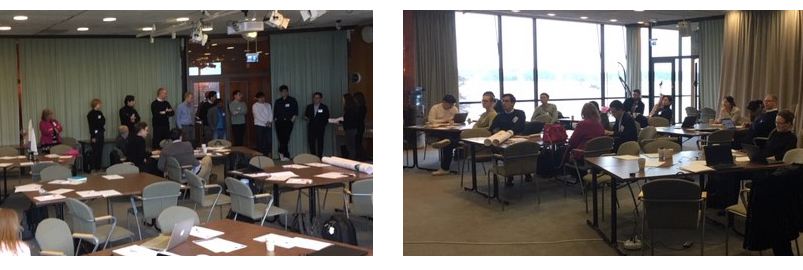
Last Wednesday and Thursday (on April 10-11) we had the annual ITM PhD student conference at Skogshem and Wijk on Lindingö. The theme this year was equality (JML) and sustainability. Alice Marshall gave an introduction to “one KTH” followed by several group exercises/discussions. In one of them we were all supposed to stand in different corners divided in how equal we think our working environment is on a scale between 1 and 10, 10 being perfect in terms of gender equality. The choice of “environment” could be the closest group or even the whole of KTH. It was interesting to see that we were spread out between 8-9 to 2-3.

Sara Linderson shortly presented the new platform, Industrial Transformation, a platform that will coordinate all KTH researchers that in different ways support the transformation to a sustainable CO2-neutral industry. The manager of the platform is Monica Bellgran, KTH Södertälje.

In the evening, beforea very nice dinner, there was a poster session with the goal to bridge the gap between different research fields i.e. find a PhD student colleague in another area where there is some overlap of interest.

In the morning of the second day Ulf Sandström gave a lecture about the Vancouver Rules on Publishing. The rules discuss “Who Is an Author?” and the following four criteria must be fulfilled for any author:

  1. Substantial contributions to the conception or design of the work; or the acquisition, analysis, or interpretation of data for the work; AND
  2. Drafting the work or revising it critically for important intellectual content; AND
  3. Final approval of the version to be published; AND
  4. Agreement to be accountable for all aspects of the work in ensuring that questions related to the accuracy or integrity of any part of the work are appropriately investigated and resolved.

This is something for the students to discuss in their respective research environments and with their supervisors. It think that it is important not to be too interested in the ranking lists but to make sure that authorship and citations are treated in a correct way.

After a coffee break Hélène Hermansson gave a talk about sustainability and the 17 Sustainable Development Goals (SDG:s) and asked the participants to think and discuss how these goals can connect to their own research, both in a positive and negative ways.

The SDG:s can be found here.

Thank you all lecturers, DAs and participants!