KTH Logo

Overnight transformation to online education

I hope you are all healthy and still feel connected to KTH in these strange times when we’re all forced to work so much remotely from home. Since KTH of course gives priority to ensure that our students can complete their education (at the same time as we all work to reduce the spread of the covid-19 virus) studies and exams will take place remotely for the rest of the semester. This means that we must plan for alternative teaching and examination forms (and also make sure to attest invoices the same day they arrive to help our sub-contractors). You have all struggled extensively to execute all P4 courses by the help of digital tools and I am deeply impressed of the amazing result that ITM’s teachers has accomplished.

Personally my working days are filled with different investigations into the plethora of educational challenges that has arisen, as well as discussions and decisions in the multitude of meetings that the Committee for First and Second Cycle Education executes. The issues we discuss and then decide upon are presented here.

A page I hope both students are employees visit regularly.

Now the first major test of digital examination will come up during the re-exam period 14-17th of April. It will be an exciting and interesting time and I have the same challenges as many of you since I’m conducting a re-exam of my P3 course. So if you, like me, are trying to figure out the best way to design your digital re-exam please check out these useful pages (in Swedish).

And don’t miss out on the useful Lunch-n-learn seminars that are given every day this week through Zoom! Both coming and previous seminars are available here.

Finally I want to take the opportunity to wish you all a Happy Easter with lots of rest and good food.

Anna Jerbrant, Deputy Head of School
Celebrating 200 years of education in Materials Science and Engineering!

Dear all,

This time I wish to tell you about the importance of 2019 for MSE, ITM and KTH. We celebrate that it is now 200 years since the King Karl XIV Johan laid the foundation for higher technical education in Sweden through the decision to establish Bergsskolan in Falun. This was later moved to Stockholm and became part of KTH. The first Professor in 1819 was Gabriel Sefström and he represents the first among many Professors related to the current MSE department.

The Department Head Annika Borgenstam and her co-workers at MSE have organized a conference to celebrate this jubilee, which will take place during June 17 and 18. The first day is devoted to the education in materials science and engineering. Here, both our President Sigbritt Karlsson as well as Annika Borgenstam will give opening speeches. Thereafter, the Director General of Swedish Council for Higher Education Karin Röding will talk about higher education in Sweden. Among the other speakers I wish to especially mention Professor Greg Olsson from Northwestern University, USA. He will present his views on Materials design: research and education – past experiences and future development.

The second day will be devoted to research. The focus will be on future research areas and the presentations are:

  • Modelling of new alloys
  • Process technology for reduced environmental impact
  • Circular economy
  • Additive manufacturing – materials and applications

The second day is also organized in collaboration with and sponsored by the KTH Materials Platform. Please join us at the conference to celebrate Materials Science and Engineering!

Sign up at here

Pär Jönsson, Vice Dean

Industrial collaborations – focus on faculty

In my last blog I discussed how we could collaborate with industry. I wish to continue on the same theme this time. However, now taking the perspective of a person that is working in industry. How can such a person be part of KTH?

There are two main ways, namely an affiliated faculty or an adjunct Professor.

Typically, what happens is that an individual researcher at a department has collaborated with someone in the industry for some time. The person in the industry enjoys giving lectures, supervising students and writing papers in collaboration with KTH researchers, etc. At this point the person discusses with the KTH contact and the closest manager if it would be possible to have a more official connection to KTH.

At this time I am usually contacted by a Department Head that wishes to know which of the two ways are most suitable. Here it is clear that most external people wish to have the title “Professor”. However, we need to make sure that they fulfil all requirements stipulated by KTH. The requirements for becoming an adjunct professor can be found on the KTH home page:

https://www.kth.se/en/samverkan/partnerskap/personrorlighet/adjungerade/adjungerade-professorer-brobyggare-mellan-kth-och-omvarlden-1.329822

Me, the Department Head and the KTH teacher that wish to establish the collaboration carefully go through the persons CV After that, Dekanus Katja Grillner makes a pre-evaluation of the persons CV to judge whether the person has the qualifications of becoming an affiliated faculty or an adjunct professor. Thereafter, the candidate can officially apply for the position. At this stage of the process, one of our ITM administrators, Helena Lundquist or Malin Bolin, will support the candidate and the department to establish and upload the required documents.

If a person becomes an affiliated faculty it opens up the possibilities to carry out more academic work as part of their work assignments. As mentioned before this may include writing papers on collaborations with KTH researchers and co-supervision of PhD students, which both represents activities that helps to boost a person’s CV. Thus, if the collaboration is successful and appreciated from both organisations, the person could apply for an adjunct professorship in the future.

As shown in the link given above, and adjunct professorship application will be evaluated by external experts as well as by Dekanus. If a person passes this evaluation it is most common to have the position for one day a week (20%), but up to a maximum of a 50% position.

We have seen an increase in the number of people that wish to work closer to us at KTH. This is very positive, since they bring their industrial experience into our KTH academic environment. This helps our students to better understand the industrial situation that most of them will work with in the future.

Finally, I wish to say that I hope that you had a fantastic winter break, “sportlov”.

Myself I took one day of to visit the historical places Uppsala and Österbybruk . At the latter place I picked up my son that had taken a one-week course in stone laying. My hope is that I finally get my drive way fixed this summer….

Pär Jönsson, Vice Dean

Collaboration with industry – a days experience in Avesta

Collaboration with industry is one of the important factors for a successful technical university. This can take place in so many ways as I experienced yesterday when I visited Outokumpu Stainless in Avesta. I had three meetings planned: 1) a discussion about how we could use slag as a replacement for lime in a neutralization process, 2) a discussion with an industrial PhD student, and 3) a visit to the plant to spot study the AOD reactor. Note, during the plant visit I proudly wore my safety jacket with a KTH logo on for the first time! My colleague Anders Tilliander came up with the idea. It turned out to be a great idea since I got many positive comments and people knew where I came from.

The first example on collaboration involves one of our PhD students, Leo Carlsson, who was on the same morning train as me. His research topic is machine learning big data related to metallurgical industry. The last two years he has spent on trying to model the energy consumption in an electric arc furnace, which is an important reactor in the circular economy since it uses recycled metallic scrap as a raw material. Leo’s results are promising but in order to better understand the reliability of the huge amount of input variables he uses, he decided to sit together with the operators during a day to learn more about input variables that they use to control the process. Thus, the purpose is of course to make sure that the theoretical model he has developed will be of use in the production. This close contact with the industry is important when introducing new concepts in production. I am sure he will be back many times before finishing his PhD!

Another example of how we can collaborate with industry is also from yesterday and connected to the visit in Avesta. In arecent VINNOVA project, KTH was granted a project to study how if it is possible to use vibration measurements to indirectly determine how much gas that is injected in to liquid steel. This is a challenging task and it includes deep knowledge on processes, measurement techniques, signal treatment as well as how this information can be coupled to machine learning theories. The project is led by Nils Andersson and Björn Glaser. They spent yesterday in Avesta to spot suitable places to mount the vibration measurement devices and are doing the same thing today at Uddeholm in Hagfors. The project is a collaboration with machine learning experts at Luleå university and measurement experts at SWERIM as well as a collaboration with a handful of Swedish steel companies. This is a typical example on how universities, an institute and several industrial partners can collaborate in studying industrial relevant projects.

A third example of how we can collaborate with industry is related to the PhD education. In one PhD course at the materials science and engineering department the focus is on production technology and how it is necessary to combine economical aspects to technical aspects in the working life to come up with sustainable and profitable solutions. The two PhD students Carrie Jonsson and Amanda Vickerfält also visited Outokumpu yesterday to study the electric arc furnace process in order to better understand the practical aspects before completing their project report.

My last example of how important it is with collaboration between KTH and industry is from having lunch at the company. I was amazed over how many people I greeted, which had been educated by KTH. They are our alumni and I can feel the connection by their comments:

  • Hi professor are you here to get some experienceof the “real” metallurgy?
  • Pär, do you have any good students we can hire?
  • Great to see so many KTH students in the plant today!
  • How many new students applied to materials design this year?

My reflections over the day when I was on the train back home were that this extremely good and frequent collaboration KTH, and especially ITM, has with the industry and society is ot the outmost importance. People talk about life-long learning but I would like to extend it to a life-long collaboration with us at ITM (KTH) and the industry!

Pär Jönsson, Vice Dean


Collaboration to Reach Excellence in Education, Research and Ranking

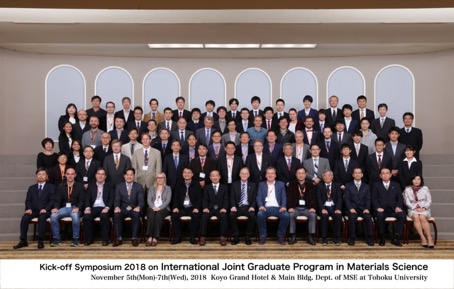
During November 6-7, eight universities from Japan, Korea, China, Canada,Taiwan Germany, France and Sweden met in Sendai in Japan to discuss the possibilities to collaborate to reach excellence in education and research. The event was arranged by Tohoku University who has an overall aim to reach a top 10 ranking in the fields of Spintronics, Environmental & Earth Science, Cosmic Physics, Machine Science, and Materials Science. Together with the Director of Studies Anders Eliasson I attended a workshop focusing on materials science, where collaborations within the areas of “Metallurgy”, “Materials Science” and “Materials Processing” were discussed. Each university was given one hour each to explain the education of BSc, MSc and PhD students. In addition, visits to laboratories and meeting with students took place the second day. Here it was clear that the equipment at Tohoku University is very modern and advanced.

It is clear that it is difficult to collaborate with other universities on a Bachelor level, with the exception from the University of British Colombia in Vancouver. They already have 30% foreign students on their Bachelor programs, which all are given in English. On a MSc level, it is clear that the simplest way to reach a fruitful collaboration is by students carrying out MSc theses at a partner university. However, it is possible to create double degree programs with some universities.

It is also clear that it seems quite easy to collaborate on a PhD level with most universities. For example, Tohoku University has received at least 1 student per year from the Department of Materials Science and Engineering KTH during the last 15 years. During this meeting it was clear from discussions with several faculty members that more KTH students are welcome to carry out research in their groups.

One peculiar reflection was that the French universities got complain from the French authorities that they were ranked very low in international rankings. Then, a number of institutes and universities recently merged into the University of Lyon, which in total has 140 000 students (Yes! You read it correctly!). In this way they anticipate that they fast will obtain a higher ranking. I have an innovative solution, namely that we merge all science universities in Sweden to create the Royal Nobel University of Science!

No, I am kidding! We really need to reconsider what is important for us at KTH and not only consider ranking. Our main impact is through our undergraduate and graduate students. We need to give them a suitable “toolbox” so that they can contribute to developing societies in an innovative and sustainable manner!

/ Pär Jönsson, Deputy Head of School